AI Takes Over Fusion’s Fastest Decisions—But Practical Power Is Still a Long Way Off
A new control framework from Princeton researchers has steered fusion plasma on the DIII-D tokamak in roughly 20 milliseconds, faster than human operators can react. The advance could make difficult plasma experiments more manageable, but it is a control breakthrough—not proof that fusion power is ready for the grid.
By StoryBreak
Published September 6, 2026 at 8:03 PM
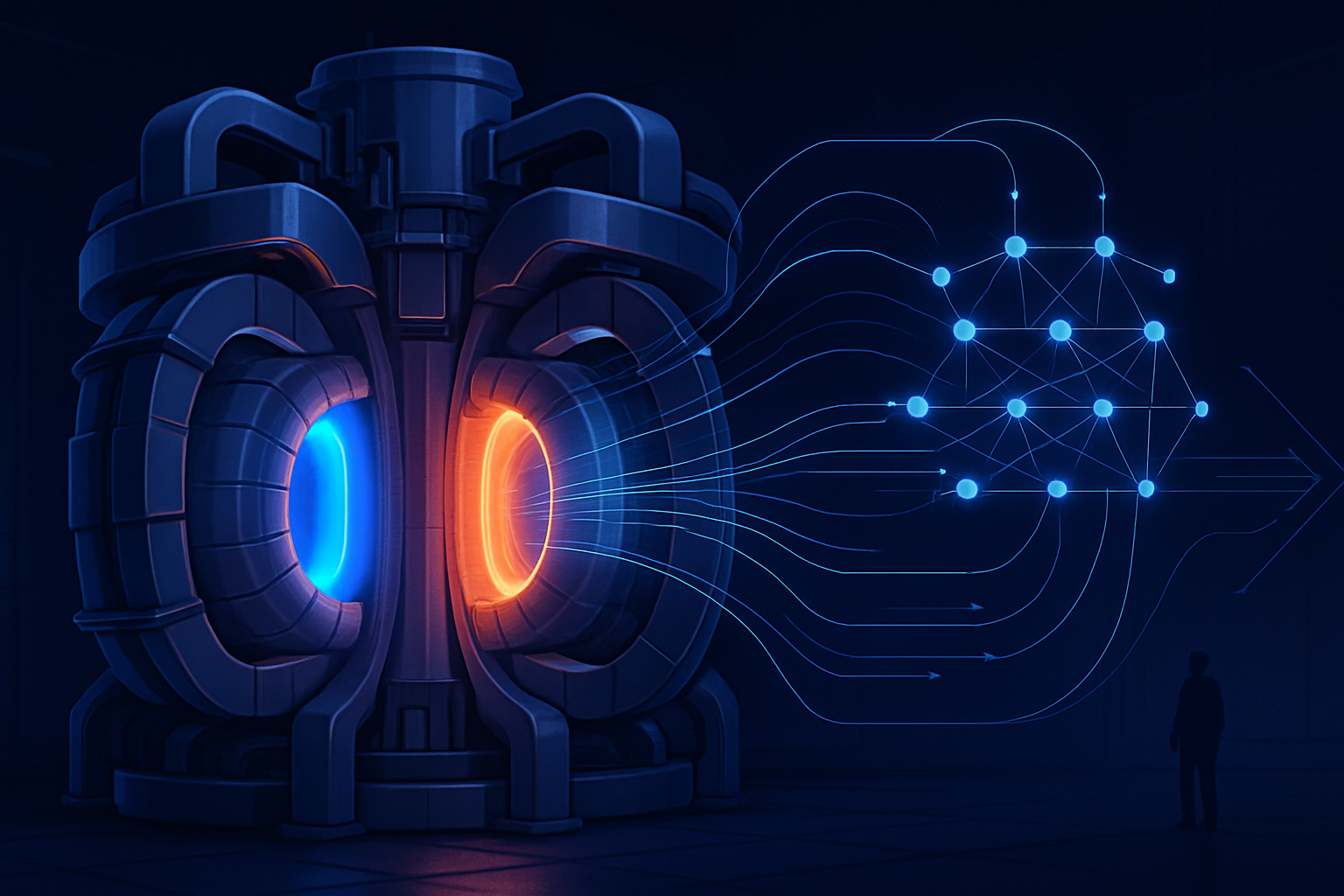
A fusion plasma can become unstable in milliseconds—far faster than a human operator can watch a screen, interpret the data and adjust the machine. Researchers at Princeton University and the U.S. Department of Energy’s Princeton Plasma Physics Laboratory have now demonstrated an artificial-intelligence control framework designed for exactly that problem.
Called PACMAN, the system was tested in five experiments on the DIII-D tokamak, a major U.S. fusion research facility. According to PPPL, its control loop typically completes in about 20 milliseconds and repeats continuously. Instead of waiting for a person to recognize a problem, the software processes diagnostic measurements, estimates what the plasma is doing, predicts what may happen next and calculates commands for the tokamak’s actuators.
That speed matters because magnetic-confinement fusion is a balancing act. The plasma must be held in place by magnetic fields while remaining hot enough and dense enough for fusion reactions. Small changes can grow into instabilities that damage confinement or terminate an experiment. A human operator remains important for setting goals and supervising the system, but cannot manually make decisions at the timescale of the plasma’s most rapid changes.
The significant advance is not simply that an AI model can make a prediction. Researchers have been using machine learning for plasma prediction and control for years. In 2021, a deep-reinforcement-learning system demonstrated real-time control of multiple plasma shapes on the TCV tokamak. Other experiments have used AI to help avoid tearing instabilities and suppress edge-localized bursts that can degrade confinement.
PACMAN’s contribution is integration. The framework connects multiple steps that are often handled separately: collecting signals from different diagnostics, checking and organizing those measurements, running machine-learning predictions, selecting among controllers and sending commands while enforcing hardware safety limits. The peer-reviewed study describes experiments involving reinforcement learning, model-predictive control and machine-learning-based prediction of plasma behavior.
That architecture addresses one of fusion research’s less visible problems. A controller that works in a simulation or in a narrowly defined experiment is not automatically useful on a real machine. Real tokamaks have sensor delays, actuator limits, incomplete measurements and competing control objectives. Several algorithms may also need to share the same hardware. Integrating them into one real-time loop is an engineering challenge as much as an AI challenge.
Still, the result should not be read as evidence that fusion electricity is around the corner. DIII-D is an experimental tokamak, not a commercial power plant. The reported work shows that AI can help operate a research plasma at a speed humans cannot match; it does not show net electricity production, continuous power generation or an economically viable reactor.
The distinction is important. A future fusion plant will need fast control, but it will also need materials that survive intense neutron and heat loads, reliable exhaust systems, fuel handling, maintenance strategies and affordable construction. AI cannot substitute for those requirements.
What PACMAN may provide is a better way to explore the physics and engineering of high-performance plasmas. If the framework can be transferred safely across machines and operating conditions, it could allow researchers to test more complicated scenarios, respond earlier to instabilities and reduce the amount of manual tuning required for each experiment.
The next milestone is therefore not simply a faster algorithm. It is demonstrating that these systems remain dependable when the plasma behaves differently from the data used to train them—and that conventional protection systems can safely override them when predictions fail. Fusion’s path to the grid still depends on many technologies. But controlling the plasma quickly enough to keep that path open is one of the problems AI may genuinely be able to help solve.
Sources & Further Reading
- Princeton Plasma Physics LaboratoryPrimary source
- Nuclear Fusion / Institute of PhysicsPrimary source
- U.S. Department of Energy Office of SciencePrimary source
- NaturePrimary source
- U.S. Department of Energy Office of SciencePrimary source
StoryBreak
Independent digital news and reporting, updated throughout the day.
This article was researched and drafted with AI assistance and reviewed as part of StoryBreak's editorial process before publication. Read our editorial standards.