Ali, Frazier and Foreman vs. Today: How Heavyweight Boxing Has Evolved
The heavyweight division has grown taller, heavier and more global since Muhammad Ali, Joe Frazier and George Foreman ruled the 1970s. But the modern era has also changed the sport’s rhythm, structure and definition of greatness.
By StoryBreak
Published September 5, 2026 at 2:12 AM
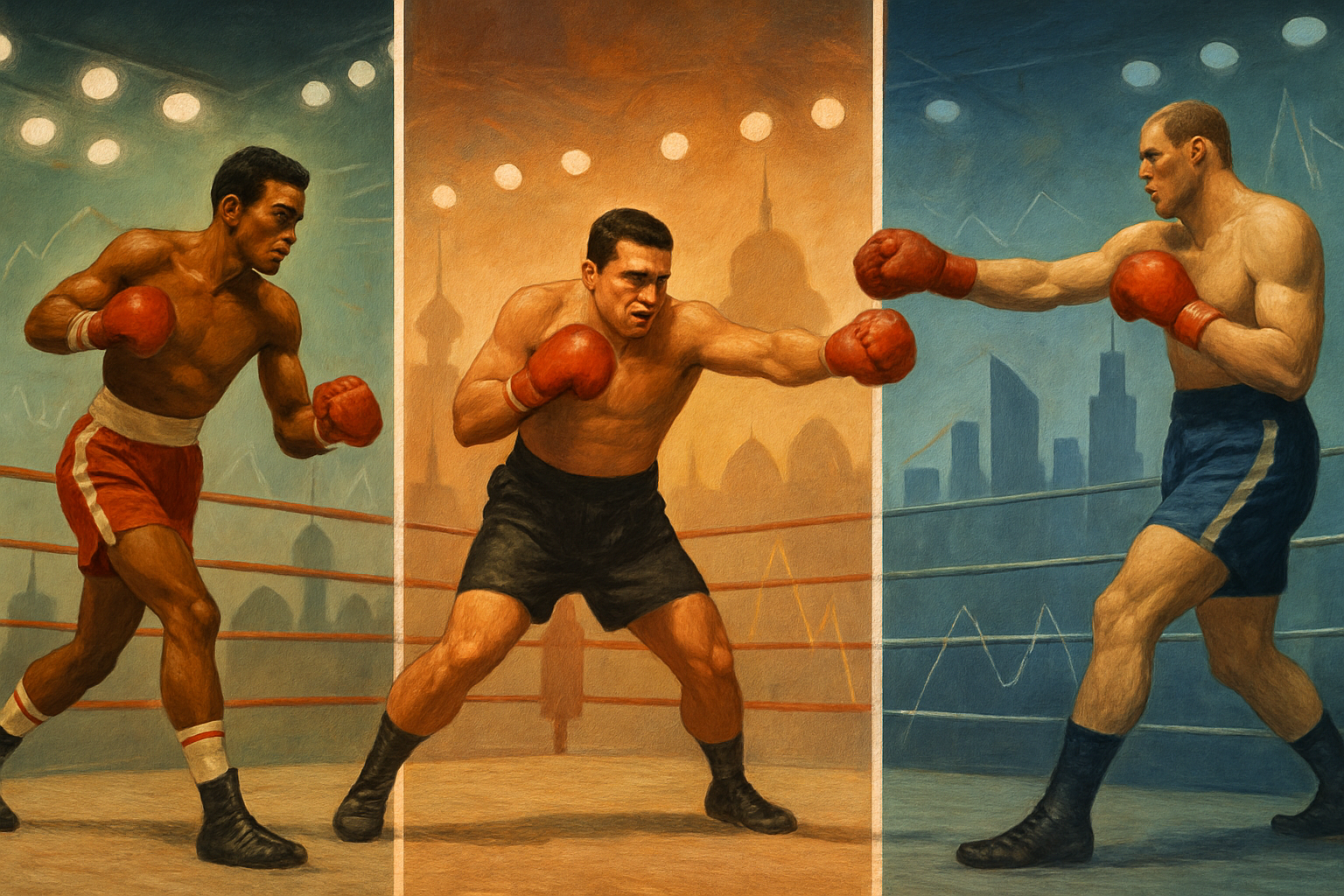
The heavyweight division Muhammad Ali, Joe Frazier and George Foreman dominated was built around a small group of stars who repeatedly fought one another for the sport’s biggest prizes. Today’s division is larger, more international and more scientifically prepared—but also more fragmented and less defined by a single rivalry.
That contrast begins with size. A peer-reviewed study of 182 world heavyweight championship bouts found that contestants in the modern era averaged roughly 6 feet 4 inches and 238 pounds. Winners were taller and had longer reaches than their opponents on average. The research also found that heavyweight champions and challengers have generally grown larger over boxing’s history.
Ali, Frazier and Foreman were hardly small by the standards of their time. Ali and Foreman stood around 6 feet 3 inches, while Frazier was shorter but exceptionally compact and powerful. Yet their listed fight weights—generally in the range of 205 to 225 pounds—would place them below many of today’s leading heavyweights. Modern boxing has no upper weight limit, allowing athletes with the size of basketball forwards and the strength of elite power athletes to compete in the same division.
The physical difference, however, does not settle the argument over which era was better. The 1970s produced an unusually concentrated championship story. Frazier defeated Ali in the 1971 “Fight of the Century.” Foreman then overwhelmed Frazier in January 1973, ending the champion’s unbeaten run and taking the title. In October 1974, Ali defeated Foreman in Kinshasa, using movement, timing and a defensive strategy that became known as “rope-a-dope.”
Those fights also showed three contrasting approaches to heavyweight boxing. Ali relied on speed, reflexes, footwork and psychological pressure. Frazier’s bobbing movement and left hook allowed him to close distance against taller opponents. Foreman imposed strength, leverage and a punishing attack at close range. Their rivalry became a practical demonstration of how different styles could succeed at the highest level.
Today’s elite heavyweights are generally more specialized. Bigger fighters often use long jabs, clinches and controlled distance to make their physical advantages count. Smaller heavyweights can still thrive, but they must compensate with timing, conditioning and technical discipline. Oleksandr Usyk’s rise is the clearest modern example: a former undisputed cruiserweight champion, he moved up and defeated much larger opponents through angles, footwork and sustained activity.
The business and governance of the division have changed just as dramatically. In the 1970s, the major world titles were already beginning to split, but the championship picture was less crowded than it is now. In September 2026, the World Boxing Council lists Agit Kabayel as its heavyweight champion, while its ratings page identifies Daniel Dubois as holding the WBO and IBF titles with Usyk. The result is a landscape in which “world champion” can depend on which organization a fan follows.
The modern division is also more global. The WBC’s current heavyweight ratings include fighters from Europe, Africa, North America, Oceania, Central Asia and the Caribbean. That breadth reflects the expansion of boxing’s talent base beyond the United States and the United Kingdom, even if the biggest events are still concentrated in a handful of major markets.
Training has evolved, too. Contemporary heavyweights benefit from sports science, nutrition programs, video analysis, specialist strength work and larger professional teams. The goal is no longer simply to arrive strong and durable; it is to manage recovery, optimize weight and prepare for opponents through detailed data.
But technology has not eliminated the old truths of the division. A heavyweight still needs balance, composure and the ability to solve problems under pressure. Size can create advantages, yet it can also slow movement and drain stamina. Speed remains dangerous. Timing remains decisive. And a single clean punch can still erase the most sophisticated game plan.
The fairest comparison is not that modern heavyweights are automatically better or that the 1970s were unbeatable. The sport has evolved toward greater size, deeper international participation and more specialized preparation. Ali, Frazier and Foreman competed in a less fragmented era with a uniquely compelling triangle at its center. Today’s fighters operate in a more advanced but more divided marketplace.
What has not changed is the division’s central appeal: every heavyweight carries the possibility of ending the argument instantly. That is the thread connecting Ali’s agility, Frazier’s pressure, Foreman’s power and the modern era’s larger, more technical athletes.
Sources & Further Reading
StoryBreak
Independent digital news and reporting, updated throughout the day.
This article was researched and drafted with AI assistance and reviewed as part of StoryBreak's editorial process before publication. Read our editorial standards.