More Than Half of Americans Say They Spend Too Much Time on Their Phones. Here’s Why Cutting Back Is So Hard
A new Pew survey finds that 53% of U.S. adults think they spend too much time on their smartphones. The challenge is not simply self-control: phones are useful, socially expected and woven into automatic routines that can persist even when notifications stop.
By StoryBreak
Published September 7, 2026 at 9:50 PM
More than half of American adults—53%—say they spend too much time on their smartphones, according to a Pew Research Center survey conducted May 26 through June 1, 2026.
The admission is widespread but not evenly distributed. Seven in 10 adults ages 18 to 29 say they use their phones too much, as do 64% of adults ages 30 to 49. Among adults 65 and older, the figure falls to 25%.
Many people are not merely complaining about the habit. Forty-five percent of U.S. adults say they tried to cut back during the previous 12 months. But the results reveal the familiar gap between intention and behavior: only a quarter of those who tried said they were extremely or very successful. Another 52% called their efforts somewhat successful, while 23% said they were not too or not at all successful.
That gap is easy to interpret as a failure of discipline. The evidence suggests something more complicated.
A smartphone is not just an entertainment device. Pew found that 73% of adults say using one helps them stay informed, and 51% say it helps them feel connected to other people. At the same time, 41% say smartphone use hurts how much sleep they get. The same object can function as a map, alarm clock, workplace, news source, social lifeline and distraction machine—often within the same hour.
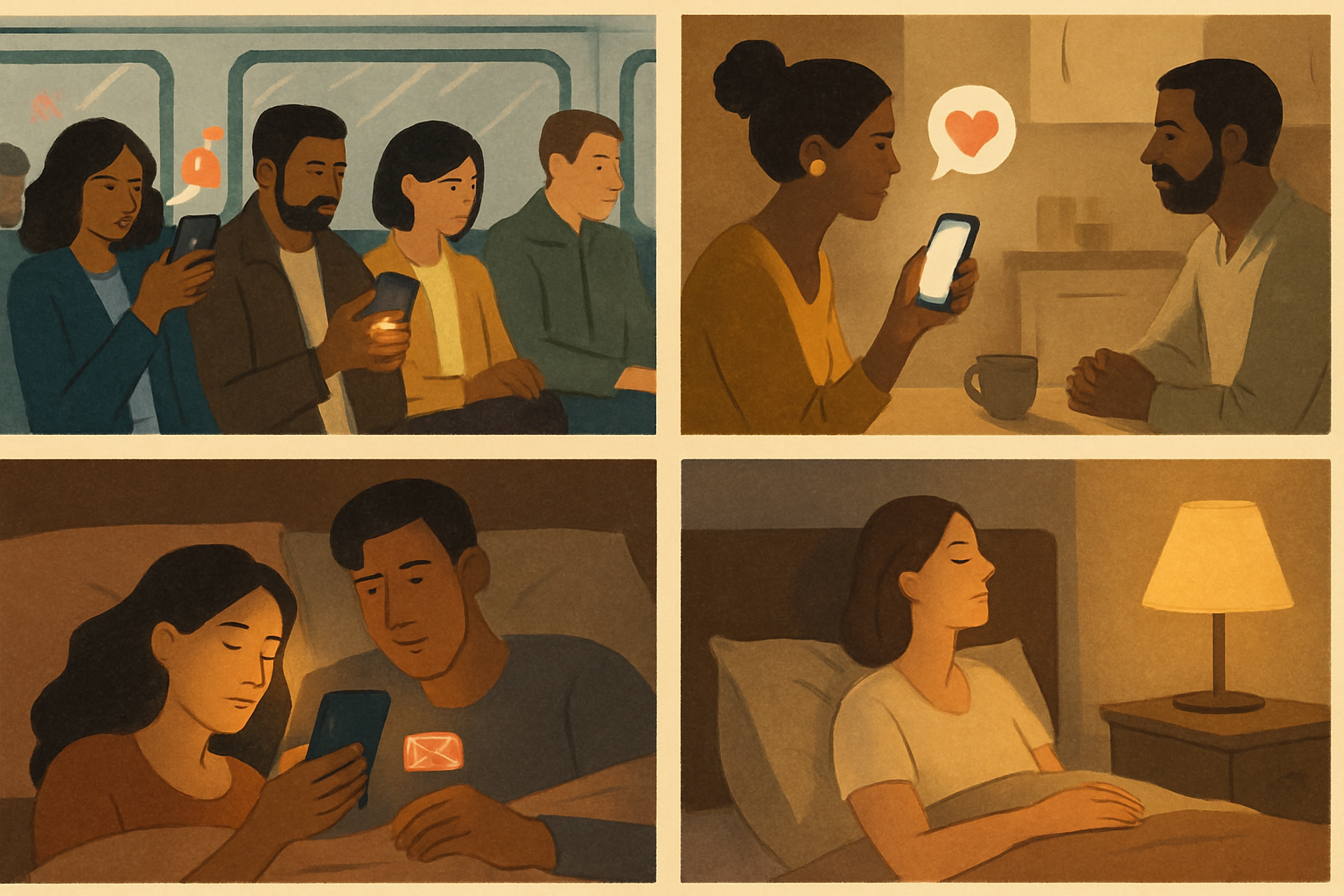
That usefulness makes a clean break difficult. So does the way checking becomes embedded in ordinary moments: waiting in line, sitting on public transit, pausing between tasks or feeling bored for a few seconds. A peer-reviewed observational study that examined smartphone behavior in real-world settings found that 89% of interactions were initiated by users rather than notifications. The researchers also found that many interactions were unconscious or went unnoticed by the participants.
In other words, turning off alerts may remove some interruptions without removing the underlying habit. The hand reaches for the phone not only because it buzzed, but because the situation has become a cue.
Notifications still matter. Research summarized by the American Psychological Association found that batching notifications into three predictable periods improved participants’ reported attention, stress, productivity, happiness and sense of control compared with receiving alerts as usual. But the same experiment found that eliminating notifications altogether could increase anxiety and fear of missing out. The lesson is less “disconnect completely” than “make the phone less demanding without making it unusable.”
That helps explain why digital well-being tools can feel disappointing. A screen-time warning arrives after the behavior has already happened. It tells users that they have spent too long on an app, but it does not necessarily change the boredom, loneliness, uncertainty or transition that prompted the check in the first place. In fact, one two-month experiment found that pop-up warnings about excessive smartphone use did not reduce participants’ screen time or the frequency with which they checked their phones.
A more realistic strategy is to redesign the moments surrounding the habit. Disable alerts that are not genuinely urgent. Keep the phone out of reach during meals or bedtime. Create a replacement for the automatic check—a short walk, a book, music or simply leaving the pause empty. The goal is not to prove that a person can survive without a smartphone. It is to stop every spare moment from being automatically assigned to one.
The Pew findings show that Americans already understand the problem. The harder question is whether they can change an environment that continually rewards checking while also depending on the device for connection and information.
Cutting back is difficult partly because people are fighting their own habits. They are also negotiating with a tool that has become infrastructure for modern life.
Sources & Further Reading
- Pew Research CenterPrimary source
- Heitmayer and Lahlou, Computers in Human BehaviorPrimary source
- Loid, Täht and Rozgonjuk, Computers in Human BehaviorPrimary source
- American Psychological Association
StoryBreak
Independent digital news and reporting, updated throughout the day.
This article was researched and drafted with AI assistance and reviewed as part of StoryBreak's editorial process before publication. Read our editorial standards.