
Anak Krakatau’s Ash Cloud Shows Why Volcanoes Can Ground Planes Far Away
Indonesia’s Anak Krakatau eruption disrupted flights and temporarily closed airspace near Jakarta. The reason is not simply visibility: volcanic ash can melt inside jet engines, damage critical components and create risks hundreds of miles from the volcano.
By StoryBreak
Published September 7, 2026 at 1:02 AM
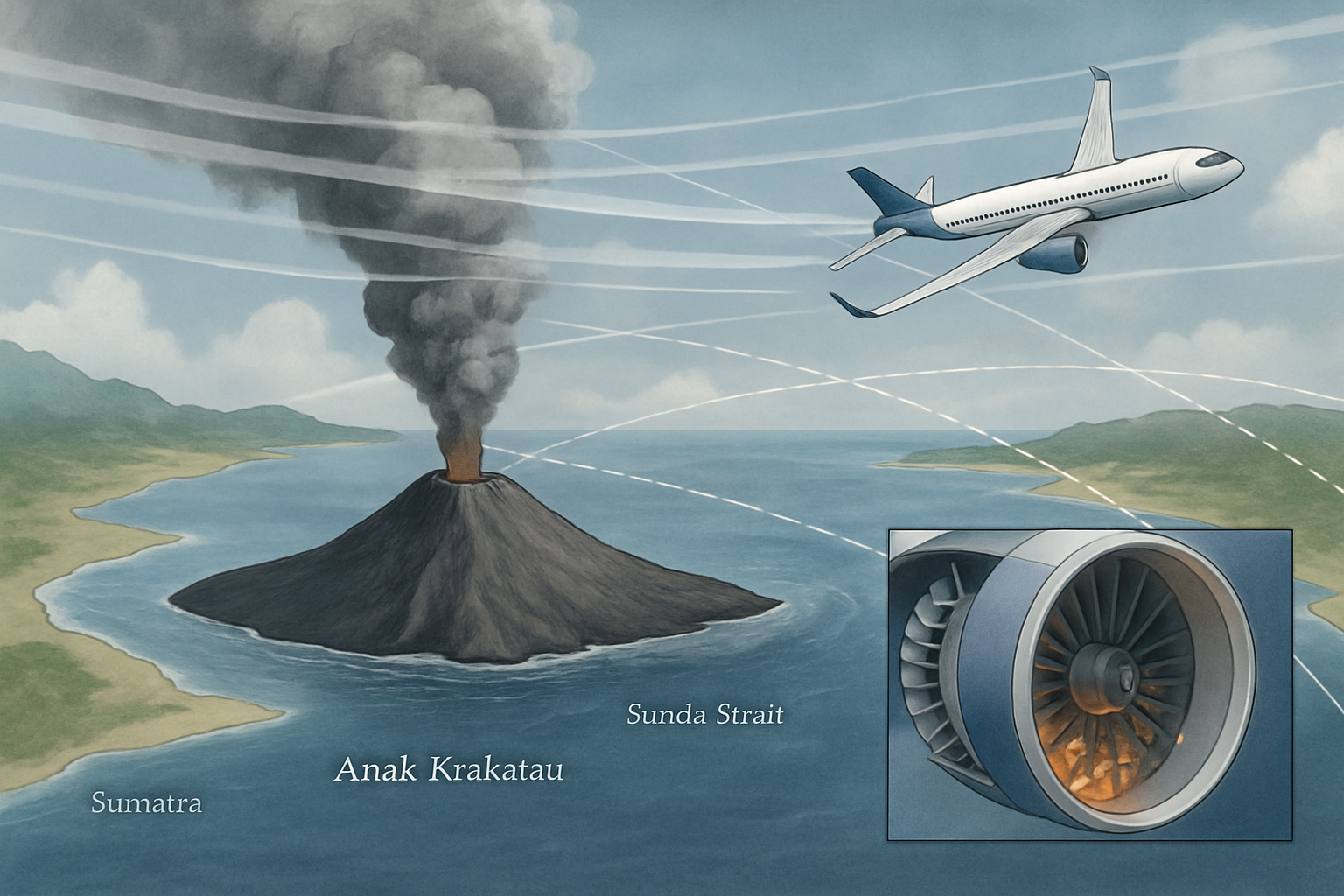
Anak Krakatau’s latest eruption has become an aviation problem far beyond the small volcanic island in Indonesia’s Sunda Strait.
Indonesian authorities intensified round-the-clock monitoring after the volcano’s activity sent ash into the atmosphere. The country’s transport ministry said volcanic ash led to a temporary closure affecting Jakarta’s Soekarno-Hatta International Airport on September 6, 2026. Indonesia’s airport operator reported that 764 scheduled flights were affected at the airport, while other airports and domestic services also faced disruption.
That response can seem disproportionate when compared with the volcano’s location. Anak Krakatau lies between Java and Sumatra, while Jakarta is more than 100 kilometers away. But aircraft do not need to fly directly over the crater to encounter danger. Ash clouds can be carried by winds, spread across flight paths and remain difficult to detect from the cockpit.
The central problem is what volcanic ash actually is. It is made up of tiny fragments of rock and volcanic glass, not soft smoke. Those particles can abrade aircraft windshields, leading edges and engine parts. They can also enter ventilation and other systems, reducing the reliability of instruments and controls.
Jet engines create an even more serious hazard. Inside the hottest parts of an engine, ash particles can melt. As the material moves into cooler sections, it can harden again on turbine components and air passages. That buildup can disrupt airflow, damage the engine and, in severe encounters, cause a compressor stall or loss of thrust.
This is why aviation authorities treat ash forecasts as a safety issue rather than a routine weather inconvenience. Indonesia’s meteorological agency, BMKG, has been issuing volcanic-ash advisories and aviation warnings while monitoring the eruption’s effects on the atmosphere and air routes. Airlines use those warnings to reroute flights, delay departures or cancel services before an aircraft enters contaminated airspace.
The disruption can also continue after an ash cloud moves away. Airports may need to inspect and clean runways, taxiways and aircraft. Ash on the ground can be kicked back into the air by jet blast, vehicles or wind. Even when one airport resumes operations, aircraft and crews may be in the wrong locations, creating delays that spread through an airline’s network.
That explains how a localized eruption can produce a regional aviation ripple effect. The first decision may be to close one route or airport for several hours. The next effects involve missed connections, aircraft rotations, crew working limits and limited spare capacity. In other words, the ash threat is physical, but the disruption becomes logistical as well.
The current eruption should not automatically be read as a repeat of the catastrophe associated with Krakatau. Anak Krakatau is the active volcano that emerged in the caldera left by the 1883 Krakatau eruption, and its collapse during an eruption in December 2018 triggered a deadly tsunami. The official information available for the present event confirms continuing volcanic activity and ash-related aviation precautions; it does not by itself establish a comparable tsunami threat.
For travelers, the practical lesson is simple: an airport’s distance from a volcano is not a reliable guide to whether flights will operate. The decisive questions are how much ash is being produced, how high it rises, where the winds carry it and whether aviation authorities can establish a safe corridor.
As long as Anak Krakatau remains active, those answers can change quickly. Airlines will continue to rely on updated ash advisories and official airspace notices, while passengers should check their carrier directly rather than assume that an airport reopening means every scheduled flight has returned to normal.
Sources & Further Reading
- Badan Meteorologi, Klimatologi, dan Geofisika (BMKG)Primary source
- Ministry of Transportation of the Republic of IndonesiaPrimary source
- Badan Nasional Penanggulangan Bencana (BNPB)Primary source
- Ministry of Energy and Mineral Resources of IndonesiaPrimary source
- ANTARA News
- Associated Press
- U.S. Geological SurveyPrimary source
- U.S. Geological SurveyPrimary source
StoryBreak
Independent digital news and reporting, updated throughout the day.
This article was researched and drafted with AI assistance and reviewed as part of StoryBreak's editorial process before publication. Read our editorial standards.