Ancient Meteorite Records a Magnetic Force That May Have Helped Build the Solar System
Magnetic minerals preserved inside an Antarctic meteorite suggest that the newborn solar system was shaped not only by gravity but also by a strong magnetic field. The evidence reaches back to the system’s earliest 200,000 years, although scientists still need to test whether the signal appears in other meteorites.
By StoryBreak
Published September 25, 2026 at 3:24 AM
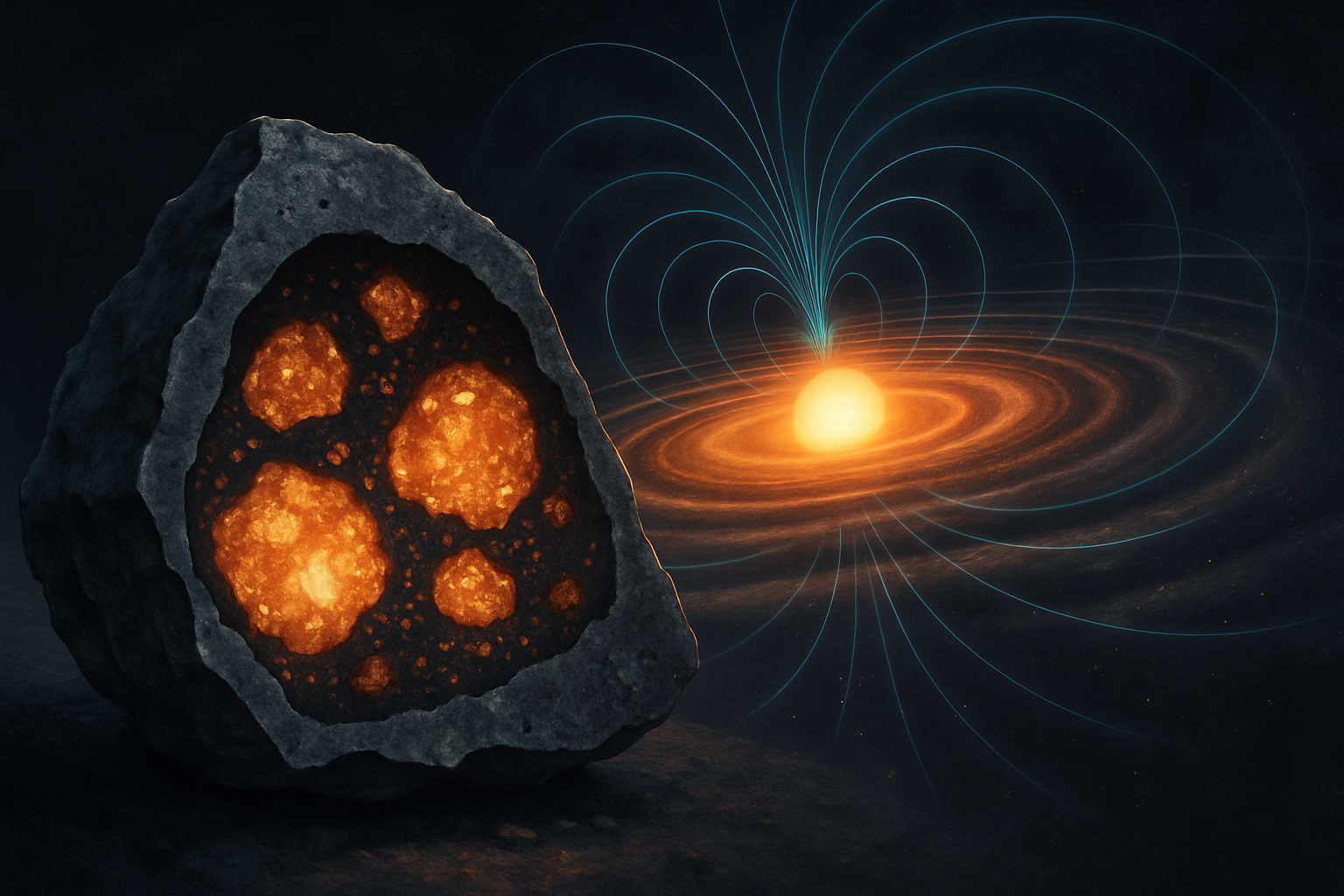
For decades, gravity has been the main character in the story of how the solar system formed: a cloud of gas and dust collapsed, most of its material gathered into the young Sun, and the remainder flattened into a disk that supplied the planets.
A tiny piece of an Antarctic meteorite now points to another force working alongside it.
In a study published in the Proceedings of the National Academy of Sciences, researchers examined microscopic inclusions inside Dominion Range 08006, or DOM 08006. The meteorite, recovered in Antarctica in 2008, is considered one of the least altered examples of its type. Inside it are calcium-aluminum-rich inclusions, among the oldest solid materials formed in the solar system.
Several of those inclusions contain iron-bearing minerals that retain remanent magnetization—a faint magnetic record left behind by the field surrounding them when they formed or cooled. From that signal, the researchers infer that a substantial magnetic field existed during the solar system’s earliest stage, possibly within the first 200,000 years.
The reported field was estimated at roughly 150 to 600 microteslas. That is several times stronger than Earth’s present surface field and, at the upper end, about 12 times stronger. The significance is not that magnetism overpowered gravity. Rather, magnetic fields can exert stresses on electrically conducting gas, helping move material and redistribute angular momentum in a young star-forming disk.
That matters because a collapsing cloud faces a physical problem. As gas falls inward, it spins faster, much as a figure skater rotates more rapidly when pulling in their arms. Without an efficient way to shed angular momentum, material has difficulty reaching the center to build a star. Magnetic interactions are one mechanism that can help transfer that angular momentum through the disk, allowing gas to accrete onto the growing Sun.
The meteorite provides something telescopes cannot: a physical record from the environment in which our system formed. DOM 08006’s primitive composition and limited alteration make it an unusually useful archive. Its grains formed before the solar system had settled into the architecture seen today, then became sealed inside a parent asteroid and survived billions of years before arriving in an Antarctic collection.
But the result is evidence, not a complete reconstruction. The study examined a limited number of inclusions, and the interpretation depends on determining when their magnetic signal was acquired. Later chemical changes inside the parent asteroid, or other local effects, could complicate the record. The researchers therefore need to repeat the measurements on inclusions from other primitive meteorites.
That test will determine whether DOM 08006 preserves a system-wide magnetic field or an unusual local event. If similar signals appear across different meteorite groups, models of the Sun’s birth—and of planet formation around other stars—will have to give magnetism a more prominent role.
The broader lesson is already clear: the solar system was not assembled by a single force acting alone. Gravity gathered the material, but magnetism may have helped organize its movement at the moment the Sun and its planetary disk were taking shape.
Sources & Further Reading
- Proceedings of the National Academy of SciencesPrimary source
- MIT News
- Lunar and Planetary Institute / Meteoritical BulletinPrimary source
StoryBreak
Independent digital news and reporting, updated throughout the day.
This article was researched and drafted with AI assistance and reviewed as part of StoryBreak's editorial process before publication. Read our editorial standards.