Apple’s New M6 Chip Takes Aim at the AI PC Race With Huge Performance Gains
Apple has unveiled its first 2-nanometer M6 processor, bringing major AI performance improvements to the Mac mini as the company pushes toward a future where powerful AI models and autonomous agents can run directly on personal computers.
By StoryBreak
Published August 31, 2026 at 1:10 AM
Updated September 7, 2026 at 12:23 AM
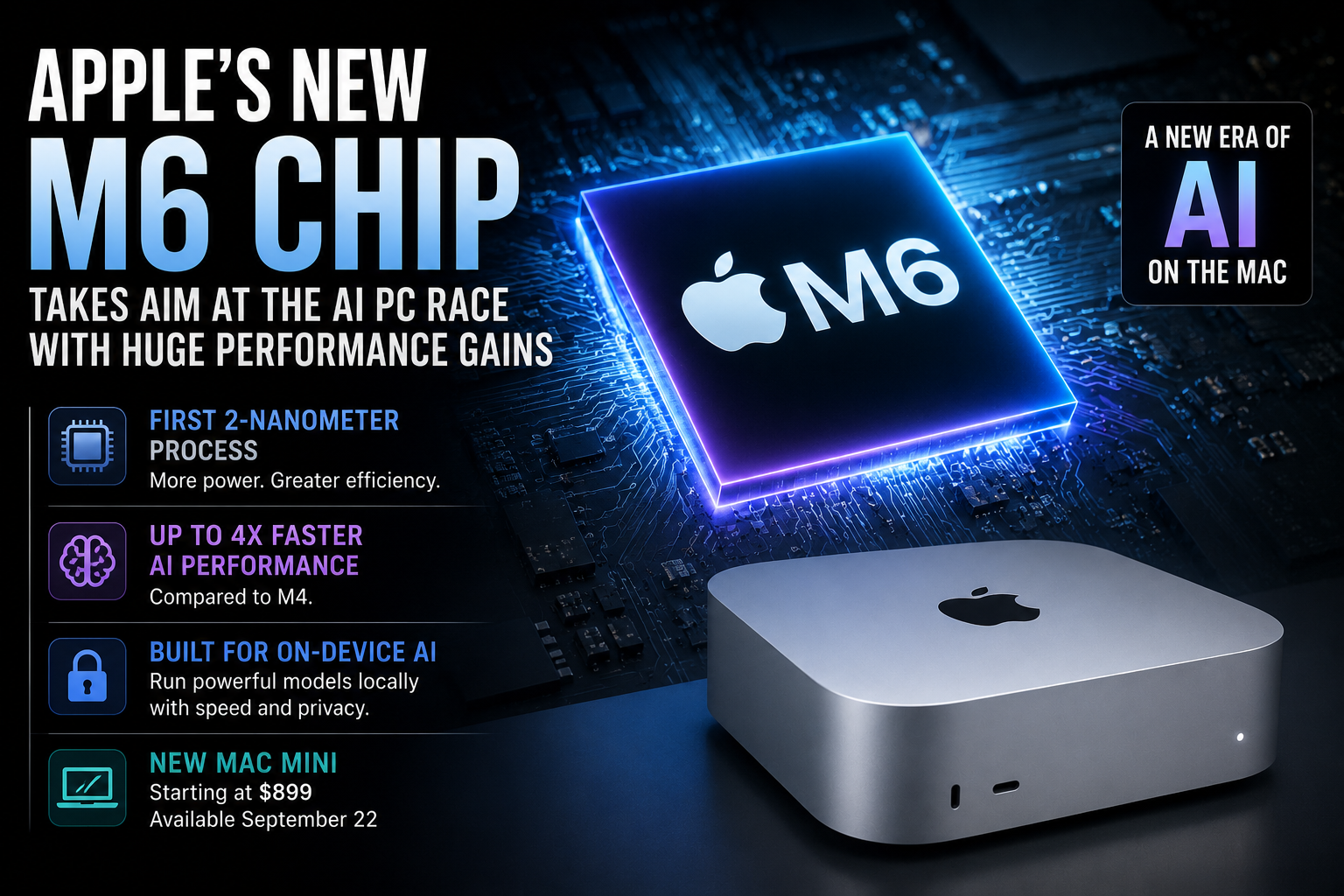
Apple is making a major new push into artificial intelligence computing with the introduction of its M6 processor, the company's first Mac chip manufactured using a 2-nanometer process.
The M6 is debuting inside Apple's new Mac mini and represents another significant step in the company's transition toward computers capable of handling increasingly demanding artificial intelligence workloads directly on the device.
Apple says the M6 Mac mini can deliver up to four times faster AI performance than the previous M4-powered model. The chip includes a 12-core CPU, a 12-core GPU with Neural Accelerators and a new Dual 16-core Neural Engine designed specifically to accelerate artificial intelligence workloads.
The smaller 2-nanometer manufacturing process allows Apple to pack more transistors into a smaller area while improving performance and power efficiency.
But the biggest story surrounding the M6 may be what Apple expects people to do with all that computing power.
The company is increasingly positioning the Mac as a machine capable of running artificial intelligence locally rather than sending every request to enormous cloud data centers.
That includes running large language models and AI agents directly on a user's computer. Local AI can potentially provide faster responses and greater privacy because some information can remain on the device instead of being transmitted to remote servers.
Apple says developers can use its software frameworks to run and fine-tune AI models locally while taking advantage of the Mac's CPU, GPU and Neural Engine.
How the M6's AI strategy differs from Intel and Snapdragon
Apple's approach to on-device AI is distinct from its two biggest rivals in the "AI PC" category. Intel's Core Ultra chips and Qualcomm's Snapdragon X series have focused primarily on fast inference for smaller, targeted on-device tasks — background transcription, image processing, quick assistant queries — while pairing with a discrete GPU (often Nvidia's, on Windows machines) for heavier workloads like CUDA-based AI development. Apple's M-series chips are instead built around the bet that AI PC users increasingly want to run much larger models — reportedly up to 400-billion-parameter open-weight models — directly on the machine, which is why Apple keeps expanding unified memory and neural-engine throughput rather than relying on an external GPU. Independent testing of Apple Silicon against Intel's Core Ultra platform has also found Apple's laptops holding a substantial battery-efficiency edge — for example, a MacBook Pro built around the M-series lasting roughly 22 hours in video playback versus about 16 hours for a comparable Intel Core Ultra machine — though Intel's platform remains the stronger choice for workstation users who need a discrete Nvidia GPU for CUDA-dependent AI development work Apple's ecosystem doesn't support. Third-party head-to-head M6 benchmarks were still limited at launch, since the chip only began shipping September 22; independent reviewers have generally cautioned that Apple's own performance claims should be treated as a starting point rather than a verified ceiling until wider testing catches up.
The new Mac mini also reflects how quickly personal computers are being redesigned around artificial intelligence. Apple, Microsoft, Nvidia and other major technology companies are competing to provide hardware capable of running increasingly sophisticated AI applications.
Apple's M6 Mac mini starts at $899 and is scheduled to become available September 22.
For consumers, the M6 may be an early glimpse at a much larger change coming to personal computers: instead of simply connecting to artificial intelligence through the internet, the computer sitting on your desk may increasingly become the machine actually running it.
Sources & Further Reading
StoryBreak
Independent digital news and reporting, updated throughout the day.
This article was researched and drafted with AI assistance and reviewed as part of StoryBreak's editorial process before publication. Read our editorial standards.