
Argentina’s Andean Solar Train Runs on Sun-Charged Batteries—Not Roof Panels
Jujuy’s Tren Solar de la Quebrada carries tourists through the Quebrada de Humahuaca using lithium batteries charged with locally generated solar electricity. The project is less a futuristic solar vehicle than a practical experiment in battery-electric rail for a short mountain route.
By StoryBreak
Published September 21, 2026 at 12:38 AM
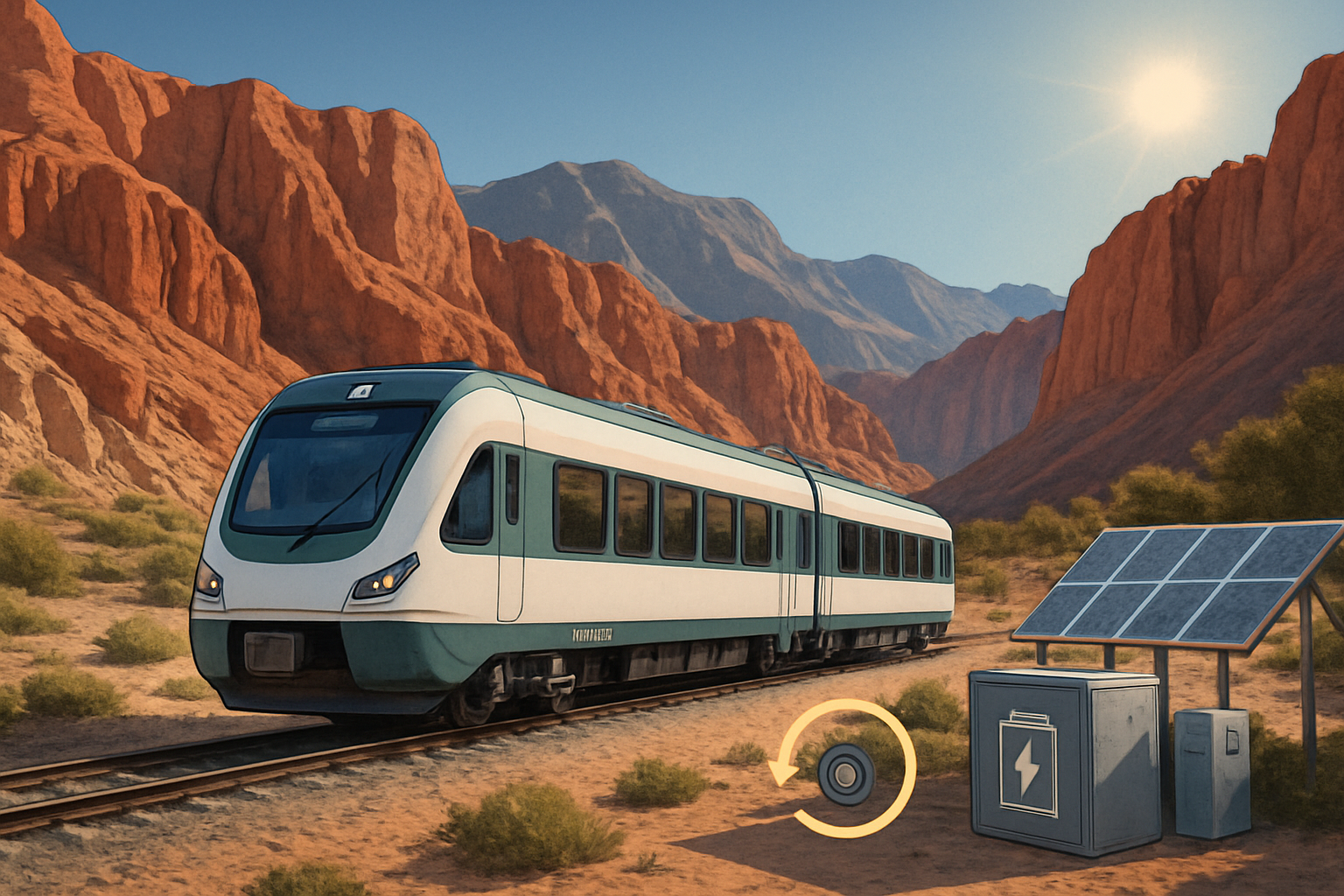
In northern Argentina, a tourist train is turning the intense sunlight of the Andes into motion—but not quite in the way its name may suggest.
The Tren Solar de la Quebrada runs through Jujuy’s Quebrada de Humahuaca on a 42-kilometer route linking communities including Volcán, Purmamarca and Tilcara. Rather than drawing electricity from overhead wires or burning diesel, the two-car train relies on six lithium batteries charged with solar-generated electricity in the province.
That distinction matters. The train is not covered in photovoltaic panels that directly power it as it travels. Its energy is produced separately, stored in batteries and delivered through fast-charging points along the route. When the train brakes, some of its kinetic energy can also be recovered and stored for later use.
According to independent reporting by Euronews, the batteries provide an estimated range of 100 to 120 kilometers. That is approximately 2.4 to 2.9 times the length of the current route, giving the operator room to complete journeys without installing a continuous electric line above the track.
The system is particularly suited to this railway’s role. The Tren Solar de la Quebrada is a tourist service through a UNESCO World Heritage landscape, not a high-frequency commuter network. Avoiding overhead wires can reduce visual intrusion in a culturally and environmentally sensitive valley, while battery power eliminates the need to carry diesel fuel on the train.
The route also represents the return of passenger rail to part of the Quebrada de Humahuaca. Argentina’s national government transferred operation of the tourist line between Volcán and Tilcara to Jujuy province, and the official train operator describes the service as Latin America’s first solar-powered train.
But the project should be read as a targeted transport experiment rather than a wholesale answer to railway emissions. Battery trains need reliable charging infrastructure, and their practicality depends on route length, gradients, passenger loads, weather and the availability of replacement batteries. A short tourist line with strong solar resources is a very different challenge from a heavily used intercity railway.
The train’s reported range is nevertheless significant for the current operation. Even at the lower end of the estimate, 100 kilometers, the batteries can cover more than twice the 42-kilometer route before recharging. A third charging point planned near Tilcara could make the system more flexible as service expands.
That is the more useful lesson from Jujuy. Solar power is not replacing the railway’s entire electrical system by magic; it is being combined with storage, charging stations and regenerative braking to fit the needs of one carefully defined route.
For communities along the valley, the promise is both environmental and economic: a quieter, lower-emission visitor service that connects towns while showcasing the region’s renewable-energy potential. Whether that model can be extended beyond tourism will depend on the next phase—how reliably the batteries perform, how much the charging network costs, and whether passenger demand justifies longer or more frequent service.
Sources & Further Reading
- Tren Solar de la QuebradaPrimary source
- Argentina.gob.arPrimary source
- Euronews
- Gobierno de JujuyPrimary source
StoryBreak
Independent digital news and reporting, updated throughout the day.
This article was researched and drafted with AI assistance and reviewed as part of StoryBreak's editorial process before publication. Read our editorial standards.