China Is Building Hospitals Around AI. The Hard Part Comes After the Hype
China is moving beyond isolated medical AI tools toward hospitals designed around shared data, AI agents and continuous online-offline care. The projects are ambitious—but the evidence still shows systems assisting human clinicians, not replacing them.
By StoryBreak
Published September 9, 2026 at 2:49 PM
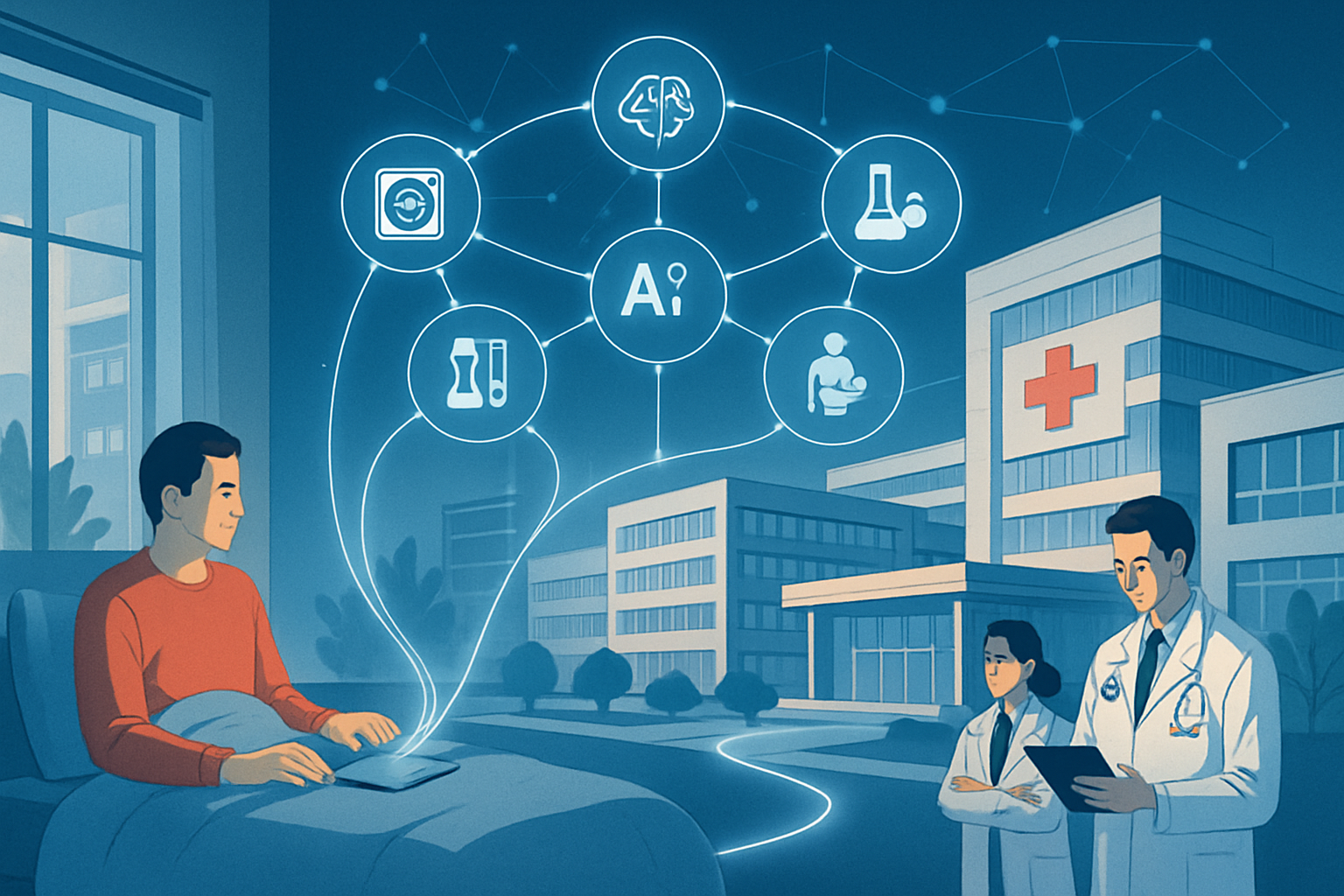
China’s artificial-intelligence ambitions in healthcare are entering a new phase: AI is no longer being treated only as a tool that reads scans, summarizes notes or answers patient questions. In several projects, it is being positioned as the operating layer of the hospital itself.
The clearest example is in Beijing, where Arion Cancer Center is developing an estimated 6 billion yuan ($872 million), 800-bed campus backed by ByteDance. The project is intended to open by the end of 2029 and eventually expand beyond oncology. Its designers envision AI agents working across clinical operations, health management, research, education and administration, rather than sitting in one department as a stand-alone assistant.
That distinction matters. Most hospitals adopting AI are adding software to systems built for an earlier era. Data may remain divided between imaging, laboratory, pharmacy, billing and patient-record platforms. An AI-native hospital attempts the reverse: build the data architecture and workflows around machine intelligence from the start, allowing systems to exchange information and coordinate tasks.
Tsinghua University and partner medical institutions used a March 2026 forum in Beijing to publish what they described as the first international consensus defining an AI hospital. The document says such a hospital would combine physical care with online services through a shared intelligent system. Doctors and nurses would still handle diagnosis, surgery and complex treatment, while AI could support triage, monitoring, follow-up, rehabilitation and medication reminders.
In other words, the proposed model is not a hospital without doctors. It is a hospital that continues caring for a patient after discharge—and potentially begins helping before the patient arrives. A wearable device might feed recovery data into the system; an abnormal pattern could prompt an alert to a clinician; a patient with a chronic condition could receive structured support without making repeated trips to a clinic.
China’s national health authorities are encouraging that direction. A policy issued in November 2025 called for wider use of AI-assisted imaging, clinical decision support, intelligent patient services and hospital management. It set a 2027 goal for more clinical models and pilot bases, and said that by 2030 hospitals above the primary level should widely use tools such as intelligent imaging and clinical decision support.
The push is already visible outside Beijing. In June, Hubei’s provincial industry and information department reported the launch of the Optics Valley AI Hospital, a collaboration involving the local government, Wuhan University Zhongnan Hospital and medical-AI companies. The initiative listed applications ranging from imaging and pathology to intensive care, traditional Chinese medicine, health management and hospital operations.
Research published through University College London’s repository also described DeepSeek systems being deployed in nearly 90 Chinese tertiary hospitals, with uses extending beyond diagnosis into administration, research and patient management. That is significant—but it should not be mistaken for proof that AI is independently practicing medicine. The same evidence points to an adoption phase in which hospitals are testing where models can assist and where human verification remains necessary.
The central uncertainty is therefore not whether AI can perform useful tasks. It can. The harder question is whether a hospital can safely make AI part of every decision pathway without creating new forms of fragmentation, bias or concealed error.
Healthcare data is unusually sensitive, and AI systems can produce confident but incorrect recommendations. When a clinician follows an AI-generated suggestion, responsibility may be divided among the doctor, hospital, software developer and data provider. A system that works well in one hospital may also fail elsewhere if its training data does not reflect different patients, equipment or clinical practices.
China’s AI-hospital projects are best understood as large-scale experiments in redesigning healthcare infrastructure. Their success will not be measured by the number of digital assistants launched, but by harder outcomes: faster access, safer decisions, better continuity of care and improved results for patients.
The future hospital may indeed be AI-native. But for now, China is building the foundation—and testing whether the technology can earn a place beside the people who remain accountable for care.
Sources & Further Reading
StoryBreak
Independent digital news and reporting, updated throughout the day.
This article was researched and drafted with AI assistance and reviewed as part of StoryBreak's editorial process before publication. Read our editorial standards.