
China Is Preparing Humanoid Robots for War. The Battlefield Is Still a Long Way Off.
China’s military is testing and procuring technologies that could give humanoid robots battlefield roles, from reconnaissance and patrols to hazardous missions. But the evidence points to an early development phase—not operational robot soldiers—and the first real deployments are more likely to be remotely controlled support machines than autonomous combatants.
By StoryBreak
Published September 7, 2026 at 9:32 PM
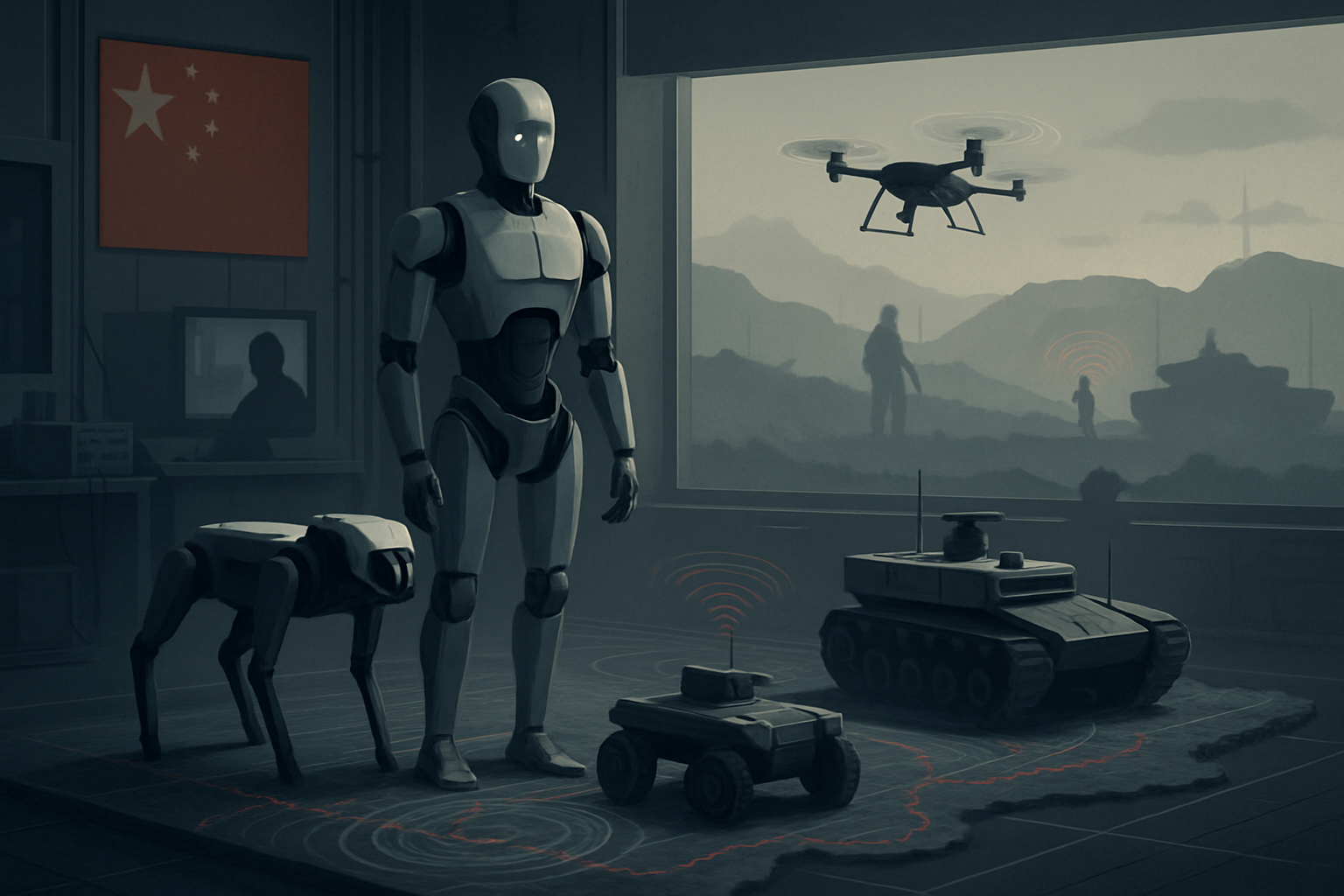
China is moving humanoid robots closer to the military world—but not yet to the front line.
A Reuters review published September 7, 2026, found more than 100 Chinese military procurement notices, academic studies, patents, government records and defense-industry materials pointing to a growing effort to adapt humanoid machines for warfare. The work includes battlefield simulations, robot procurement, perception systems and the collection of data that could teach machines how to move through real terrain.
The distinction matters. There is no evidence that armed humanoid robots have been deployed with an operational People’s Liberation Army unit. What China is building instead is the foundation for future human-machine operations.
Some of the clearest evidence comes from the PLA’s own paperwork. In May 2025, the military issued a tender for a humanoid robot, along with installation and technical training. A later notice sought an “embodied” humanoid system capable of intelligent perception and dexterous operation. In June 2026, another procurement document set aside about $300,000 for a system to collect and label camera, radar and motion data—including information about terrain robots could cross.
That last category may be more important than a robot’s ability to walk upright. A humanoid can only be useful in combat if it can recognize obstacles, manipulate objects, understand changing surroundings and act reliably when communications are degraded. Those capabilities require enormous amounts of training data and extensive testing outside controlled demonstrations.
Chinese military researchers have already imagined demanding scenarios. A 2025 competition connected to the National University of Defense Technology simulated robots moving behind enemy lines, mapping an area and locating targets. Other scenarios envisioned identity checks, security patrols and base inspections. The goal was not to show that robots were ready for combat, but to push humanoid systems toward military environments.
China’s defense industry is now entering the picture. Norinco, the state-owned arms conglomerate, has promoted a full-size humanoid called Fuxi for sentry duty, all-weather reconnaissance, patrols and dangerous work. The company also describes a teleoperation system that allows a human to control the machine remotely.
That remote-control detail is a reality check. The first useful military humanoids are unlikely to be independent “robot soldiers.” They are more likely to be machines operated by people, perhaps with limited autonomy for navigation or routine tasks. A human could send one into a hazardous building, inspect damaged infrastructure, carry equipment or search an area where chemical, explosive or structural dangers make sending soldiers too risky.
China’s current military exercises show a similar progression. Official reports describe PLA units using robotic dogs, unmanned all-terrain vehicles, heavy-lift drones and exoskeletons for reconnaissance, transport, medical assistance and casualty evacuation. Those systems have more specialized designs than humanoids and are therefore easier to deploy for particular jobs.
Humanoids have one major theoretical advantage: they are designed for a world built around human bodies. They could use stairs, doors, ladders, tools and vehicles without requiring every facility to be redesigned. But that flexibility comes with costs. Two-legged machines must balance themselves, carry batteries and actuators, withstand dust and damage, maintain a reliable communications link and make sense of unpredictable terrain. A wheeled vehicle, drone or robot dog may perform the same mission more cheaply and efficiently.
The war in Ukraine has already shown where military robotics is becoming practical: aerial drones for surveillance and attack, ground robots for supply delivery and casualty recovery, and systems that combine human direction with limited autonomy. Humanoids are entering that broader ecosystem, but they are not necessarily its most useful form.
So how close are we to robot warfare? In one sense, it has already begun—through drones and unmanned ground systems. In the narrower sense of humanoid machines fighting alongside or instead of soldiers, China appears to be in the testing-and-infrastructure stage.
The next threshold will not be a dramatic product unveiling. It will be evidence that a humanoid can operate repeatedly in a contested environment, under human supervision, while navigating obstacles, handling equipment and surviving communications disruptions. Until that happens, China’s robot warriors remain a military program under construction—not a battlefield force.
Sources & Further Reading
StoryBreak
Independent digital news and reporting, updated throughout the day.
This article was researched and drafted with AI assistance and reviewed as part of StoryBreak's editorial process before publication. Read our editorial standards.