Scientists Test Vision Correction That Reshapes the Cornea Without Lasers or Incisions
A technique that uses mild electrical currents to temporarily soften and mold the cornea has produced targeted refractive changes in extracted rabbit eyes. The approach is promising—but still far from human treatment.
By StoryBreak
Published September 30, 2026 at 12:55 AM
Scientists are testing a way to reshape the eye without a laser, blade or corneal incision—but the technology is still firmly in the laboratory.
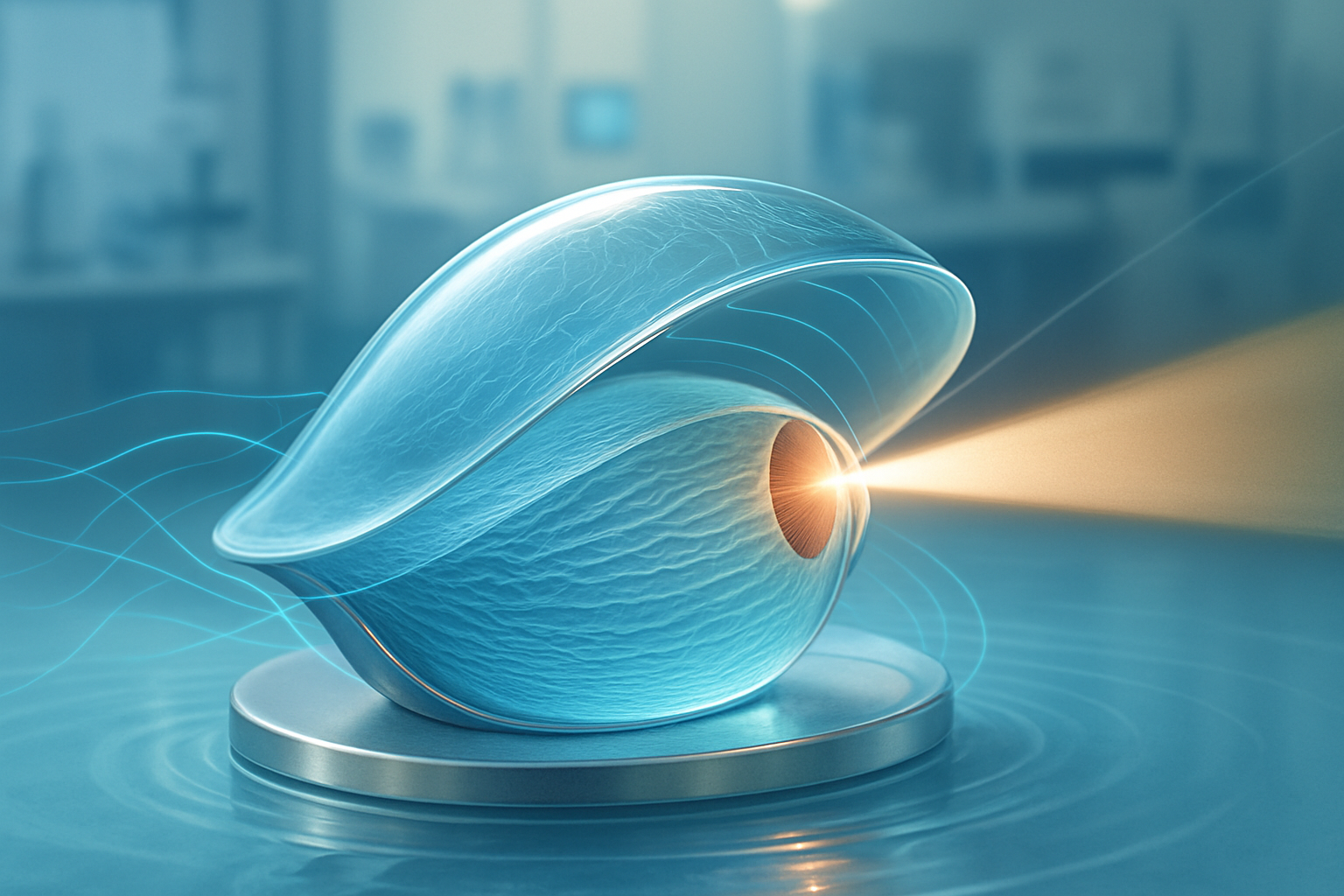
The method, known as electromechanical reshaping, uses a small electrical potential and a custom-shaped platinum contact lens to change the curvature of the cornea. In experiments on extracted rabbit eyes, researchers reported that the technique could produce curvature changes corresponding to correction of nearsightedness.
That is a meaningful distinction from LASIK. Laser refractive surgery removes precisely calculated amounts of corneal tissue to change how light is focused on the retina. EMR instead attempts to remodel the tissue without removing it.
The chemistry is relatively simple in principle. The cornea is built from tightly organized collagen-rich tissue whose shape is partly maintained by interactions between charged molecules. Applying a controlled electrical potential generates a localized pH change. That temporarily weakens some of the chemical interactions holding the tissue rigid, allowing the cornea to conform to the shape of the contact lens. When the electrical treatment ends and the tissue returns toward its normal chemical state, the researchers say the new shape becomes fixed.
In the latest results described by the American Chemical Society, the team placed a platinum “lens” over each rabbit eyeball while the eye was immersed in a saline solution. The lens served both as a mold and as an electrode. After roughly a minute of treatment, the cornea had flattened to a target curvature in the laboratory setup. The researchers repeated the experiment on 12 extracted eyes, including 10 modeled as nearsighted, and reported that each of those 10 reached the intended focusing power.
The work builds on a peer-reviewed 2023 study in which the same general approach produced controlled changes in corneal curvature across a range of refractive powers. Imaging suggested that optical transparency and apparent cell viability were preserved under the tested conditions. A later study examined the collagen framework more closely and found that pulsed electrical treatment appeared less damaging to the collagen signal than continuous treatment, while also calling for additional testing.
But “without lasers or incisions” should not be confused with “ready for patients.” The experiments were performed on eyes removed from rabbits. An extracted eye does not reproduce the full environment of a living human eye, including blood supply, blinking, healing responses, immune activity and ordinary eye pressure. The researchers have not yet shown that the correction would remain stable in a living animal, or that the treatment would avoid inflammation, scarring or other complications over the long term.
Those unanswered questions are central because the cornea is not merely an optical surface. It also helps protect the eye and must retain enough structural strength to resist changes caused by normal pressure. A technique that makes the tissue temporarily more malleable will need extremely precise control: too little reshaping would fail to correct vision, while excessive acidity, electrical exposure or mechanical pressure could injure the cornea.
The next step is therefore not a human trial, but a series of animal studies. The researchers have said they need to test the procedure in living rabbits, determine how long the new curvature lasts, refine the electrical dosage and explore whether the same platform can correct farsightedness and astigmatism.
If those studies succeed, EMR could eventually offer a different trade-off from today’s options. Unlike LASIK, it would not depend on ablating corneal tissue. Unlike overnight orthokeratology lenses, which temporarily mold the cornea and require continued wear to maintain the effect, EMR aims to create a lasting change after a short treatment. But that possibility remains prospective, not demonstrated.
For now, the real achievement is narrower—and more scientifically useful. Researchers have shown that electrical chemistry can make an extracted cornea conform to a prescribed shape while preserving key optical properties under laboratory conditions. Turning that proof of concept into a safe, repeatable vision treatment will require years of testing, not a trip to an eye clinic.
Sources & Further Reading
StoryBreak
Independent digital news and reporting, updated throughout the day.
This article was researched and drafted with AI assistance and reviewed as part of StoryBreak's editorial process before publication. Read our editorial standards.