A ‘Fire Amoeba’ Pushes the Heat Limit for Complex Life to 158°F
A newly identified amoeba can reproduce at 145°F and survive brief exposure to 158°F, resetting the known heat boundary for eukaryotic life.
By StoryBreak
Published September 22, 2026 at 11:33 PM
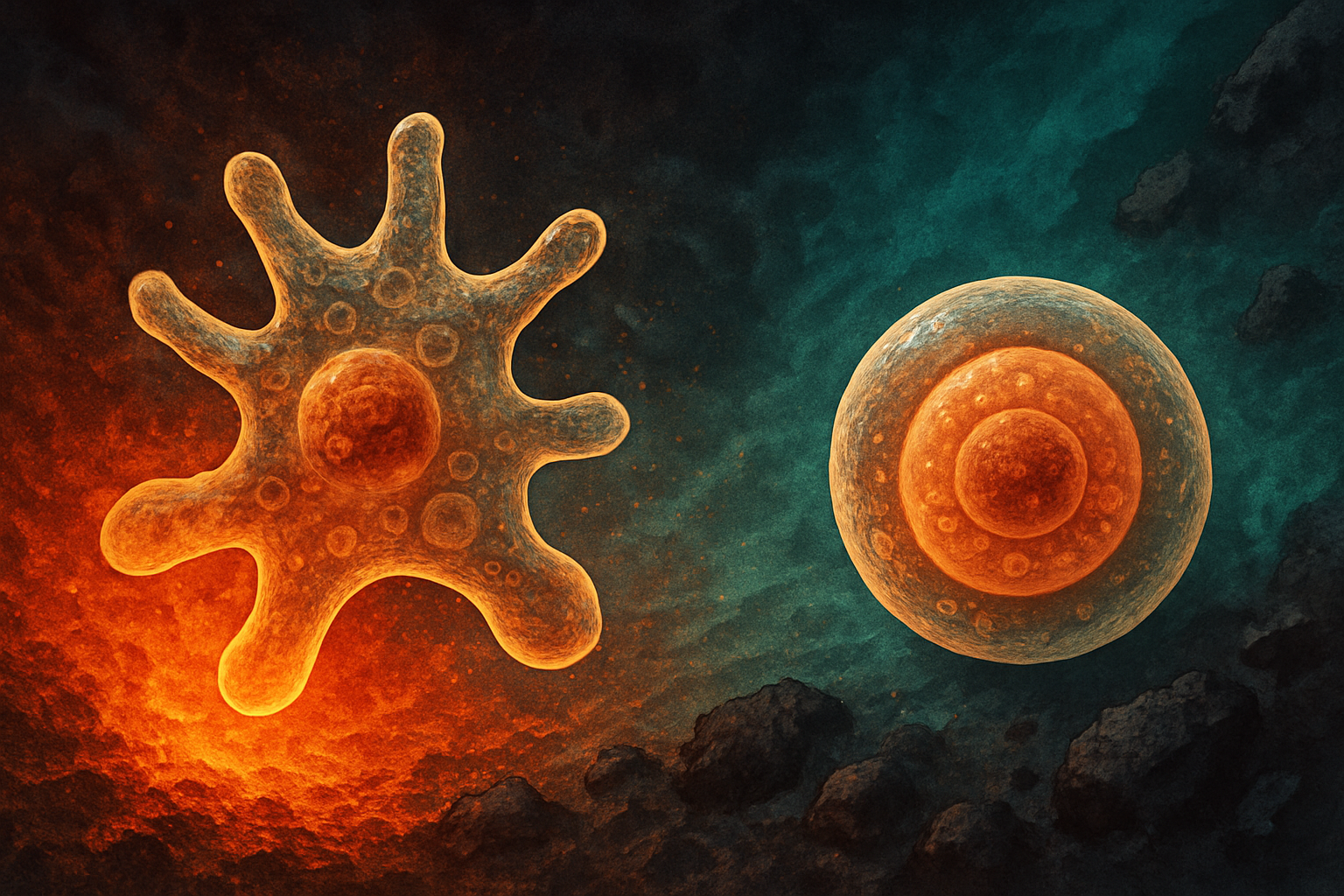
A newly discovered amoeba from a California hot spring has pushed the known heat limit for complex life to a temperature that would be fatal to nearly every familiar organism.
The species, named Incendiamoeba cascadensis, can reproduce at 63 degrees Celsius—about 145.4 degrees Fahrenheit—according to a peer-reviewed study published Tuesday in Cell. That is the highest documented temperature at which any known eukaryote can divide.
The amoeba can also keep moving at temperatures up to 64°C, or about 147°F. When the heat rises further, it can form a protective outer layer and endure exposure to 70°C, equivalent to 158°F, before recovering after being returned to cooler conditions.
That distinction matters. The organism does not grow normally at 158°F. Instead, it appears to switch into a defensive state that helps it survive a short period of extreme stress. Its demonstrated growth range is lower, with the strongest growth occurring around 55–57°C, or roughly 131–135°F.
Still, the findings overturn a long-standing assumption about eukaryotic cells. Eukaryotes contain nuclei and complex internal structures; the group includes animals, plants, fungi and protists such as amoebas. Those structures are vulnerable to heat because proteins can lose their shape, membranes can become unstable and the machinery needed for cell division can fail.
For decades, 60°C had been treated as the upper edge for eukaryotic growth. Some fungi and red algae were known to reproduce at that temperature, while a previously studied amoeba had been documented growing at lower temperatures. Incendiamoeba’s ability to divide at 63°C shows that the boundary was not as fixed as scientists thought.
The organism was isolated from geothermal springs in Lassen Volcanic National Park. Researchers sampled 20 locations over three years and found the amoeba at 14 sites along a tributary of Hot Springs Creek. The water temperatures at the sampling locations ranged from 49°C to 65°C, creating an environment where heat tolerance would be essential rather than incidental.
Laboratory experiments showed that the amoeba is an obligate thermophile: it requires high temperatures for growth and did not grow at 40°C or below. The researchers also visualized mitosis—the process by which one cell divides into two—at 63°C, confirming that the cells were not merely lingering in hot water but completing the basic process of reproduction.
Genomic analysis offered clues about how it manages that feat. Compared with related amoebas, the species showed an enrichment of genes associated with maintaining protein stability, protecting the genome and sensing changes in its surroundings. The researchers also observed that the amoeba can change shape, a flexibility that may help it forage in one condition and move away when temperatures become unfavorable.
The discovery does not mean complex life can rival the most heat-tolerant microbes. Certain bacteria and archaea can grow at temperatures far above 100°C under the right pressure and chemical conditions. The new record applies specifically to eukaryotic replication, not to life as a whole.
Its broader importance is that it expands the map of where complex cellular life might persist. Geothermal systems may contain more heat-loving eukaryotes that have gone unnoticed, and the amoeba’s heat-stable proteins could eventually interest researchers developing industrial enzymes or other biological tools.
For astrobiologists, the result is another reminder that habitability cannot be defined only by conditions comfortable for familiar animals or plants. Even among complex cells, life may occupy niches once dismissed as too hot to support anything more sophisticated than microbes.
Sources & Further Reading
- Cell / PubMed CentralPrimary source
- Cell Press via EurekAlert!
- Nature
- Science News
- National Park ServicePrimary source
StoryBreak
Independent digital news and reporting, updated throughout the day.
This article was researched and drafted with AI assistance and reviewed as part of StoryBreak's editorial process before publication. Read our editorial standards.