First Evidence of Diplodocus in Europe Found in Spain—With a Scientific Caveat
Fossils from Teruel, Spain, identified as Diplodocus sp. provide the first reported evidence of the iconic dinosaur outside North America. The discovery points to Late Jurassic movement between the continents, though independent experts say the fragmentary remains leave room for future revision.
By StoryBreak
Published September 16, 2026 at 2:50 AM
For more than a century, Diplodocus has been treated as a dinosaur of North America. A new study now places the iconic long-necked giant on the other side of the Atlantic—at least provisionally.
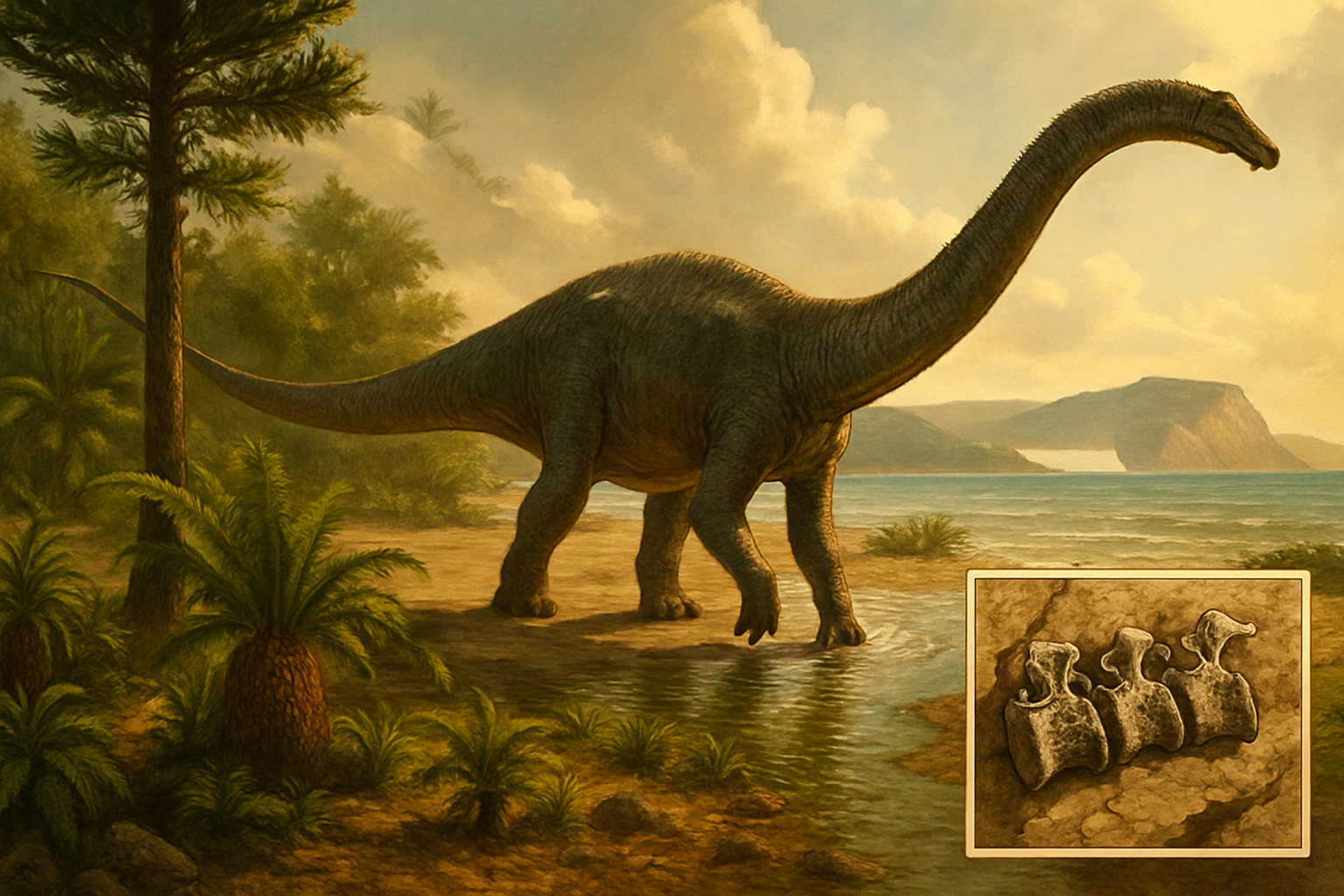
Paleontologists have identified 14 tail vertebrae and several chevron bones recovered from the La Tejería fossil site near El Castellar, in Spain’s Teruel province, as belonging to the genus Diplodocus. The research, published September 15, 2026, in the Journal of Vertebrate Paleontology, represents the first reported evidence of Diplodocus outside North America.
The specimen dates to roughly 150 million years ago, near the end of the Jurassic Period. Researchers estimate that the animal was about 25 meters long—roughly 82 feet—and comparable in scale to its better-known North American relatives.
The identification rests on a combination of anatomical details in the tail. The vertebrae contain large pneumatic cavities, elongated centra without lateral ridges and deep grooves along their undersides. The associated chevrons, bones that helped protect blood vessels beneath the tail, are forked in a form considered characteristic of Diplodocus.
The research team also used phylogenetic analysis, which compares anatomical traits across related dinosaurs to estimate evolutionary relationships. Those analyses placed the Spanish animal within Diplodocus, although the paper assigns it only to the open-ended designation Diplodocus sp. It is not yet possible to say which species it represents.
That distinction matters. The fossils are scientifically valuable, but they are not a complete skeleton. Several outside experts consulted by Science Media Centre Spain described the study as important and well executed, while noting that 14 tail vertebrae and chevrons leave some uncertainty. One expert said the material is compatible with Diplodocus but could potentially belong to a closely related sauropod, such as Supersaurus or another genus. More complete fossils would provide a stronger test.
Even with that caution, the find changes the geographic question surrounding these dinosaurs. Diplodocus fossils have been especially associated with the Morrison Formation of the western United States. The new Spanish material shows that a dinosaur lineage previously documented there also lived in Iberia during the same broad interval.
The Atlantic Ocean of the Late Jurassic was not the ocean seen on modern maps. North America and Europe were closer together, and geological evidence indicates that temporary land connections or shallow crossings may have allowed some dinosaur populations to move between the regions. The Spanish Diplodocus joins a growing list of dinosaur groups—including Allosaurus, Stegosaurus and Torvosaurus—with representatives known from both sides of the ancient Atlantic.
That makes this discovery less a story about a dinosaur suddenly appearing in Europe than about a missing piece in a much larger puzzle. Fossils from Portugal and Spain have already shown striking similarities with dinosaur communities of North America. The new specimen adds a giant herbivore to that transatlantic pattern.
It also illustrates a central limitation of paleontology: the fossil record is incomplete, and the most important conclusions often begin with a handful of bones. A tail can preserve enough distinctive anatomy to suggest a genus, but it may not reveal the full animal’s species, appearance or route of migration.
Researchers will need more fieldwork and additional specimens to resolve those questions. For now, the strongest conclusion is also the most defensible one: about 150 million years ago, a Diplodocus-like giant was living in what is now northeastern Spain, showing that Europe’s Jurassic ecosystems were more closely connected to North America than the classic museum displays once suggested.
Sources & Further Reading
StoryBreak
Independent digital news and reporting, updated throughout the day.
This article was researched and drafted with AI assistance and reviewed as part of StoryBreak's editorial process before publication. Read our editorial standards.