
France’s School Protests Spread Nationwide as Clashes Force a Government Reckoning
More than 1,000 French high schools have been affected by protests over staffing, overcrowding and deteriorating conditions. As clashes and arrests mount, the government is hardening its response—but that may not resolve the grievances driving the movement.
By StoryBreak
Published October 2, 2026 at 5:53 PM
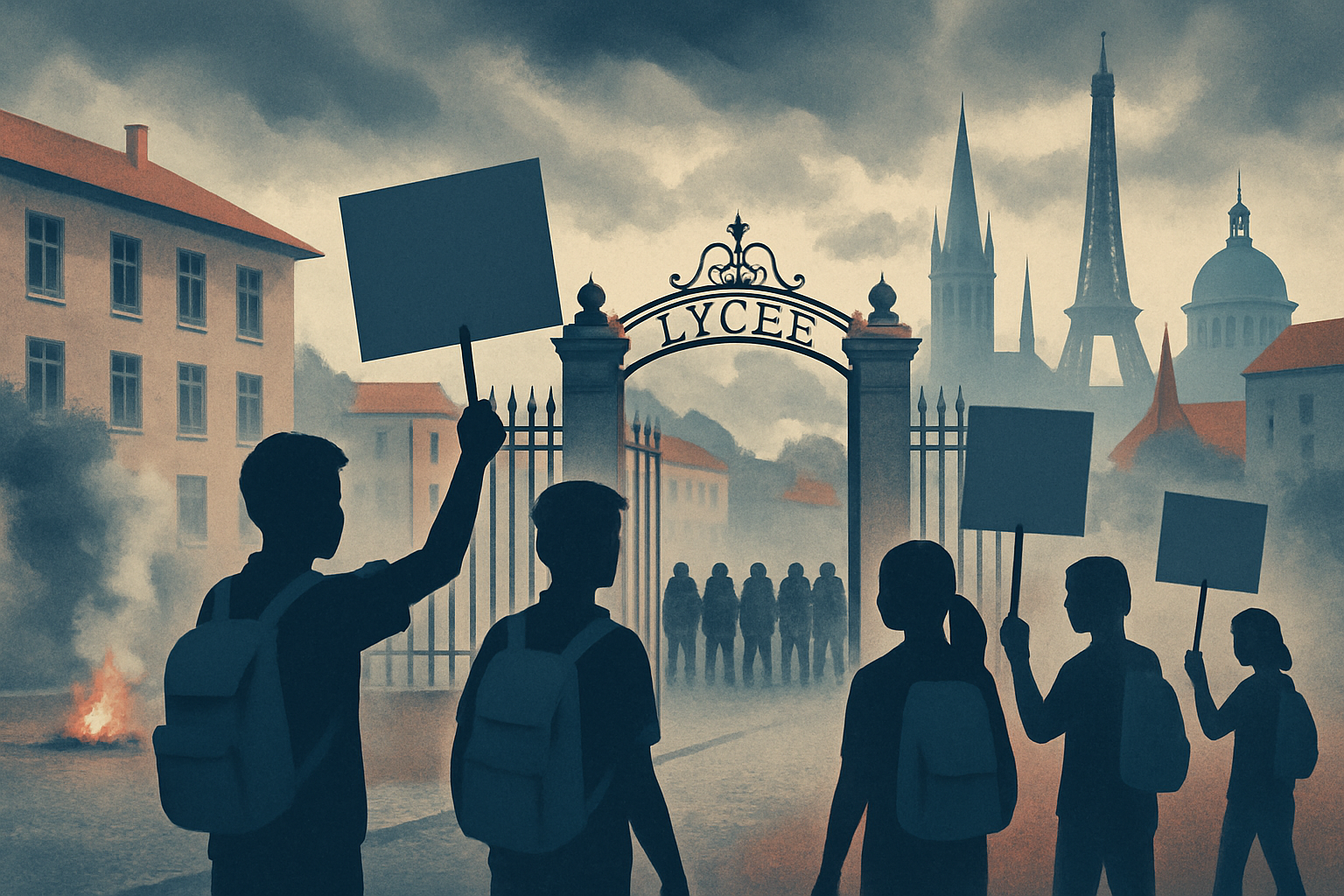
France’s high-school protest movement has entered a more dangerous phase, with demonstrations spreading to roughly one in four schools, clashes erupting in several cities and the government deploying riot police as it tries to regain control.
More than 1,000 high schools were affected by strikes, demonstrations or blockades by Thursday, October 1, according to figures attributed to the Education and Interior ministries. More than 200 schools were blocked, while about 400 were expected to remain closed on Friday, October 2. The movement has also begun reaching universities.
The unrest has included burning trash bins, damage to school entrances and confrontations with police. In Nantes, the entrance of the Nelson-Mandela high school was damaged by fire. Public transportation was temporarily suspended in several cities, including Strasbourg, Orléans, Nice, La Rochelle and Marseille, as authorities sought to limit the spread of violence.
The government says the protests have changed character. Prime Minister Sébastien Lecornu convened an emergency meeting, while Interior Minister Laurent Nuñez described the situation as no longer merely a legitimate student protest but a form of urban violence. Police operations on Thursday resulted in 1,949 arrests, according to figures reported from the Interior Ministry.
Those numbers capture the escalation—but not the reason the movement has spread so rapidly.
Students interviewed in different parts of the country have described classrooms packed beyond comfortable capacity, teacher vacancies, missing school nurses, damaged buildings and schedules they say leave them exhausted. Some have also complained about the national system used to apply for higher education, which has intensified anxiety over their futures.
In the Paris suburb of Sevran, students said their school had gone months without a French teacher. In other schools, teenagers said they were studying in programs they had not chosen and felt that the education system was failing to prepare them for work or further study. Those complaints help explain why the protests have appeared in both working-class suburbs and prestigious schools, and why some private Catholic institutions have joined symbolic actions.
That breadth complicates the government’s effort to portray the unrest as primarily the work of radical-left groups. Officials have accused political actors, including the La France Insoumise party and affiliated activists, of exploiting the mobilization. But reporting from protest sites has found a more mixed movement, with students raising similar concerns even where there is no clear party organization.
The distinction matters. A tougher police response may disperse barricades and prevent attacks on public buildings, but it cannot by itself resolve teacher shortages, overcrowding or deteriorating facilities. It may also deepen mistrust if students believe legitimate demonstrations are being treated as criminal disorder from the outset.
The government now faces a two-track test: restore safety around schools while demonstrating that it has heard the demands behind the protests. Education Minister Édouard Geffray was due to meet student and parent organizations on October 2. Student and university groups have called for another national day of action on Tuesday, October 6.
The next few days will show whether those talks can redirect the movement toward negotiation—or whether the cycle of blockades, arrests and clashes will widen. For France, the central issue is no longer simply whether schools can reopen. It is whether a generation that says it feels neglected will accept promises from a government that first answered its anger with riot police.
Sources & Further Reading
- Associated Press — High school protests in France prompt crisis meeting and arrests
- Associated Press — School protests in France are morphing into widespread unrest
- Le Monde — Facing worsening situation in high schools, French government sends riot police
- Le Monde — High school student protests spread across France as tensions escalate
- Deutsche Welle — France: 400 schools closed as student protests continue
- French Ministry of Education — La semaine de la démocratie scolairePrimary source
- French national police — Local information for Pyrénées-AtlantiquesPrimary source
StoryBreak
Independent digital news and reporting, updated throughout the day.
This article was researched and drafted with AI assistance and reviewed as part of StoryBreak's editorial process before publication. Read our editorial standards.