A Minimally Invasive Knee Procedure May Help Some Arthritis Patients Put Off Replacement Surgery
Genicular artery embolization is showing promise for reducing osteoarthritis pain for one to two years, but researchers have not yet proved that it prevents or meaningfully delays knee replacement.
By StoryBreak
Published September 22, 2026 at 11:35 PM
For people with painful knee osteoarthritis who are not ready for—or not yet candidates for—joint replacement, a catheter-based procedure is emerging as a possible middle step.
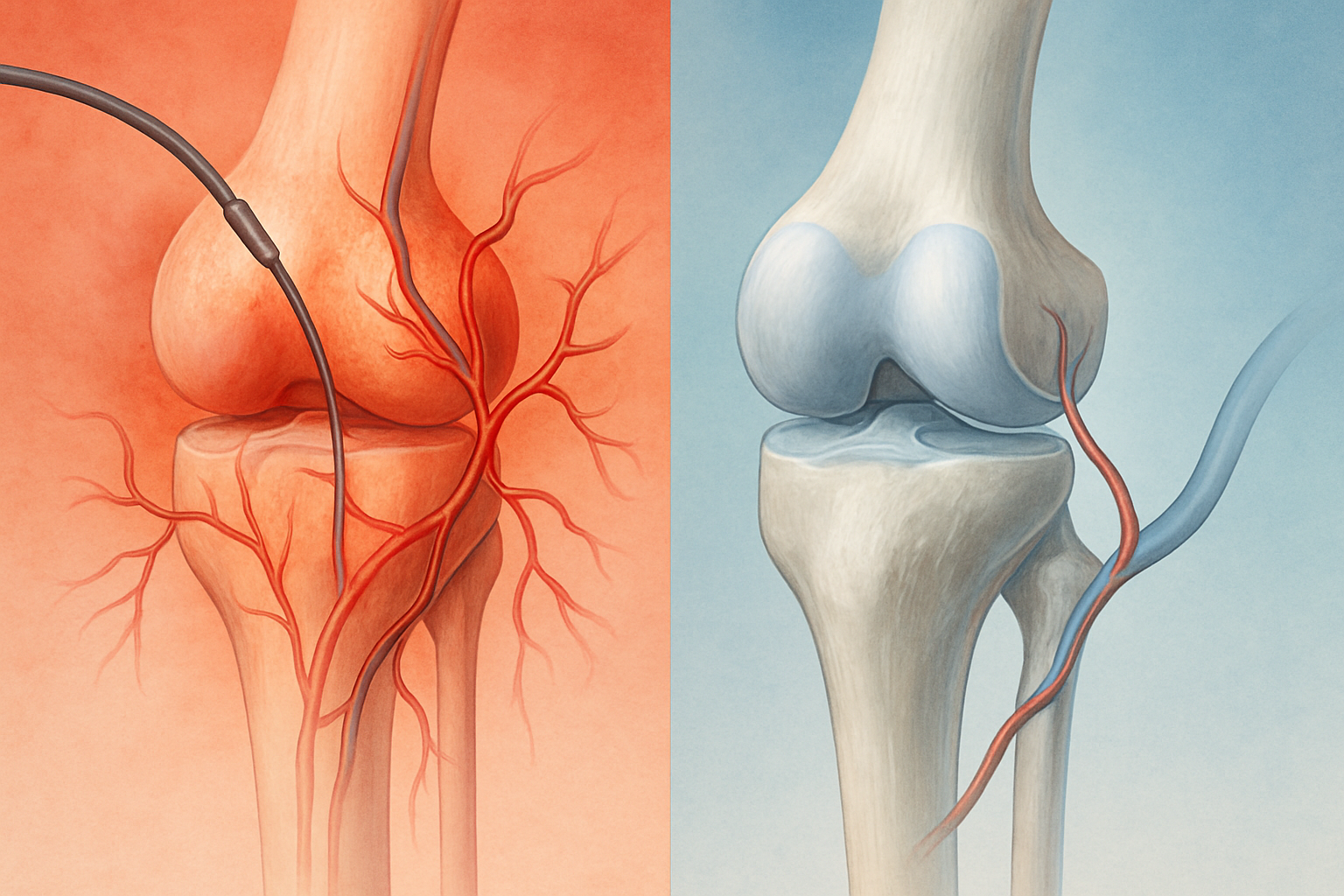
The treatment is called genicular artery embolization, or GAE. During the procedure, an interventional radiologist guides a small catheter into arteries supplying the knee and blocks abnormal blood vessels associated with inflamed tissue. The goal is not to rebuild cartilage. It is to reduce the blood flow linked to inflammation and pain.
A 2025 prospective study published in Radiology followed 194 people with knee osteoarthritis after GAE using rapidly resorbable gelatin-based microspheres. The study reported that the typical pain score fell from 7 to 3 on a 0-to-10 scale after 12 months, and 80% of participants achieved an improvement considered clinically meaningful. Reported adverse events were mild and self-limited.
Those findings add to earlier follow-up research. In a 40-person prospective trial, 47.4% of participants still had at least a 50% improvement in an osteoarthritis symptom score two years after treatment. Among patients who had initially responded at one year, 72% maintained that response at two years. Some patients did experience a return of symptoms.
That is encouraging—but it is not the same as proving that GAE postpones knee replacement.
Most studies have measured pain, mobility and quality of life rather than tracking whether patients ultimately underwent arthroplasty. And the randomized evidence remains unsettled. In a double-blind, sham-controlled trial of 58 people with mild-to-moderate knee osteoarthritis, both the treatment and sham groups improved, with no statistically significant difference in the main pain outcome after four months. Researchers concluded that more comparative studies were needed.
The distinction matters because knee replacement is not prescribed solely on the basis of an X-ray. Symptoms, daily function, physical examination, other medical conditions and a patient’s goals all influence the decision. The American College of Rheumatology and American Association of Hip and Knee Surgeons recommend shared decision-making when nonoperative treatments have failed and a patient is considering joint replacement. Their guidance does not establish GAE as an alternative to arthroplasty.
For an appropriate patient, the practical appeal of GAE is that it may provide relief without removing or replacing the joint. That could create time to remain active, improve overall health or simply defer a major operation. But relief may fade, and the procedure does not reverse the underlying cartilage loss of osteoarthritis.
Patients should also understand that GAE is still an evolving treatment. Studies differ in the type of embolic material used, the severity of arthritis treated and how success is defined. The procedure can also cause complications, even though recent studies have generally reported favorable short-term safety profiles.
The clearest takeaway is therefore modest: GAE may help some people manage knee arthritis for months or years, and that symptom relief could allow them to delay replacement surgery. Whether it actually changes the long-term need for a new knee remains an open research question.
Anyone considering the procedure should ask a treating specialist how severe the arthritis is, what evidence applies to that stage of disease, how long benefits typically last locally, what complications are possible and whether standard treatments or knee replacement would offer a more predictable outcome.
Sources & Further Reading
- Radiological Society of North America, RadiologyPrimary source
- Radiological Society of North America, RadiologyPrimary source
- Journal of Vascular and Interventional Radiology / PubMedPrimary source
- British Journal of General Practice / PubMedPrimary source
- American College of Rheumatology and American Association of Hip and Knee Surgeons / PubMedPrimary source
StoryBreak
Independent digital news and reporting, updated throughout the day.
This article was researched and drafted with AI assistance and reviewed as part of StoryBreak's editorial process before publication. Read our editorial standards.