
Iceland votes on whether to restart talks to join the European Union
Icelanders are voting in a closely watched referendum that could restart negotiations for the country to join the European Union, reopening a debate shaped by the cost of living, interest rates, fishing rights and national sovereignty.
By StoryBreak
Published August 29, 2026 at 7:53 PM
Updated September 7, 2026 at 12:06 AM
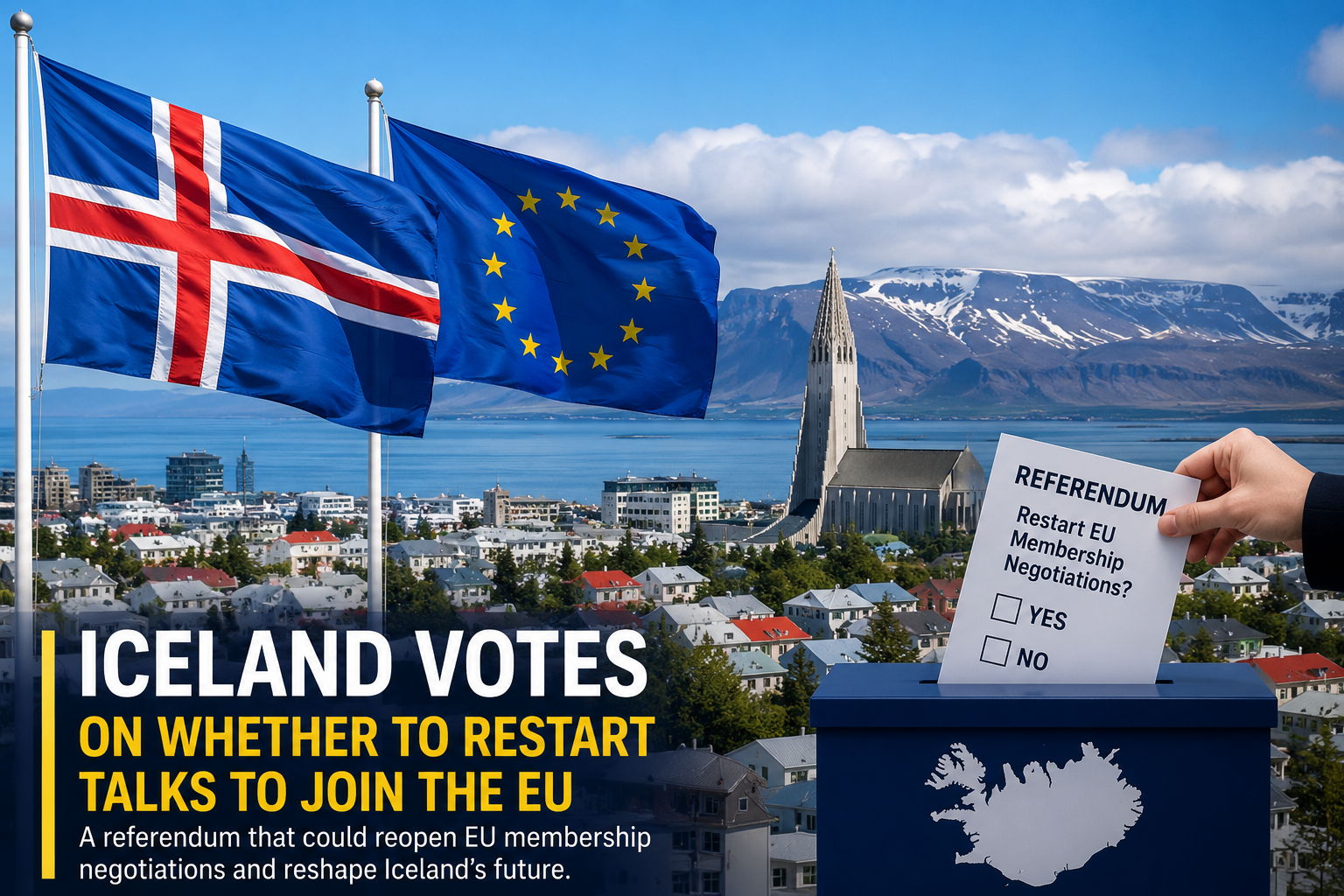
Icelanders headed to the polls Saturday to decide whether their country should reopen negotiations to join the European Union, putting a decades-old debate over Iceland's relationship with Europe back before voters.
The referendum does not ask Icelanders to approve EU membership. Instead, voters are deciding whether the government should resume accession negotiations with the 27-member bloc.
If the proposal passes, Iceland could begin negotiating the terms of possible membership with the EU. Icelanders would then have another opportunity to vote before the country could actually become a member.
That distinction has been an important part of the campaign: A "yes" vote Saturday would be a vote to negotiate, not a final decision to join.
A race too close to call
The contest entered Saturday extremely close.
A Gallup survey conducted in the days before the referendum found 51.6% opposed reopening negotiations and 48.4% in favor. Another recent poll had shown a similarly narrow advantage for supporters of renewed talks.
The competing polls underscored how divided Iceland remains over its future relationship with the European Union.
Among the biggest issues in the campaign are the cost of living, interest rates, control of Iceland's valuable fishing industry and concerns about how EU membership could affect the country's sovereignty.
Iceland has struggled with high interest rates, making mortgages and borrowing more expensive for households and businesses. Supporters of closer EU integration argue that membership could eventually provide greater economic stability and potentially open a path toward adopting the euro.
Opponents argue Iceland can address its economic challenges independently and question whether the benefits of EU membership would outweigh the loss of control over some national policies.
Fishing could be one of the biggest obstacles
Few issues are as important to the debate as fishing.
Iceland's fishing industry has long played an outsized role in the island nation's economy and identity. Opponents of EU membership worry that joining the bloc could weaken Iceland's ability to independently manage its fishing waters and quotas.
Supporters argue that Iceland could negotiate protections for its fishing interests as part of any future membership agreement.
Those negotiations would likely become one of the most closely watched parts of the accession process if voters approve restarting talks.
Iceland already has close ties to Europe
Despite not being an EU member, Iceland is already closely connected to Europe.
The country participates in the European Economic Area, giving it access to much of the EU's single market. Iceland is also part of the Schengen Area, allowing passport-free travel across participating European countries.
Those arrangements mean Iceland already follows a significant amount of EU legislation while remaining outside the institutions where member countries formally help make many of those rules.
Full membership would give Iceland representation in EU decision-making institutions but would also bring additional obligations.
Iceland has been here before
Iceland first applied for European Union membership in 2009 following the global financial crisis.
Formal accession negotiations began the following year, but the process was eventually put on hold after a change in government in 2013.
By that point, 27 negotiating chapters had been opened and 11 had been provisionally closed, according to the European Commission.
In 2015, Iceland's government formally asked the EU not to consider the country a candidate for membership.
More than a decade later, the question has returned.
Economic pressures and a changing international environment have helped renew the debate over whether Iceland should seek a larger role in European affairs.
Prime Minister Kristrún Frostadóttir's government backed giving Icelanders another opportunity to decide whether negotiations should resume.
What happens next?
Polling stations are scheduled to close at 10 p.m. GMT Saturday, with results expected during the early hours of Sunday.
If voters reject the proposal, Iceland's EU accession process would remain dormant.
If voters approve it, the government could reopen negotiations with Brussels. Iceland's foreign ministry has estimated talks could begin by the end of 2026 and potentially take 18 to 24 months.
Even then, Iceland would not automatically become an EU member.
Any agreement negotiated between Iceland and the European Union would have to return to Icelandic voters in another referendum before membership could move forward.
Saturday's vote therefore answers only the first question in what could become a much longer process: whether Iceland wants to find out what an EU membership agreement would actually look like.
Update: Icelanders rejected the proposal to reopen EU accession talks, with 52.8% voting no and 47.2% voting yes on a turnout of about 82.5% of eligible voters, according to official results. Prime Minister Frostadóttir's government had described the vote as a "now or never" moment; with its rejection, Iceland's EU membership question is set aside for the foreseeable future.
StoryBreak
Independent digital news and reporting, updated throughout the day.
This article was researched and drafted with AI assistance and reviewed as part of StoryBreak's editorial process before publication. Read our editorial standards.