James Webb telescope finds ice older than the star it orbits
NASA’s James Webb Space Telescope detected water and carbon dioxide ice in the debris disk around Beta Pictoris. The ice likely formed in cold interstellar conditions before the roughly 20-million-year-old star and its planetary system developed.
By StoryBreak
Published November 14, 2026 at 12:01 PM EST
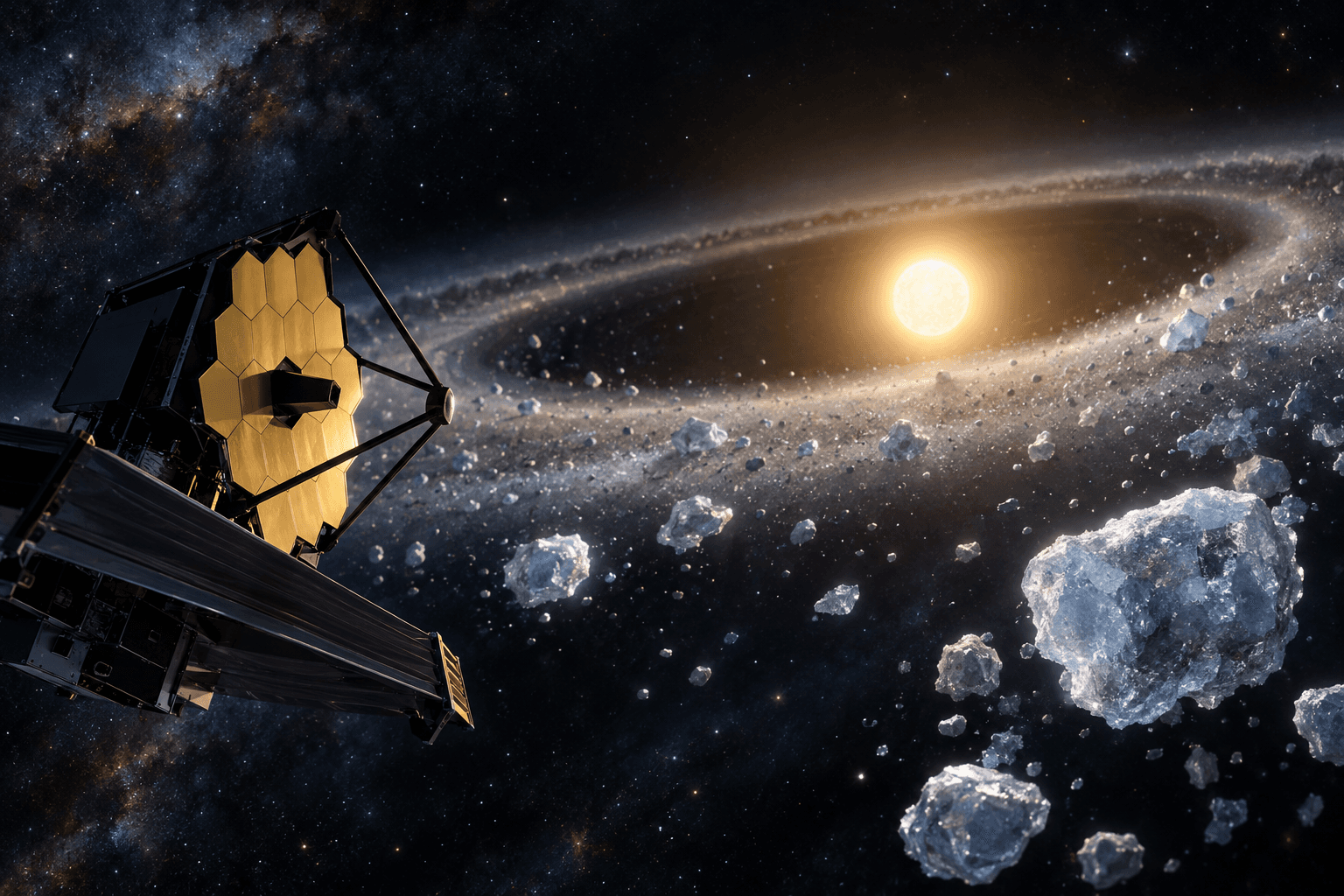
The James Webb Space Telescope has detected water and carbon dioxide ice in the debris disk surrounding Beta Pictoris, a star about 20 million years old and roughly 64 light-years from Earth.
The observations were made with Webb’s Near-Infrared Spectrograph, or NIRSpec, on December 7, 2023. The instrument recorded light from 0.6 to 5.2 micrometers and examined two regions of the disk located about 100 astronomical units from the star.
Analysis of the spectrum identified amorphous water ice, with less than 7 percent crystallinity. It also found carbon dioxide ice in both carbon-12 and carbon-13 forms. The carbon dioxide is mixed with water ice at an approximate ratio of one part carbon dioxide to 10 parts water.
The carbon dioxide signatures indicate that the molecules are trapped within the water ice. The ice’s amorphous structure is consistent with formation in the cold interstellar medium before Beta Pictoris formed, meaning the material may predate the star it now orbits.
The data also point to a dynamic debris disk. Frequent collisions among bodies in the disk are required to explain why the icy dust is distributed uniformly across the observed regions.
The observations offer a view of material carried from interstellar space into a developing planetary system. The supplied research does not establish an exact formation date for the ice, but it links the material’s composition and structure to conditions that existed before Beta Pictoris formed.
Sources & Further Reading
- DryadPrimary source
- Ars Technica
StoryBreak
Independent digital news and reporting, updated throughout the day.
This article was researched and drafted with AI assistance and reviewed as part of StoryBreak's editorial process before publication. Read our editorial standards.