Scientists Find a New Clue That Could Unlock More 2,000-Year-Old Herculaneum Scrolls
A new study suggests that lead hidden in ancient writing ink could make carbonized scrolls much easier to read with X-rays—offering researchers a way to identify the most promising artifacts without opening them.
By StoryBreak
Published September 17, 2026 at 1:16 AM
A small amount of metal may help researchers decide which of the world’s most fragile ancient books are worth scanning first.
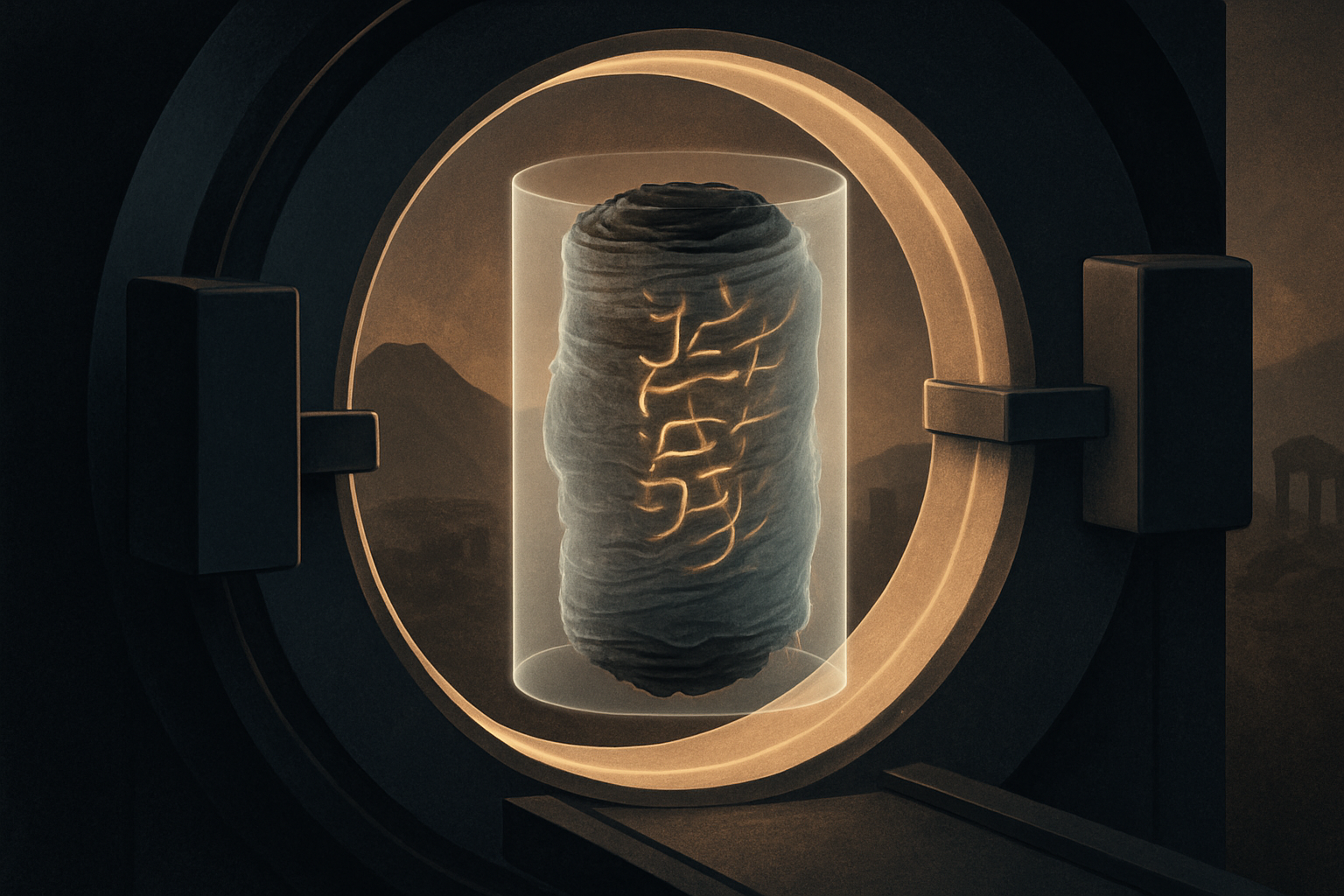
In a study published September 16, scientists report that lead-containing ink can stand out dramatically from the carbonized papyrus of scrolls destroyed by the eruption of Mount Vesuvius nearly 2,000 years ago. The finding could give researchers a new way to search the unopened Herculaneum scrolls for writing without physically unrolling them.
The Herculaneum collection was buried when Vesuvius erupted in 79 C.E. The heat turned the papyrus into brittle, charcoal-like cylinders. Attempts to open many of the scrolls have produced little more than ash, leaving their contents trapped inside.
Modern X-ray scanning has offered a safer alternative. Researchers can create three-dimensional images of a scroll, reconstruct its layers and flatten them digitally—a process known as virtual unrolling. But the technique faces a basic problem: both the papyrus and much of the ink are carbon-based, so the writing can be difficult to distinguish from the material around it.
The new study focuses on an exception. Some ancient inks appear to contain lead or other metals. Because lead absorbs X-rays much more strongly than carbonized papyrus, it can create a sharper signal in a scan.
To test the idea, researchers made a modern papyrus scroll and wrote on it with ink containing carefully measured amounts of lead. They then carbonized the scroll under low-oxygen, high-temperature conditions designed to mimic the damage caused at Herculaneum. X-ray CT scans revealed the lead-based letters as bright features against the darker carbonized material. The team reported that concentrations as low as 25 micrograms per square centimeter could be detected.
The researchers also found that a relatively inexpensive handheld X-ray fluorescence scanner could identify lead in the ink. That matters because it suggests a possible two-step workflow: first screen scrolls for metal-containing ink, then send the most promising candidates through more demanding high-resolution scans and digital-unrolling software.
The discovery is promising—but it is not yet a newly decoded ancient book. The experiment was performed on a modern replica, not on an unopened Herculaneum scroll. Scientists still need to determine how widespread leaded ink is in the collection and whether the metal remains sufficiently concentrated and evenly distributed after nearly two millennia of heat and chemical change.
That uncertainty is important because the Herculaneum project has already produced major results using other methods. Researchers recently reported the complete virtual unrolling and extended reading of one scroll, PHerc. 1667. Work on another scroll, PHerc. 139, identified evidence for a previously unrecognized eighth book of the Epicurean philosopher Philodemus’ work *On Gods*.
The new lead-detection study could make such discoveries less dependent on trial and error. More than 600 Herculaneum scrolls remain unopened, according to the University of Kentucky’s EduceLab and the Vesuvius Challenge. Instead of treating every scroll as equally difficult, researchers may be able to sort the collection by the strength of the physical clues hidden in its ink.
The larger significance is not that scientists have found a shortcut to every lost work of antiquity. It is that chemistry may help guide the next stage of a project once dominated by imaging and artificial intelligence. If leaded ink turns out to be common enough, a material trace invisible to the naked eye could become a map to the library’s most readable—and possibly most historically important—secrets.
Sources & Further Reading
StoryBreak
Independent digital news and reporting, updated throughout the day.
This article was researched and drafted with AI assistance and reviewed as part of StoryBreak's editorial process before publication. Read our editorial standards.