
Mercury May Have Shrunk 14 Miles—But the Real Surprise Is What Scientists Couldn’t See
A new study suggests Mercury’s total diameter may have decreased by up to 14.5 miles over its geological history—roughly 30% more than earlier estimates. The result could reshape scientists’ understanding of how the planet cooled and evolved.
By StoryBreak
Published September 11, 2026 at 5:33 PM
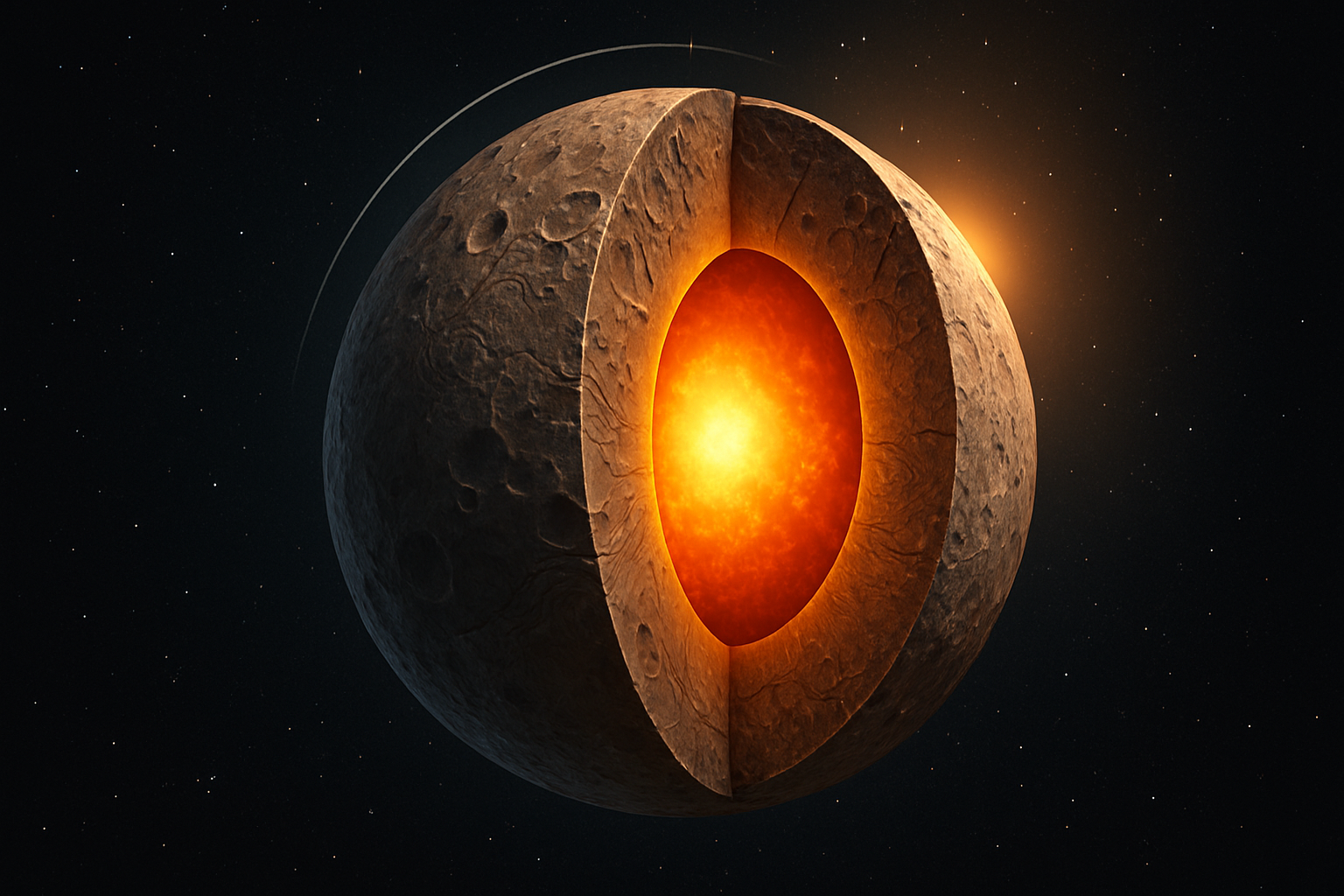
Mercury may have become up to 14.5 miles (23 kilometers) smaller since its formation, according to a new study—but the planet did not suddenly lose that distance, and scientists did not measure the change directly.
Instead, researchers reconstructed Mercury’s geological history from the wrinkles in its surface: scarps, ridges and other structures formed as the planet’s interior cooled and contracted. Their analysis suggests that earlier estimates missed some of those features because they are buried beneath debris from billions of years of asteroid impacts.
The study, published September 10 in Geophysical Research Letters, estimates that Mercury may have contracted 10% to 30% more than previously thought. Earlier estimates placed the planet’s total diameter change at roughly 2.5 to 10 miles (4 to 16 kilometers). The new upper estimate is about 14.5 miles.
That distinction matters. Mercury is only about 3,000 miles (4,900 kilometers) across, making even a few miles of contraction significant when scientists use the planet’s surface to infer what is happening deep inside it. The amount of shrinkage provides clues about how quickly Mercury cooled, how much heat it retained and how its oversized metal core formed.
The process is broadly familiar from planetary physics. Mercury formed roughly 4.5 billion years ago in a violently hot environment shaped by collisions between rocks and asteroids. As its interior gradually lost heat, it contracted. The planet’s rigid outer shell responded by crumpling and breaking, producing the long, cliff-like scarps and ridges that cross its surface.
But those geological clues are not distributed evenly. New impacts excavated craters and spread rough blankets of debris across the landscape. The researchers compared maps of surface roughness with maps of known contraction features and found that rougher regions contained fewer visible scarps and ridges.
That does not necessarily mean those parts of Mercury experienced less contraction. It may mean the evidence was harder to find. The team used relatively undisturbed areas, where contractional structures are easier to identify, to estimate how many features may be hidden in rough terrain. Their calculation produced the larger lifetime estimate.
The result also helps address a long-running tension in Mercury science. Earlier spacecraft observations suggested less contraction than some thermal models predicted. A 2014 study using NASA’s MESSENGER data estimated that Mercury may have contracted radially by as much as 7 kilometers, substantially more than earlier geological estimates but still dependent on which landforms were counted. The new work argues that surface visibility itself may be part of the problem.
Scientists caution that the revised number is still an estimate, not a final measurement. MESSENGER, which ended its mission in 2015, could reliably identify only relatively large surface features—about 3 miles (5 kilometers) across, according to the study’s research team. Smaller structures may have escaped detection.
The next test will come from BepiColombo, the European-Japanese mission now approaching Mercury. The spacecraft is expected to begin collecting higher-resolution observations in November 2026. Those measurements should allow researchers to search for smaller scarps, ridges and impact features and determine whether Mercury’s geological record contains still more evidence of contraction.
So the headline version is true only with an important qualification: Mercury may have lost up to 14 miles of diameter, but over billions of years—not recently. The immediate scientific development is that researchers have found a plausible reason previous estimates came up short, turning a seemingly finished measurement into an open question about the smallest rocky planet’s interior.
Sources & Further Reading
- American Geophysical Union NewsroomPrimary source
- Geophysical Research LettersPrimary source
- Nature GeosciencePrimary source
- Associated Press
StoryBreak
Independent digital news and reporting, updated throughout the day.
This article was researched and drafted with AI assistance and reviewed as part of StoryBreak's editorial process before publication. Read our editorial standards.