
NASA Finds 84 ‘Hypersoft’ X-Ray Sources That Could Illuminate Two Cosmic Mysteries
A Chandra archive search has uncovered 84 unusually cool but powerful X-ray sources in six galaxies. The objects may reveal hidden binary systems, possible precursors to Type Ia supernovae and a missing source of ultraviolet radiation that helps ionize galactic gas.
By StoryBreak
Published September 12, 2026 at 10:07 PM
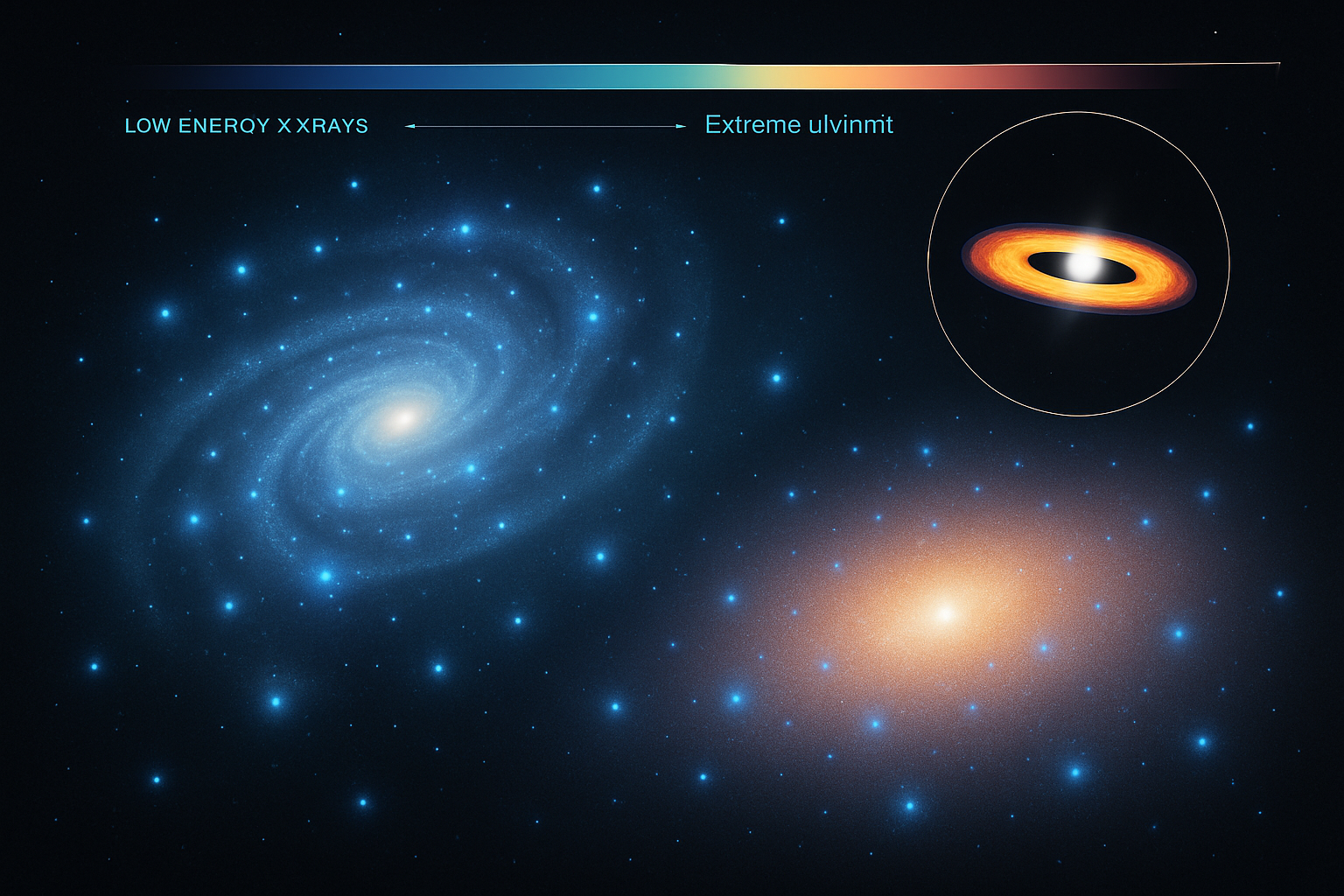
Astronomers have identified 84 unusual cosmic sources that seem to be powerful enough to rank among the brightest objects in their galaxies—yet they escaped detection in earlier surveys because they shine in an awkward part of the spectrum.
The objects, called hypersoft X-ray sources, were found by mining archival observations from NASA’s Chandra X-ray Observatory. The researchers searched six nearby galaxies, including Andromeda and the Pinwheel Galaxy, for points that appeared in Chandra’s lowest-energy X-ray images but disappeared at higher energies. Their findings were published September 9, 2026, in Nature Astronomy.
What makes the sources strange is not that they emit X-rays, but how soft those X-rays are. Most familiar X-ray binaries produce substantial radiation above 0.3 kiloelectronvolts. These newly cataloged sources emit primarily below that threshold, with little or no signal at higher energies. Their spectra suggest that much of their energy may actually be released as extreme-ultraviolet radiation, a band of light that is notoriously difficult to observe.
That creates a cosmic blind spot. Hydrogen and helium between the stars can absorb extreme-ultraviolet photons before they reach a telescope. Chandra also has limited sensitivity at the lowest end of its X-ray range. Together, those effects can make an intrinsically brilliant object look faint, unusual or invisible.
The researchers do not yet know exactly what the 84 sources are. Their leading explanation is that they are a mixed population of X-ray binaries: systems in which a compact object—such as a white dwarf, neutron star or black hole—pulls material from a companion star. As that material falls inward, it heats up and radiates.
But the newly identified sources do not behave like previously recognized examples of those systems. Some may be white dwarfs accumulating matter from companion stars. Such systems are of particular interest because at least some white-dwarf binaries are thought to precede Type Ia supernovae, explosions used by astronomers to measure the expansion history of the universe.
Type Ia supernovae are valuable cosmic distance markers, but scientists still do not have a complete explanation for which systems produce them. Astronomers usually study the progenitors after the explosion has occurred. If hypersoft sources include systems approaching that final stage, they could offer a way to observe the process before detonation—although the new study does not establish that any individual source will become a supernova.
The sources may also help address a separate question: what strips electrons from gas between stars in some galaxies? Ionized gas affects how galaxies form stars and how their interstellar material evolves. Massive, hot stars are known contributors, but they do not fully account for the observed ionization in every environment. A previously hidden population of extreme-ultraviolet emitters could provide part of the missing radiation.
That possibility is still a hypothesis, not a settled conclusion. The 84 objects were identified in only six galaxies, and their extreme-ultraviolet output is inferred largely through models because that radiation is difficult to measure directly. The sample may also be incomplete: sources in more distant galaxies, or those located behind thicker absorbing material, could remain undetected.
The immediate scientific payoff is therefore a new target list. Follow-up observations can look for optical companion stars, changes in brightness and signs of accretion. Those clues may reveal whether the catalog contains several kinds of binary systems rather than one new type of object.
The broader lesson is that the universe can hide its most energetic sources in plain sight—not because they are too faint, but because their strongest light occupies a wavelength range that telescopes and interstellar gas both make difficult to see.
Sources & Further Reading
- NASA SciencePrimary source
- Nature AstronomyPrimary source
- Chandra X-ray CenterPrimary source
- Space.com
StoryBreak
Independent digital news and reporting, updated throughout the day.
This article was researched and drafted with AI assistance and reviewed as part of StoryBreak's editorial process before publication. Read our editorial standards.