NASA Completes Ground Tests of ‘Two-in-One’ Propulsion System for Small Satellites
A NASA-led CubeSat is preparing to test whether one tank of non-toxic propellant can power both a high-thrust chemical engine and an efficient electric thruster, potentially saving mass and space on future small spacecraft.
By StoryBreak
Published September 26, 2026 at 9:02 PM
NASA engineers have completed a crucial round of ground testing on a small satellite built to use one propulsion system for two very different jobs: rapid maneuvers and fuel-efficient, long-duration orbit changes.
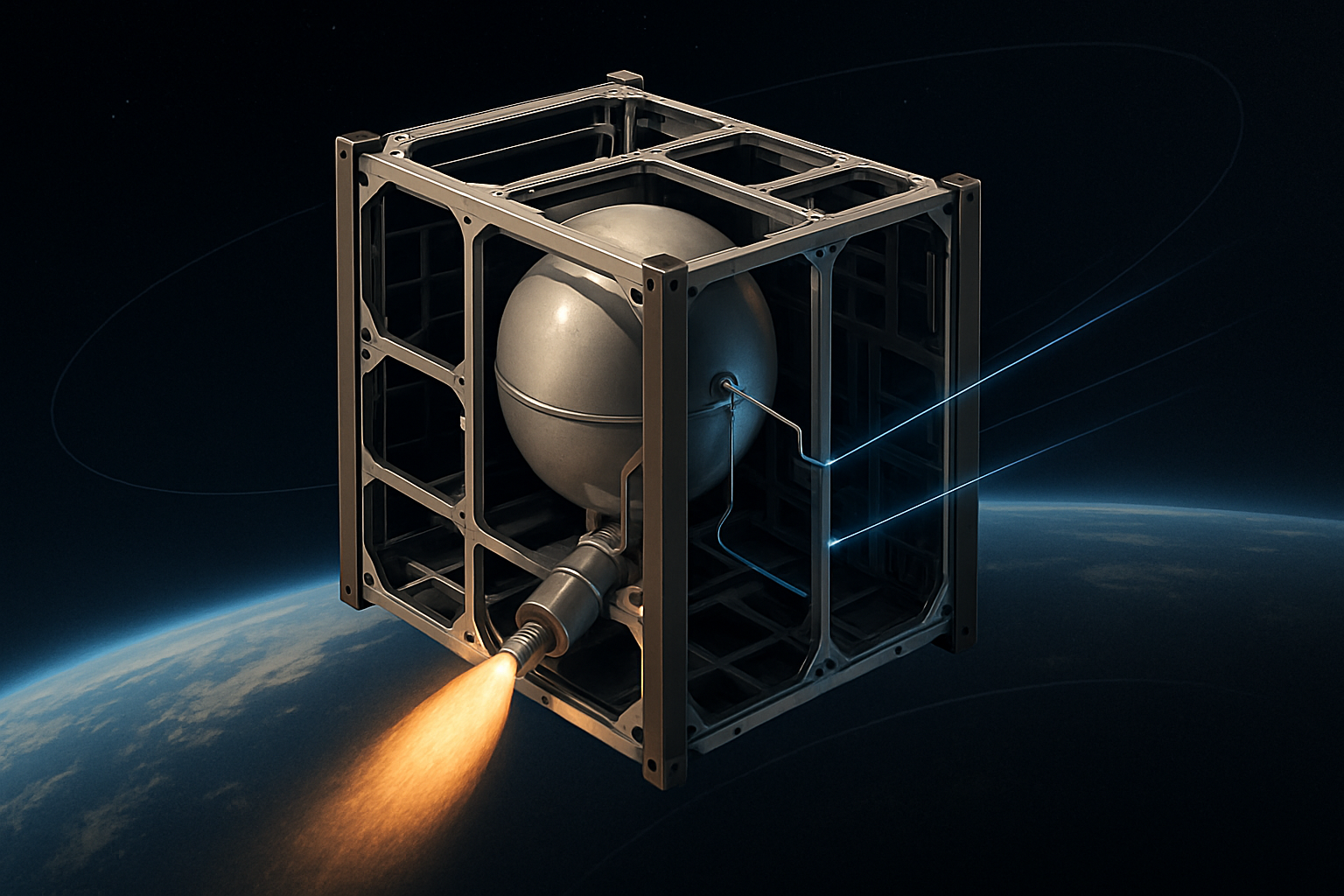
The ASCENT Propulsion Dual Mode mission is a 6U CubeSat—roughly the size of a large shoebox—that uses a single tank of ASCENT, a non-toxic propellant. The tank will feed both a high-thrust combustion engine and low-thrust electrospray thrusters.
That arrangement addresses a basic problem in small-spacecraft design. Chemical propulsion can deliver the stronger push needed for quick changes, while electric propulsion is better suited to gradual adjustments that conserve propellant. Traditionally, a spacecraft needing both capabilities may require separate systems, tanks and plumbing. Those components consume mass and internal volume that could otherwise support instruments, batteries or communications equipment.
NASA’s Marshall Space Flight Center recently subjected the flight hardware to leak checks, thermal-vacuum testing and a spin test. The leak test used pressurized helium inside a vacuum chamber to check the integrity of seals and fuel lines. Thermal-vacuum testing exposed the spacecraft to conditions that mimic the vacuum and temperature extremes of orbit. The spin test measured the satellite’s balance and center of gravity, information needed to control its orientation in space.
Those tests are important, but they do not yet prove the central idea in flight. The spacecraft has demonstrated that its hardware can pass key prelaunch checks; it has not yet shown that both propulsion modes can operate together in orbit over an extended mission.
NASA says the spacecraft is scheduled to launch no earlier than October 1, 2026, as a payload on a SpaceX Falcon 9 rocket from Vandenberg Space Force Base in California. Once deployed about 325 miles above Earth, it is expected to spend nine months conducting increasingly demanding tests. After an initial checkout, operators plan to command short chemical and electric maneuvers, followed by repeated orbit-raising and orbit-lowering operations that alternate between the two propulsion modes.
The technology is not simply about making a smaller engine. Its potential advantage is architectural: one propellant supply, shared across two types of thrusters, could reduce the amount of hardware a spacecraft must carry. In theory, that could make room for more scientific equipment or allow some missions to use smaller and potentially less expensive launch vehicles.
The ASCENT demonstration also builds on earlier work showing that compact spacecraft can use unconventional propulsion. NASA’s DUPLEX CubeSat began an in-space test in December 2025 with two polymer-based micropropulsion systems. The new mission is testing a different proposition—whether a single non-toxic propellant can support both chemical and electric propulsion.
If the orbital experiment succeeds, the immediate result will be a validated technology demonstration, not an instant replacement for every satellite propulsion system. Engineers will still need to assess thrust, reliability, power requirements and long-term wear. But success would give small spacecraft designers a new way to balance speed and efficiency without carrying two entirely separate fuel systems.
That is the real milestone to watch after launch: not whether the satellite can fire either engine once, but whether both can repeatedly perform their different jobs from the same compact spacecraft.
Sources & Further Reading
- NASAPrimary source
- NASA Ames Research CenterPrimary source
- Space.com
StoryBreak
Independent digital news and reporting, updated throughout the day.
This article was researched and drafted with AI assistance and reviewed as part of StoryBreak's editorial process before publication. Read our editorial standards.