NASA Finds a Massive Lunar Crater That Sat Unnoticed for More Than a Year
A NASA lunar orbiter has revealed a 222-meter crater formed by an impact in spring 2024. The delayed discovery is giving scientists a rare look at how a large collision reshapes the Moon—and what that could mean for future lunar bases.
By StoryBreak
Published September 19, 2026 at 11:22 PM
A crater roughly twice the length of an American football field has been sitting on the Moon since spring 2024, hidden in plain sight in NASA’s growing archive of lunar images.
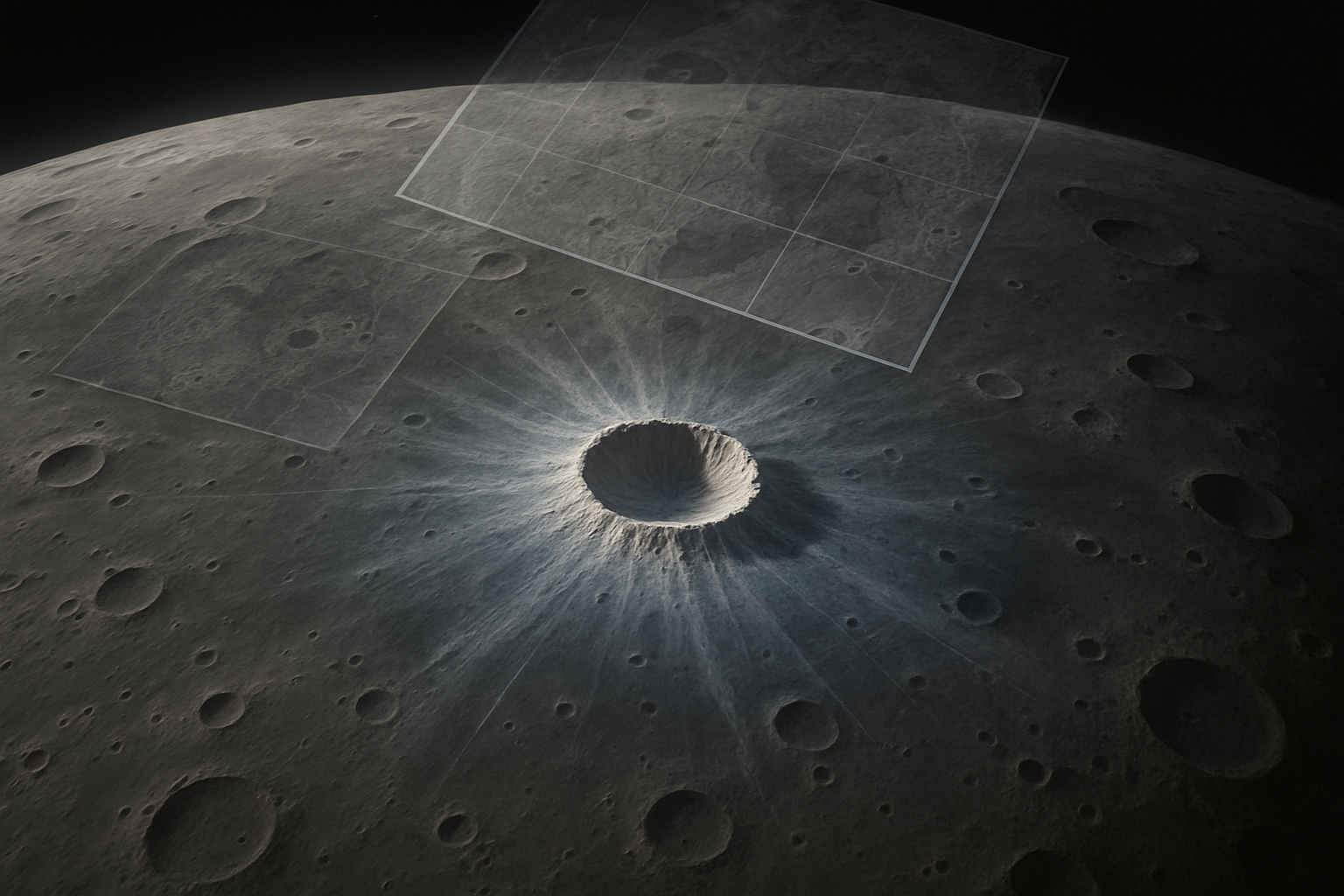
The feature, now named McGetchin crater, is about 222 meters wide and up to 43 meters deep. NASA’s Lunar Reconnaissance Orbiter, or LRO, captured images of the area after an asteroid or comet fragment struck the Moon’s near side between April 11 and May 22, 2024. But the impact was not detected in real time. Scientists found the crater only after comparing wide-angle images collected over several years.
The discovery was made on October 24, 2025, when Robert Wagner, an image-processing specialist working with LRO’s camera system, noticed an unusually bright disturbance surrounded by a darker halo. The pattern suggested that fresh material had been thrown across the surface. Sharper images later confirmed a steep-sided crater and a broad blanket of ejecta—rock and dust blasted outward by the impact.
NASA and researchers at the Lunar and Planetary Institute describe McGetchin as the largest newly formed impact crater identified during LRO’s mission. Scientists estimate that an event of this scale happens on the Moon only about once every 130 years, making it an unusually valuable natural experiment.
The important point is not simply that the Moon was hit. Lunar impacts happen constantly. With no atmosphere to burn up incoming objects, even relatively small rocks can reach the ground. NASA estimates that impacts capable of creating craters around 30 feet wide occur roughly 140 times each year across the Moon, while many smaller collisions are too subtle to distinguish in orbital images.
McGetchin stands out because its size and freshness allow scientists to examine the aftermath before the lunar environment has had much time to erase or redistribute the evidence. The impact threw debris more than 100 kilometers across the surface, according to researchers cited by The Associated Press.
A second LRO instrument found another effect that is not obvious from a photograph. The Diviner thermal instrument detected a cold region extending about four miles around the crater. Scientists attribute that temperature difference to regolith—the Moon’s loose upper layer of dust and broken rock—being churned and “fluffed up” by the collision. Less-dense material does not retain heat as efficiently overnight.
That finding gives the crater a practical significance for the next era of lunar exploration. Future landers, rovers, power systems and habitats will operate on a surface continually modified by impacts. The danger is not that a crater like McGetchin will suddenly appear beside a base; the event is extraordinarily rare. The concern is that ejecta from a distant impact could travel farther than expected, while disturbed soil could alter how vehicles move or how structures are anchored.
The discovery also illustrates a less dramatic but increasingly important feature of planetary science: the value of old data. LRO has been mapping the Moon since 2009, and its archive makes it possible to reconstruct changes that no telescope happened to witness. In this case, the impact was already over. The breakthrough came from treating years of orbital imagery as a time-lapse record.
McGetchin is therefore more than a new hole in the lunar surface. It is a reminder that the Moon is not static, that important discoveries can be hiding inside routine observations, and that future lunar planners will need to understand both the ground beneath a habitat and the debris moving above it.
Sources & Further Reading
- NASA SciencePrimary source
- Lunar and Planetary InstitutePrimary source
- Associated Press
StoryBreak
Independent digital news and reporting, updated throughout the day.
This article was researched and drafted with AI assistance and reviewed as part of StoryBreak's editorial process before publication. Read our editorial standards.