NASA’s powerful new Roman Space Telescope is ready to launch — and could transform how we see the universe
NASA's Nancy Grace Roman Space Telescope is set to launch Sunday morning on a mission to investigate dark energy, map billions of cosmic objects and search for planets beyond our solar system with a field of view dramatically larger than Hubble's.
By StoryBreak
Published August 29, 2026 at 10:49 PM
Updated September 7, 2026 at 12:04 AM
NASA is preparing to send one of its most ambitious space observatories into the cosmos.
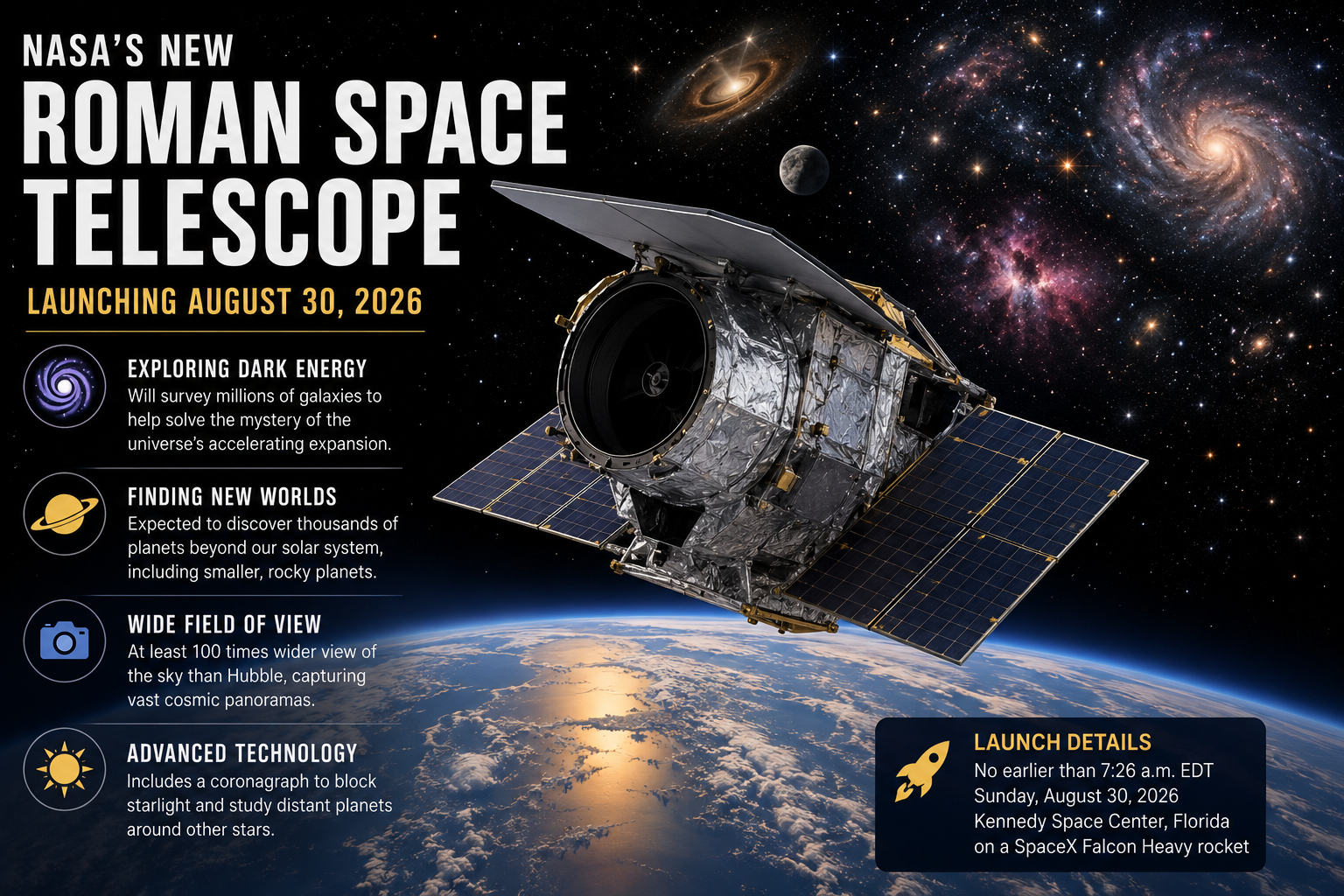
The Nancy Grace Roman Space Telescope is scheduled to lift off no earlier than 7:26 a.m. EDT Sunday, Aug. 30, aboard a SpaceX Falcon Heavy rocket from Launch Complex 39A at Kennedy Space Center in Florida.
NASA announced Friday that Roman was officially “go” for launch following a launch readiness review. On Saturday, the Falcon Heavy carrying the telescope rolled out to the launch pad.
If all goes according to plan, Roman will begin a mission designed to tackle some of astronomy's biggest unanswered questions — including what is causing the universe's expansion to accelerate and how common planets like those in our own solar system may be.
A Hubble-like view on a much bigger scale
Roman's primary mirror measures 2.4 meters across, the same diameter as Hubble's primary mirror.
But Roman is designed to see a much larger portion of the sky at once.
NASA says Roman's field of view will be at least 100 times larger than Hubble's, while maintaining similar sensitivity and infrared resolution. That could allow Roman to survey portions of the universe as much as 1,000 times faster than Hubble.
Instead of focusing primarily on individual cosmic targets, Roman will be capable of creating enormous, detailed surveys containing millions of stars and galaxies.
Its Wide Field Instrument contains a 300-megapixel camera, allowing scientists to capture extraordinarily large images of the cosmos.
The result could give astronomers something they've never had before: Hubble-like detail combined with an enormous panoramic view.
Hunting for dark energy
One of Roman's biggest missions involves something scientists still don't fully understand: dark energy.
Astronomers have discovered that the expansion of the universe is accelerating rather than slowing down.
Dark energy is the name scientists have given to the mysterious phenomenon believed to be driving much of that acceleration, but exactly what it is remains unknown.
Roman will examine hundreds of millions of galaxies and measure how matter is distributed across enormous distances.
Scientists will also study exploding stars known as supernovae, galaxy clusters and the three-dimensional distribution of galaxies to reconstruct how the universe has expanded over billions of years.
Those measurements could help scientists determine whether dark energy behaves as current theories predict — or whether our understanding of gravity itself may need to change.
Thousands of new planets could be waiting
Roman isn't only looking at distant galaxies.
It's also going planet hunting.
NASA expects Roman's microlensing survey to monitor approximately 100 million stars and discover around 2,500 planets beyond our solar system.
The technique takes advantage of gravity.
When one star passes almost perfectly in front of another from our perspective, its gravity bends and magnifies the background star's light. A planet orbiting the foreground star can produce an additional telltale change in that light.
Roman's instruments will be sensitive enough to detect planets smaller than Mars and planets orbiting at distances ranging from closer than Venus is to our Sun to farther away than Pluto.
That could give astronomers a much better picture of what typical planetary systems throughout the Milky Way actually look like.
Roman will try something else, too
The observatory carries another instrument with potentially enormous implications for future space telescopes.
Roman's Coronagraph Instrument is a technology demonstration designed to block the brilliant light coming from a star so astronomers can observe much fainter objects around it.
That includes planets.
Directly photographing an exoplanet is extremely difficult because a planet can be billions of times dimmer than the star beside it.
Roman's coronagraph will demonstrate technologies that could eventually be incorporated into future missions designed to directly study worlds more similar to Earth.
A telescope built for discoveries scientists haven't predicted
Some of Roman's most important discoveries may be things scientists aren't specifically searching for.
Hubble provided a similar lesson.
New astronomical instruments have repeatedly revealed objects and phenomena that researchers didn't know existed when the observatories were designed.
Roman's enormous field of view means scientists will be able to repeatedly survey huge portions of the universe while maintaining extraordinary detail.
NASA expects Roman to examine billions of cosmic objects, ranging from planets and stars to galaxies and black holes.
The observatory's data will also be made publicly available after processing, allowing scientists around the world to investigate discoveries made during its surveys.
For now, however, years of engineering and preparation have come down to a rocket sitting on a launch pad in Florida.
If Roman successfully begins its journey Sunday morning, astronomers will soon have an entirely new way to look at the universe — not just farther into space, but across vastly larger portions of it at once.
Sources & Further Reading
StoryBreak
Independent digital news and reporting, updated throughout the day.
This article was researched and drafted with AI assistance and reviewed as part of StoryBreak's editorial process before publication. Read our editorial standards.