Scientists Find a Sea Spider With Red Eyes, Hairy Legs and Three Lips
A University of British Columbia-led study has identified two sea spider species new to science in the Salish Sea. One has red eyes, curved leg spines and a three-lipped mouth, while the other appears to host parasites of its own.
By StoryBreak
Published September 27, 2026 at 4:36 PM
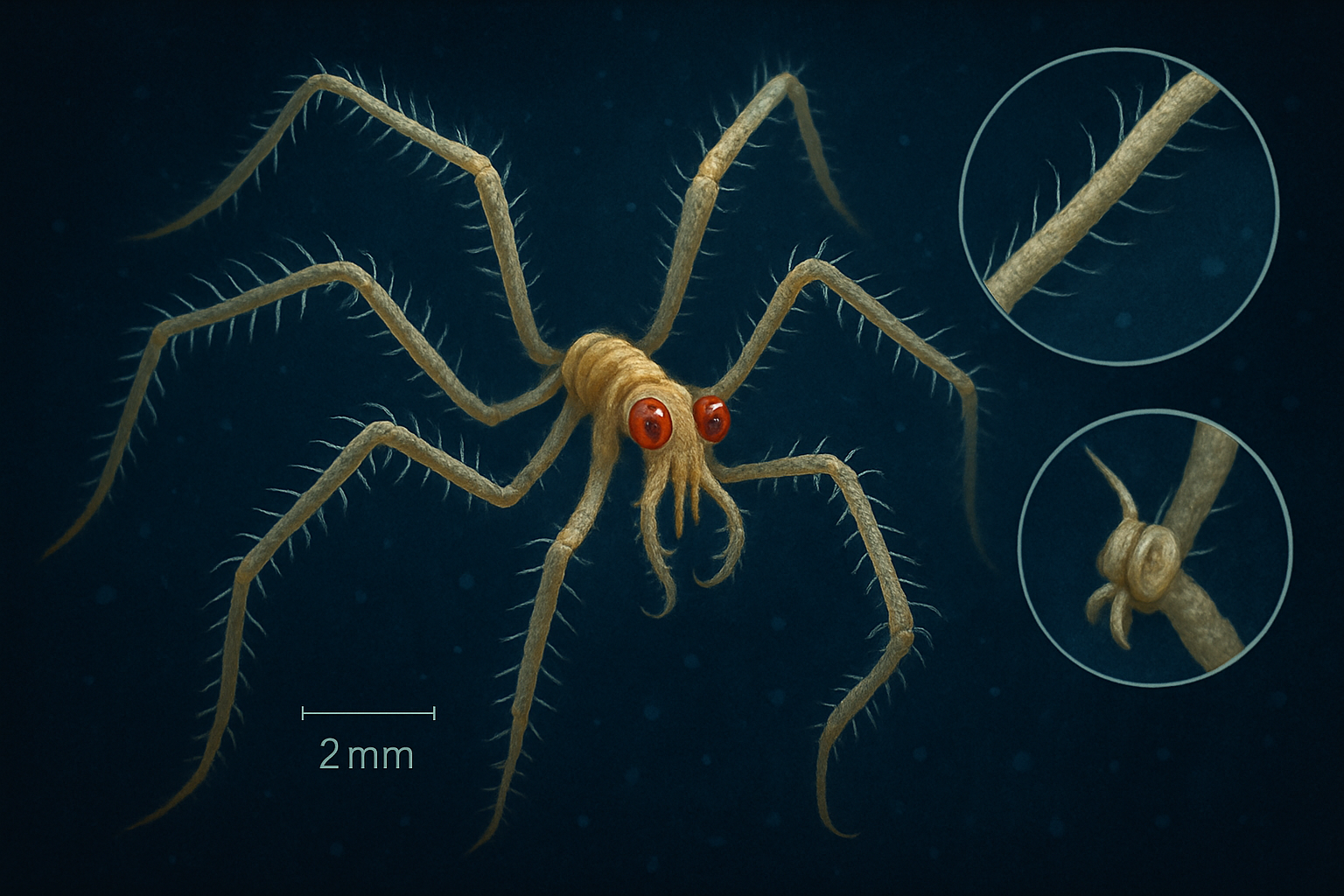
A tiny marine animal with red eyes, spiny “hairy” legs and a three-lipped mouth is one of two sea spider species newly identified in the Salish Sea by researchers at the University of British Columbia.
The species, Callipallene pilosuspedes, gets its name from the long, curved spines covering the lower parts of its legs. Under magnification, researchers found that it also has a short, claw-tipped proboscis and a triangular mouth lined with sensory tendrils.
That startling anatomy is not the main reason scientists say the discovery matters. The animals are the first sea spider species formally described from the Salish Sea in almost a century, according to the research team. The work provides a clearer baseline for understanding a poorly documented group of marine arthropods in a region facing climate change and human disturbance.
The researchers collected specimens during dives between September 2023 and August 2024, working in habitats near Quadra Island, Vancouver, Bamfield and Victoria. Some dives reached about 18 meters below the surface.
The study combined detailed physical examination, scanning electron microscopy and DNA analysis. Those methods allowed the team not only to distinguish the animals from known species but also to place them within a broader evolutionary analysis of seven coastal sea-spider species.
Callipallene pilosuspedes has another unusual feature: specialized appendages called ovigers that appear to double as grooming tools. Researchers observed the appendages wrapping around the animal’s legs, with comb-like spines helping remove debris.
The finding comes with an important scientific limitation. Only one specimen of the hairy-legged species was collected. That means the researchers can describe its anatomy, but they cannot yet estimate how abundant it is, how widely it is distributed or whether all members of the species share the same visible traits.
The second new species, Tanystylum kiixin, has a different relationship with its surroundings. Its name refers to an ancient Indigenous village site near where the first specimens were found and evokes the sound of waves breaking there. The animal’s egg-carrying appendages are shorter and less flexible than those of the hairy-legged species, apparently making it less effective at cleaning itself.
That may help explain another observation: researchers frequently found tiny parasites living on or around T. kiixin. The result is a miniature food web layered onto an already small animal—what lead author Cormac Toler-Scott described as an “ecosystem within an ecosystem within an ecosystem.”
Sea spiders are not true spiders, although they are distant relatives within the arthropod family tree. They are strictly marine animals, breathe through their skin and use a sucking proboscis to feed. In many species, males carry developing eggs on specialized limbs, an unusual reproductive arrangement that makes the animals especially distinct from land spiders.
The research team also produced genetic data for several species that had not previously been sequenced and created an identification guide for sea spiders in the Salish Sea and along Vancouver Island’s west coast.
That practical work may outlast the creature’s viral appeal. A photograph of a red-eyed animal with three lips is easy to share; a reliable way to identify it is more useful to scientists trying to measure whether coastal ecosystems are changing. The researchers say more sea-spider species likely remain undocumented in the region.
Sources & Further Reading
- University of British Columbia NewsPrimary source
- UBC Department of ZoologyPrimary source
- Phys.org
- USA Today
StoryBreak
Independent digital news and reporting, updated throughout the day.
This article was researched and drafted with AI assistance and reviewed as part of StoryBreak's editorial process before publication. Read our editorial standards.