NIH Launches PubMed Tool to Help Researchers Trace Whether Findings Hold Up
Linked Discoveries maps a research paper to related studies, reviews, retractions and replication work. But NIH says the experimental tool is a guide to the evidence—not an automated verdict on whether a finding is true.
By StoryBreak
Published September 26, 2026 at 8:58 PM
The National Institutes of Health has launched a new PubMed feature designed to help scientists see what surrounds a published finding—and whether later research offers reasons to trust it, question it or investigate it further.
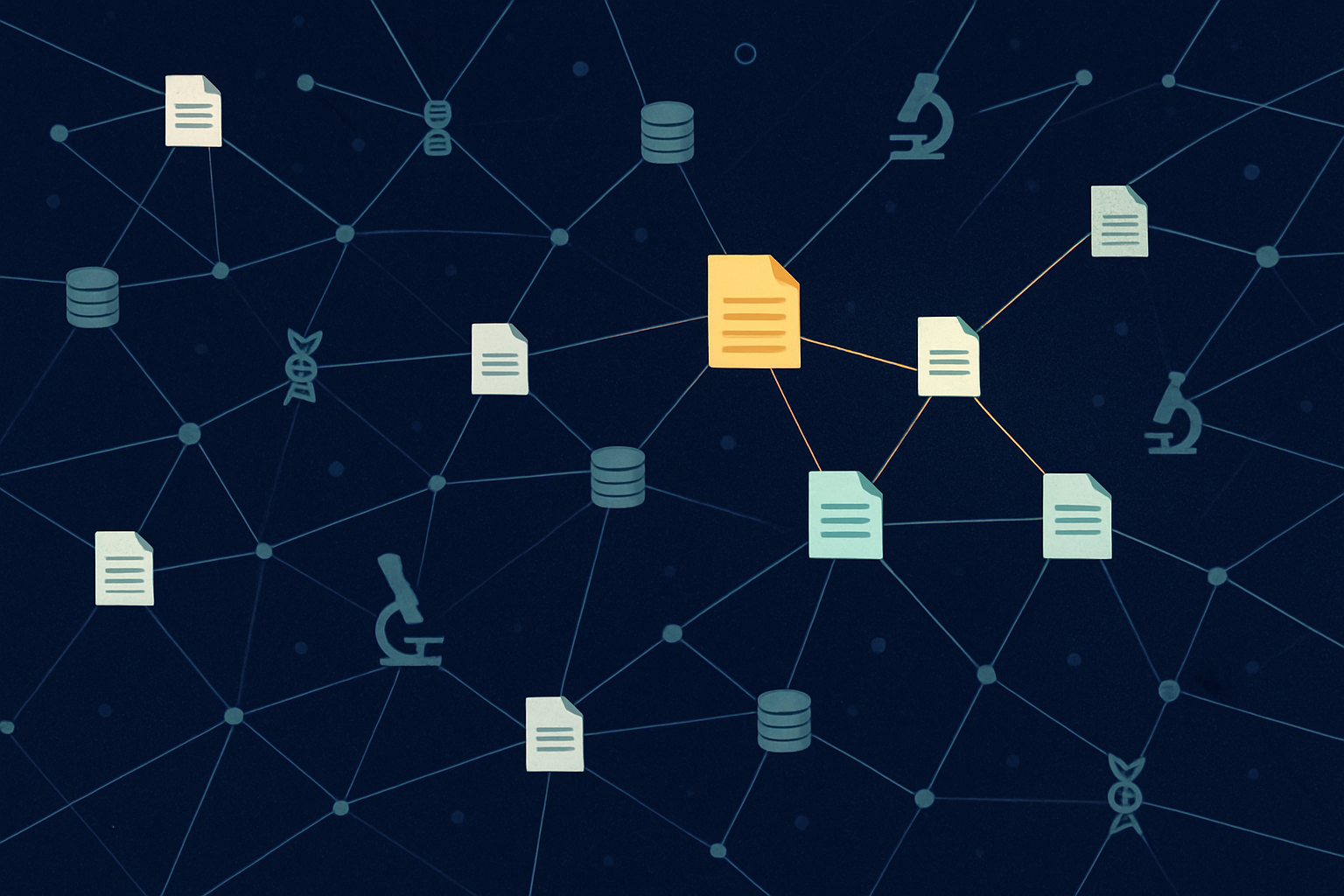
Called Linked Discoveries, the experimental tool was introduced September 24 by NIH’s National Library of Medicine, which oversees PubMed. Starting with a PubMed citation, users can explore a “neighborhood” of closely related publications, including replication studies and other research connected by topic or citation.
The launch addresses a basic problem in modern biomedical research: A paper may be easy to find, while the broader evidence needed to interpret it is scattered across thousands of publications. A researcher reading a promising result may need to locate follow-up experiments, reviews, corrections, retractions or studies that reached different conclusions. Until now, doing that often required multiple searches and considerable subject-matter expertise.
Linked Discoveries is intended to make that process more visible. Its interface can display relationships through graph and timeline views. Users can narrow results around conditions, genes and chemicals, while also examining citation connections, reviews, retractions and NIH-funded publications. NIH says more than 29 million PubMed publications are represented in the tool at launch.
That does not mean the system can tell scientists whether a result is correct.
NIH explicitly says Linked Discoveries does not judge a study’s quality or determine whether a finding has been successfully replicated. Instead, it organizes potentially relevant evidence so researchers can evaluate the strength and context of a finding themselves. The distinction matters: A paper appearing near another paper in a network is not the same as an independent confirmation.
The tool uses an AI-informed approach to identify related publications. NLM’s user guide says it uses a biomedical language model to assess how closely article texts are related, alongside links from other NLM resources. The output is therefore best understood as a research-navigation system—one that may help surface connections a conventional keyword search would miss, but that still requires human judgment.
That limitation is especially important because replication and reproducibility are not interchangeable terms. Reproducibility generally concerns whether researchers can obtain consistent results using the same data, materials or procedures. Replication asks whether a finding holds when an independent team studies the same question again. Neither question can be answered simply by counting citations or finding papers with similar words in their abstracts.
Still, a better map of the literature could make those questions easier to pursue. A PubMed-indexed study on replicability found that research findings that failed replication could continue to be cited at rates similar to findings that replicated successfully. In other words, the scientific record does not automatically push unreliable results out of view. Researchers have to identify and weigh the relevant evidence.
That is where Linked Discoveries may be useful. A scientist planning a new experiment could use it to find earlier attempts to reproduce a result. A reviewer could look for retractions, corrections or later reviews connected to a paper. A clinician or information specialist could use the surrounding literature to understand whether an apparently striking result has been repeatedly examined—or remains based on a narrow set of studies.
For now, however, NLM describes Linked Discoveries as an early-stage pilot. Its results may be incomplete or inaccurate, and the agency is asking users to submit feedback while it tests and refines the system.
The larger test will be whether the tool changes research behavior. Finding a replication study is not the same as funding one, publishing a negative result or changing a scientific consensus. But by putting more of the evidence trail next to the original paper, NIH is taking a practical step toward making those judgments easier to perform—and harder to ignore.
Sources & Further Reading
- National Institutes of HealthPrimary source
- National Library of MedicinePrimary source
- National Library of MedicinePrimary source
- PubMedPrimary source
- National Institutes of HealthPrimary source
StoryBreak
Independent digital news and reporting, updated throughout the day.
This article was researched and drafted with AI assistance and reviewed as part of StoryBreak's editorial process before publication. Read our editorial standards.