Russia and North Korea Open First Road Bridge Across Their Shared Border
The new Tumen River crossing gives Russia and North Korea their first direct road connection, expanding transport links between two governments whose strategic partnership has rapidly deepened.
By StoryBreak
Published September 7, 2026 at 9:21 PM
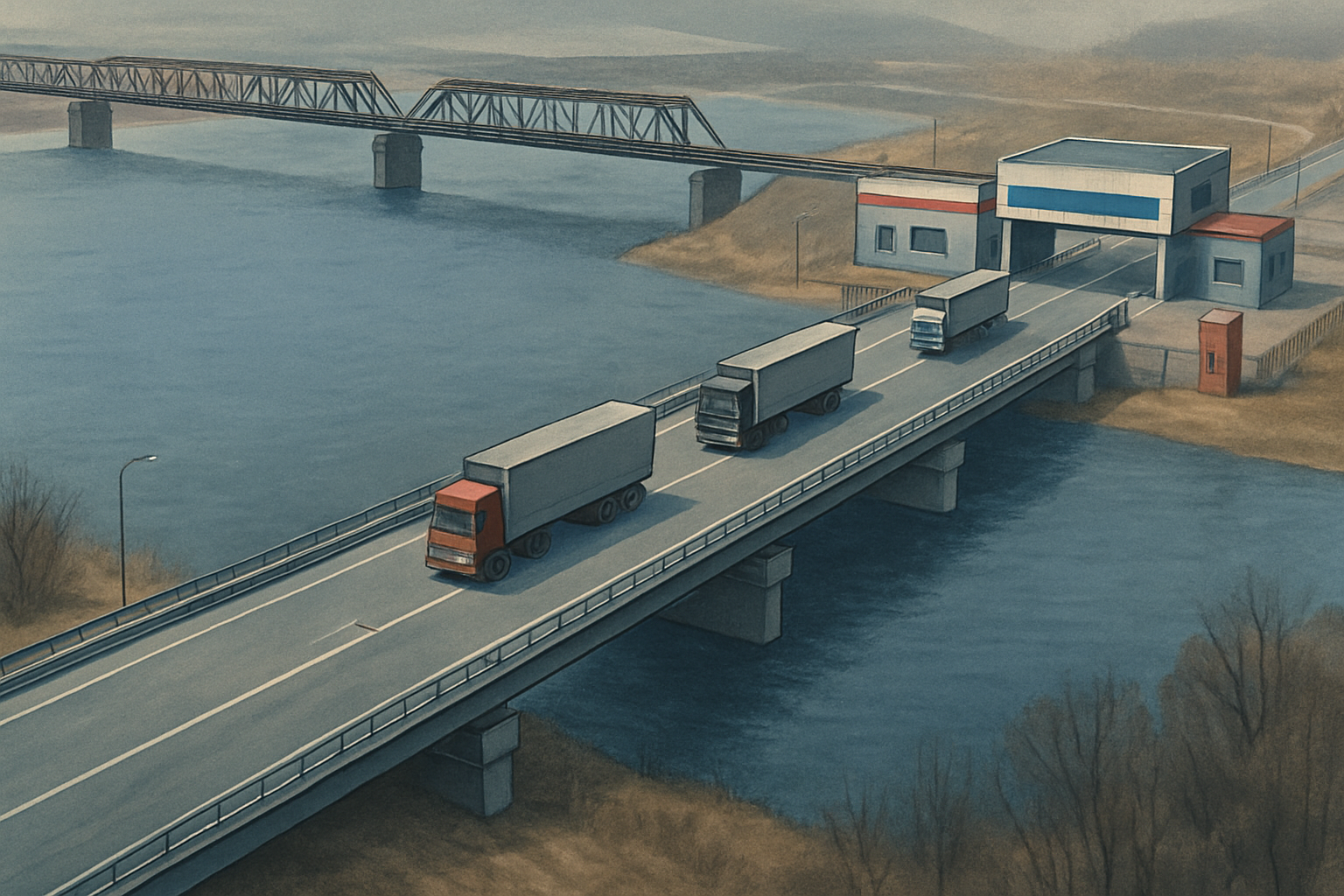
Russia and North Korea opened their first road bridge across their shared border on Monday, September 7, creating a new year-round route between Russia’s Primorye region and North Korea’s northeastern border area.
The two countries’ prime ministers, Mikhail Mishustin and Pak Thae Song, joined the opening ceremony by video link. Russia’s Transport Ministry said traffic began across the bridge and that cargo operations also started at the newly established Khasan automobile border crossing.
The crossing spans the Tumen River, which forms the countries’ short land border. The bridge itself is about 1 kilometer long and has two lanes. Including approach roads, the full route is nearly 5 kilometers.
The project is being presented by both governments as an economic and diplomatic milestone. Moscow says the road connection should increase freight capacity, reduce transport costs and create new opportunities for trade, logistics and tourism. At full operating capacity, the border checkpoint is designed to handle 300 vehicles and 2,325 people a day. Russian authorities say that vehicle capacity could eventually rise to 800 a day.
Those figures describe infrastructure capacity, not guaranteed traffic. Whether the crossing becomes commercially important will depend on customs arrangements, demand from businesses and the willingness of both governments to keep the route operating at scale.
The opening also marks a new phase in the transportation relationship between Moscow and Pyongyang. The countries were not previously cut off from one another: a railway bridge, known as the Friendship Bridge, has long carried traffic across the Tumen River, and the two governments also maintain air links. The new bridge is significant because it provides the first direct road connection, allowing trucks and other vehicles to travel without relying on rail infrastructure.
Construction began on April 30, 2025. Russia’s Transport Ministry says the work took 495 days, while the two sides joined the bridge structure in April 2026. The project was agreed after a June 2024 summit between Russian President Vladimir Putin and North Korean leader Kim Jong Un, when the two governments pledged to broaden cooperation under a comprehensive strategic partnership.
The bridge is named for Yakov Novichenko, a Soviet Red Army officer who North Korean authorities say saved Kim Il Sung’s life during a 1946 assassination attempt in Pyongyang. The choice of name gives the project a historical message as well as a practical one: the crossing is meant to symbolize the political closeness Moscow and Pyongyang have sought to showcase.
That closeness has grown sharply since Russia’s invasion of Ukraine, with the two countries expanding cooperation despite Western sanctions. But the bridge’s opening, by itself, does not show what proportion of future traffic will be commercial, civilian or connected to strategic cooperation. Nor does it guarantee that the route will quickly produce the trade gains promised by officials.
The next concrete measure will be traffic. Russia says the passenger portion of the border checkpoint is still under construction, meaning the crossing initially has a stronger freight function than a tourism one. Sustained truck movements, the goods cleared through customs and the pace at which passenger operations begin will reveal whether the new bridge is chiefly a working trade route—or, for now, a highly visible emblem of the Russia–North Korea partnership.
Sources & Further Reading
- Ministry of Transport of the Russian FederationPrimary source
- Associated Press
- The Russian GovernmentPrimary source
- Channel News Asia
- NK News
StoryBreak
Independent digital news and reporting, updated throughout the day.
This article was researched and drafted with AI assistance and reviewed as part of StoryBreak's editorial process before publication. Read our editorial standards.