
Scientists Spot a Giant 10-Sided Atmospheric Wave Over Saturn’s South Pole
New Hubble observations reveal a vast, evolving decagon embedded in Saturn’s southern jet stream. The feature resembles the planet’s famous northern hexagon but appears newer, less stable and possibly still developing.
By StoryBreak
Published September 3, 2026 at 3:09 AM
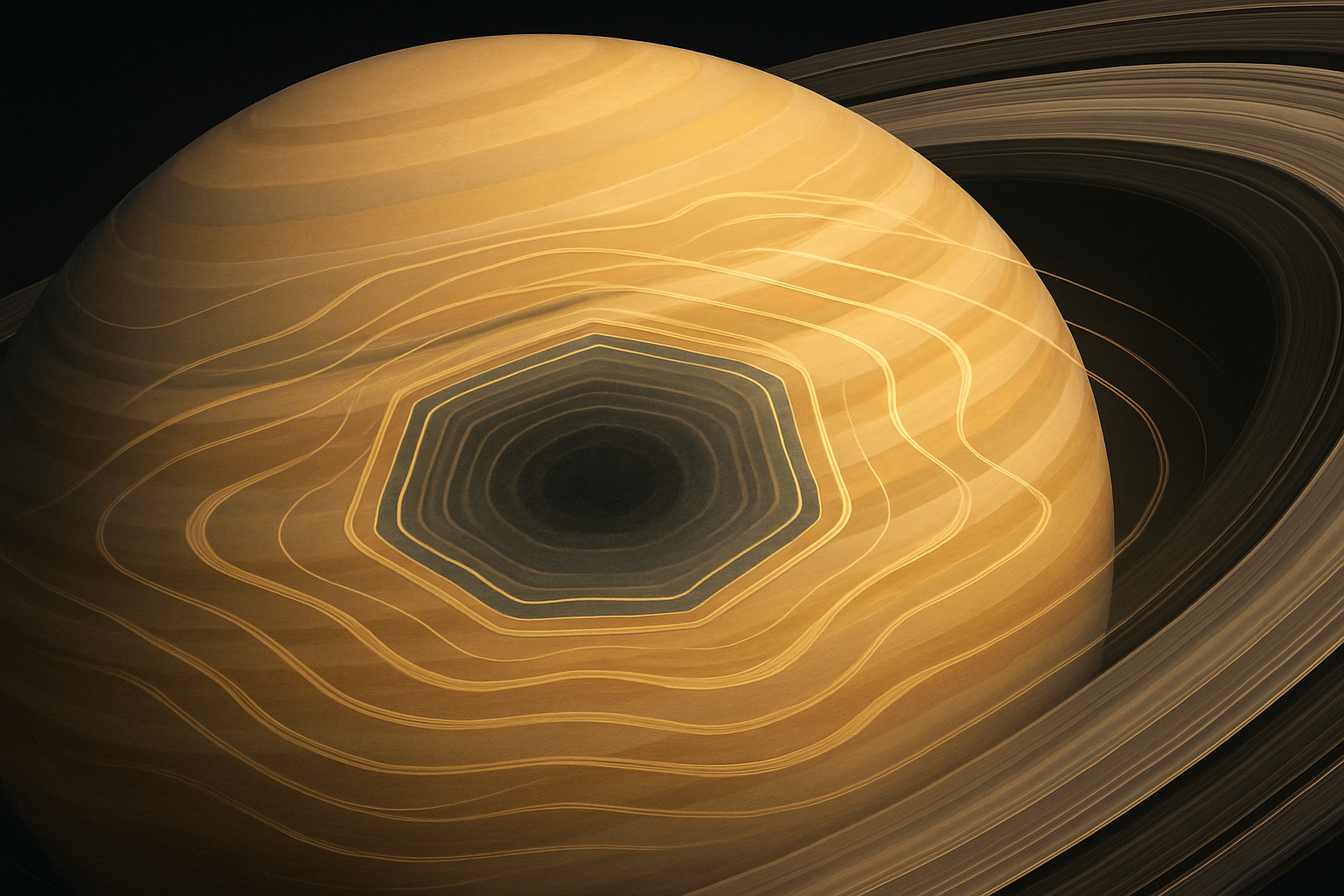
Astronomers have identified a giant, 10-sided atmospheric wave swirling around Saturn’s south pole—a newly documented feature that may be forming in the planet’s upper atmosphere.
The structure, described in a study published September 2, 2026, in Science Advances, was detected in observations from NASA’s Hubble Space Telescope. Researchers found that the decagon extends through multiple atmospheric layers and is embedded within one of Saturn’s powerful polar jet streams.
Saturn is already known for a remarkable geometric weather system: a persistent six-sided jet stream surrounding its north pole. The northern hexagon was first observed by the Voyager spacecraft in the 1980s and has remained visible for more than four decades. Unlike that long-lived feature, the newly identified southern pattern appears to have emerged relatively recently.
Researchers pieced together Hubble observations dating back to 2023. Earlier spacecraft and telescope images—including observations from NASA’s Cassini mission, which studied Saturn from 2004 to 2017—did not show evidence of a comparable long-lasting formation over the south pole. The researchers suspect the decagon may have developed sometime between 2017 and 2023, when Saturn’s seasonal orientation made the region difficult to observe from Earth.
The first hints came from ground-based images collected in 2024. Agustín Sánchez-Lavega of the University of the Basque Country in Spain and amateur astronomers Trevor Barry and Jean-Paul Oger noticed a subtle, undulating band near the southern pole. Additional observations in 2025 strengthened the case for a regular-sided pattern, which Hubble later confirmed with sharper views above Earth’s atmosphere.
The decagon is not a solid object or a fixed mark on Saturn’s clouds. It is a wave in the planet’s atmosphere, shaped by the movement of gases within a high-speed jet stream. Different Hubble wavelengths show slight shifts in the pattern’s position because they reveal different atmospheric altitudes.
The formation also differs from Saturn’s northern hexagon in its behavior. The southern decagon appears to migrate eastward at roughly 6 miles per hour, or 10 kilometers per hour, while the northern feature is comparatively stationary. One side of the decagon already stretches more than 10,000 miles—larger than Earth’s diameter—but scientists say the pattern remains unstable and may continue changing.
Its origin is still unknown. The discovery suggests that Saturn’s atmosphere may be capable of producing more than one type of polygonal wave under the right conditions. Comparing the decagon with the northern hexagon could help researchers understand how jet streams, atmospheric waves and seasonal changes interact on gas-giant planets.
Scientists are also interested in whether the pattern has parallels with polygon-shaped arrangements of storms observed near Jupiter’s poles. Those systems are not identical to Saturn’s polar waves, but studying them together may reveal broader rules governing atmospheric circulation on rapidly rotating planets.
Further Hubble observations, along with studies using the James Webb Space Telescope and computer models, should show whether the decagon settles into a stable configuration or eventually fades. For now, researchers can confirm that the unusual pattern is still present—and that Saturn’s atmosphere remains capable of producing surprises even after decades of close study.
Sources & Further Reading
StoryBreak
Independent digital news and reporting, updated throughout the day.
This article was researched and drafted with AI assistance and reviewed as part of StoryBreak's editorial process before publication. Read our editorial standards.