New solar-monitoring satellite gives forecasters more time to prepare for space storms
Space weather can disrupt GPS, radio links, satellites and power systems on Earth. A new NOAA satellite becoming operational in 2026 is strengthening the data available to forecasting teams, including the UK’s Met Office Space Weather Operations Centre.
By StoryBreak
Published August 29, 2026 at 6:00 PM
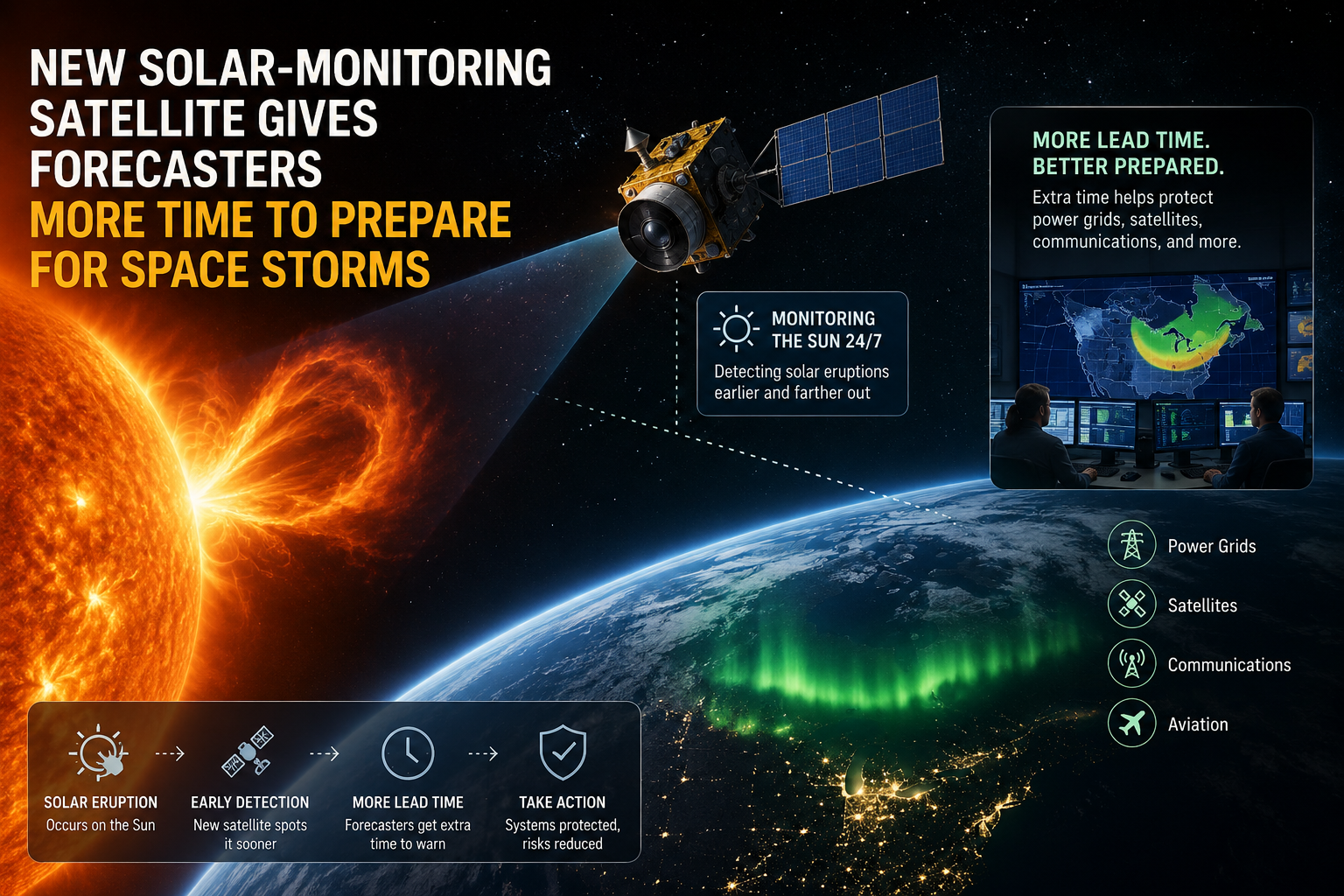
A new U.S. space-weather satellite is now supplying operational data to forecasting centres, giving teams more information about solar eruptions before they reach Earth and threaten technology on the ground and in orbit.
NOAA’s SOLAR-1 became fully operational in June 2026 after launching on September 24, 2025. Positioned at the L1 Lagrange point about 1 million miles from Earth, the spacecraft observes the Sun and measures the solar wind — the continuous stream of charged particles flowing outward from it.
The data is being used by space-weather centres around the world, including the UK’s Met Office Space Weather Operations Centre, known as MOSWOC. The centre operates continuously, issuing forecasts and warnings for government agencies, emergency responders and industries that depend on communications, navigation, satellites and electricity networks.
Space weather is created by changes on the Sun. Solar flares can release intense bursts of radiation, while coronal mass ejections — enormous clouds of magnetised plasma — can travel through space and collide with Earth’s magnetic environment. Fast-moving particles can also produce radiation storms.
The effects are usually not a direct danger to people on the ground. Earth’s atmosphere and magnetic field provide substantial protection. The main concern is the technology that modern life relies on.
A powerful geomagnetic storm can disturb the ionosphere, the electrically charged region of the upper atmosphere through which many radio and satellite signals travel. That can reduce the accuracy of GPS and other global navigation systems, interfere with high-frequency radio used by aviation and emergency services, and complicate satellite communications.
Spacecraft face additional risks. Radiation can damage electronics, while a geomagnetic storm can heat and expand the upper atmosphere. The resulting increase in atmospheric drag can slow low-Earth-orbit satellites and change their paths. Operators may need to postpone manoeuvres, switch equipment into protective modes or closely monitor a spacecraft’s position.
On the ground, changing magnetic fields can drive electrical currents through long conductors, including power lines. In severe cases, these geomagnetically induced currents can damage transformers and other grid equipment. A major storm in March 1989 caused a widespread blackout in Quebec, Canada, demonstrating that a solar event can produce consequences far from the Sun.
Aviation is another area where warnings matter. Flights on polar routes can experience problems with high-frequency radio and satellite navigation, while energetic particles can raise radiation exposure at high altitudes. Airlines may respond by changing routes or relying on alternative communication and navigation procedures.
The same disturbances that create these risks can also produce the northern and southern lights. During strong geomagnetic storms, auroras can become visible much farther from the polar regions than usual. Their appearance is spectacular, but it is not by itself a measure of whether critical infrastructure is being damaged.
Forecasting remains difficult because the danger depends not only on the size of a solar eruption, but also on its direction, speed and magnetic orientation when it reaches Earth. A coronal mass ejection may take roughly 18 to 96 hours to arrive, according to the Met Office, while some high-energy particles can reach Earth in minutes.
That makes early observation especially valuable. SOLAR-1’s coronagraph is designed to image coronal mass ejections as they leave the Sun, while other instruments measure the solar wind, magnetic field and energetic particles. NOAA says the information can give power operators, satellite companies, aviation officials and human-spaceflight teams more time to act.
More capability is planned. The European Space Agency’s Vigil mission is scheduled for launch in 2031 and is being developed to observe the Sun from the L5 point, a position that provides a side-on view of solar activity before some regions rotate into Earth’s direct view. ESA says Vigil could provide several days of advance notice for some space-weather effects once operational.
For the public, the practical message is that space-weather forecasting works much like an early-warning service. Most solar activity produces little noticeable disruption, but timely alerts allow organisations to reduce exposure, protect equipment and plan for possible interruptions before a storm arrives.
StoryBreak
Independent digital news and reporting, updated throughout the day.
This article was researched and drafted with AI assistance and reviewed as part of StoryBreak's editorial process before publication. Read our editorial standards.