Can Sheep Save Switzerland’s Melting Glaciers? Scientists Put Wool to the Test
A Swiss conservation group and the University of Lausanne are testing biodegradable sheep-wool covers on the Tsanfleuron Glacier to see whether they can slow ice loss as effectively as plastic-based geotextiles.
By StoryBreak
Published September 3, 2026 at 10:10 PM
LES DIABLERETS, Switzerland — Sheep’s wool has long been associated with sweaters, carpets and mountain farms. This summer, researchers in Switzerland are testing whether it can also help protect the country’s shrinking glaciers.
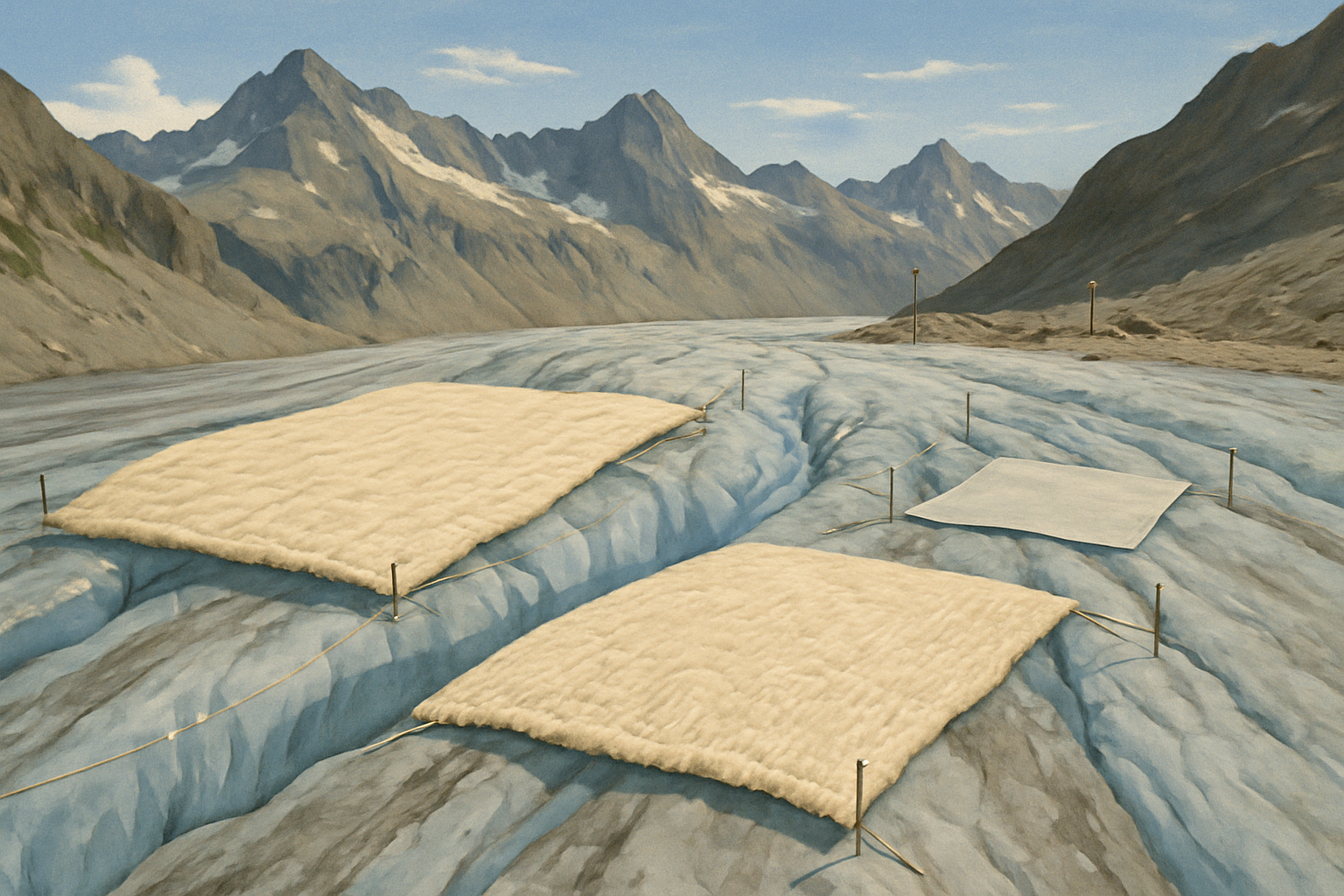
Two wool covers, each measuring 100 square metres, were installed in late June on the Tsanfleuron Glacier, also known as the Glacier 3000, above Les Diablerets in western Switzerland. The trial, called “Keep It Wool,” is being led by the Summit Foundation in collaboration with the University of Lausanne. Researchers linked to the Swiss Glacier Monitoring Network, or GLAMOS, are overseeing the scientific measurements.
The goal is not to cover an entire glacier. Instead, the experiment is examining whether wool can shield small, strategically selected areas of snow and ice from the sun and slow melting during the warm season.
Protective covers are already used at some Alpine sites, particularly in areas important to ski operations or tourism. Conventional geotextiles made from materials such as polyester or polypropylene can reduce melting in covered sections by roughly 50% to 70%, according to research cited by the Summit Foundation.
But synthetic fabrics have an environmental drawback. They deteriorate under exposure to wind, precipitation and ultraviolet light, potentially releasing small plastic particles into meltwater and the wider environment. Wool, by contrast, is a natural, renewable and biodegradable material.
The Swiss project is also designed to address a local waste problem. Much of the country’s sheep wool is considered low-value because sheep are primarily raised for meat, milk or landscape management. The material is often destroyed, composted or otherwise discarded rather than turned into higher-value products.
For the glacier test, researchers installed two wool prototypes made in different thicknesses. A synthetic cover of comparable size was placed nearby to provide a benchmark. Measurements were taken at two-week intervals over the summer, with researchers assessing both the covers’ durability in high-altitude conditions and their ability to preserve the underlying ice.
The Summit Foundation said initial observations were promising. The wool covers appeared to produce a protective effect broadly similar to that of synthetic tarpaulins, although the full evaluation will be needed to determine how the material performed over the entire test period.
The experiment’s backers are careful not to present wool as a solution to glacier loss. Protective textiles currently cover only about 0.02% of Switzerland’s total glacier area. Even if wool proves durable, effective and practical to manufacture, the method would remain limited to small sections of ice.
That limitation is crucial. Covers can reduce melting where they are placed, but they cannot reverse the broader retreat driven by a warming climate. Their role is closer to temporary preservation than restoration: buying time for specific sites while researchers study less polluting ways to protect snow and ice.
The wool trial therefore raises two separate questions. The first is technical: can a biodegradable fibre withstand months of intense sunlight, wind, rain and movement on a glacier? The second is logistical: can enough suitable Swiss wool be collected, processed and manufactured into large, robust covers at a reasonable environmental and financial cost?
The answers could determine whether the material moves beyond a small demonstration project. For now, the test offers a potentially cleaner alternative to plastic-based coverings, while underscoring the much larger problem these blankets cannot solve. Wool may help preserve a patch of glacier. It cannot, by itself, stop Switzerland’s ice from disappearing.
Sources & Further Reading
StoryBreak
Independent digital news and reporting, updated throughout the day.
This article was researched and drafted with AI assistance and reviewed as part of StoryBreak's editorial process before publication. Read our editorial standards.