
T. Rex May Have Been Almost as Warm as You Are
Chemical clues locked inside fossilized teeth suggest Tyrannosaurus rex maintained a body temperature near 97 degrees Fahrenheit—close to humans and far above modern crocodilians. The result offers the clearest temperature reading yet for the dinosaur and sharpens the case that it was an energetic, internally heated predator.
By StoryBreak
Published September 21, 2026 at 12:55 AM
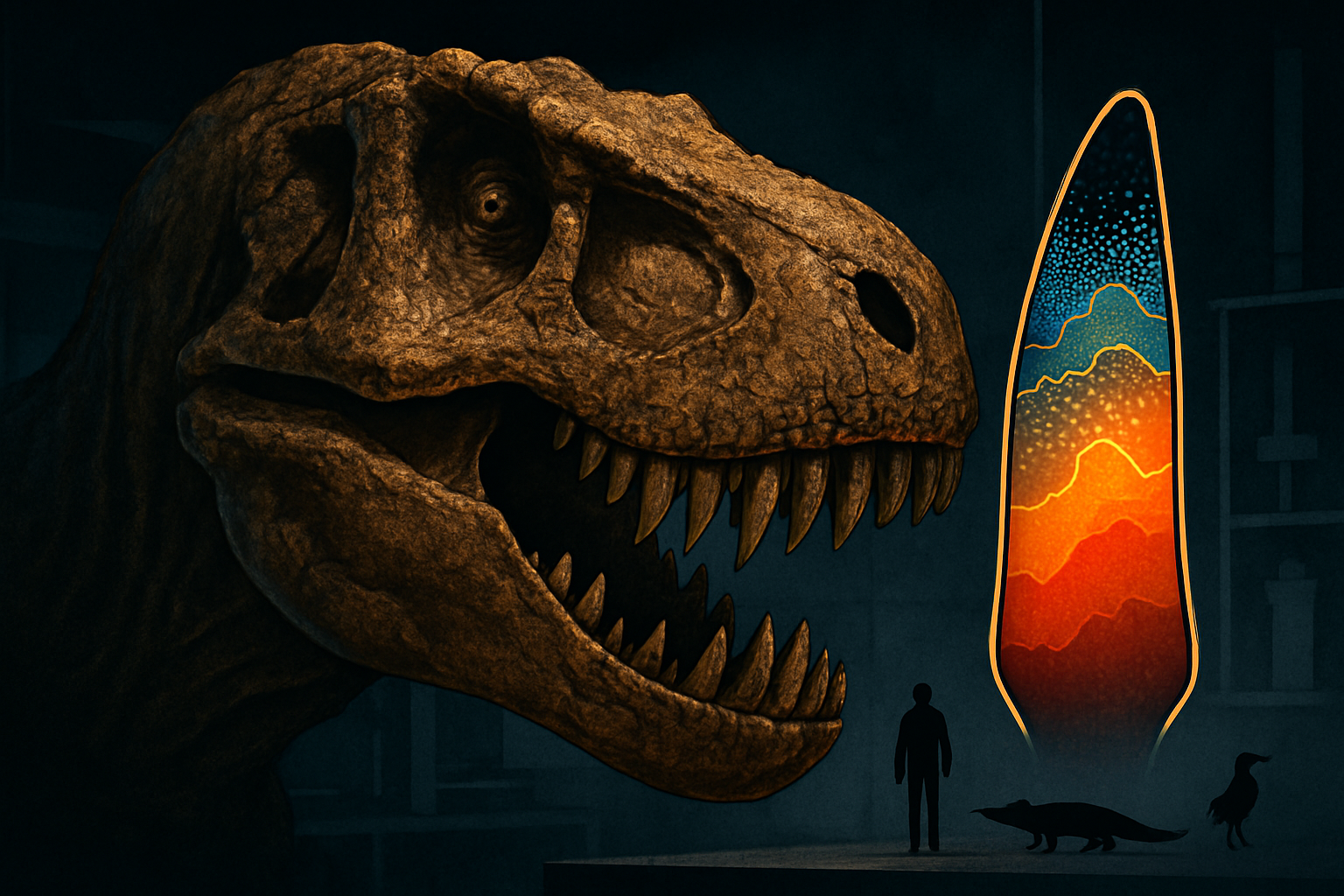
For more than a century, scientists have tried to infer what powered Tyrannosaurus rex from fossil bones, teeth and footprints. Now, researchers have put a number on one of the most basic facts about the animal: its body temperature.
A study published September 16 in the journal Science Advances estimates that T. rex ran at about 36 degrees Celsius, or roughly 97 degrees Fahrenheit. That is close to the typical temperature of a human—and substantially warmer than the body temperature commonly seen in modern crocodilians.
The result does not mean T. rex was physiologically identical to a person. But it does move the dinosaur further away from the familiar image of a sluggish reptile that had to bask in the sun before becoming active.
The researchers extracted tiny samples of enamel from three T. rex teeth, including teeth from “Thomas,” a fossil held by the Natural History Museum of Los Angeles County. They analyzed the arrangement of isotopes and chemical bonds preserved in the enamel. Those molecular patterns act as a kind of fossil thermometer because their formation depends partly on temperature.
The team also examined crocodilian fossils from the same Hell Creek region in Montana. The crocodilian signal indicated a body temperature of about 30 C, or 86 F, compared with about 36 C for T. rex. That contrast matters: if geological alteration alone had produced the readings, the two animals might have been expected to look more similar chemically.
The temperature places T. rex in an intriguing middle ground. Modern crocodilians and many other reptiles generally rely heavily on environmental heat, while birds—living dinosaurs and the closest modern comparison for many theropods—often maintain body temperatures around 40 to 43 C. T. rex appears to have been warmer than a crocodilian but cooler than many birds.
That middle position fits a growing body of evidence that dinosaurs did not fit neatly into the old cold-blooded-versus-warm-blooded binary. Studies of growth, anatomy, fossil chemistry and metabolic byproducts have increasingly suggested that at least some dinosaurs generated substantial internal heat. The new study adds something those lines of evidence could not provide as directly: an approximate absolute temperature for T. rex itself.
The number also helps explain how the predator may have functioned across its enormous range. Tyrannosaurus fossils are known from relatively temperate parts of North America, while related evidence indicates that tyrannosaurs occupied areas far to the north. An internally warm body would have made sustained activity in cooler environments more feasible than it would be for a typical ectothermic reptile.
Still, the headline should be handled carefully. Three teeth cannot reveal every detail of a species’ physiology. The estimate may not capture variation caused by age, season, illness, activity or differences between the body core and the limbs. Nor does a temperature near the human range prove that T. rex had the same metabolic machinery as a mammal.
What it does show is more specific—and more useful—than the claim that the dinosaur was simply “warm-blooded.” Its fossilized teeth preserve chemical evidence of a body that was consistently warm enough to support an active lifestyle, yet not as hot as many modern birds. T. rex was not a giant lizard waiting for sunlight. It was a large, internally heated predator operating with a physiology that occupied its own branch of the evolutionary experiment.
Sources & Further Reading
- Science AdvancesPrimary source
- University of California, Los Angeles
- ZenodoPrimary source
- Associated Press
- Live Science
StoryBreak
Independent digital news and reporting, updated throughout the day.
This article was researched and drafted with AI assistance and reviewed as part of StoryBreak's editorial process before publication. Read our editorial standards.