Scientists Confirm Two Giant Planets Less Dense Than Cotton Candy
TOI-791 b and TOI-791 c are nearly Jupiter-sized but have densities comparable to or lower than cotton candy, offering astronomers a rare test of how giant planets become so enormously inflated.
By StoryBreak
Published September 21, 2026 at 11:26 PM
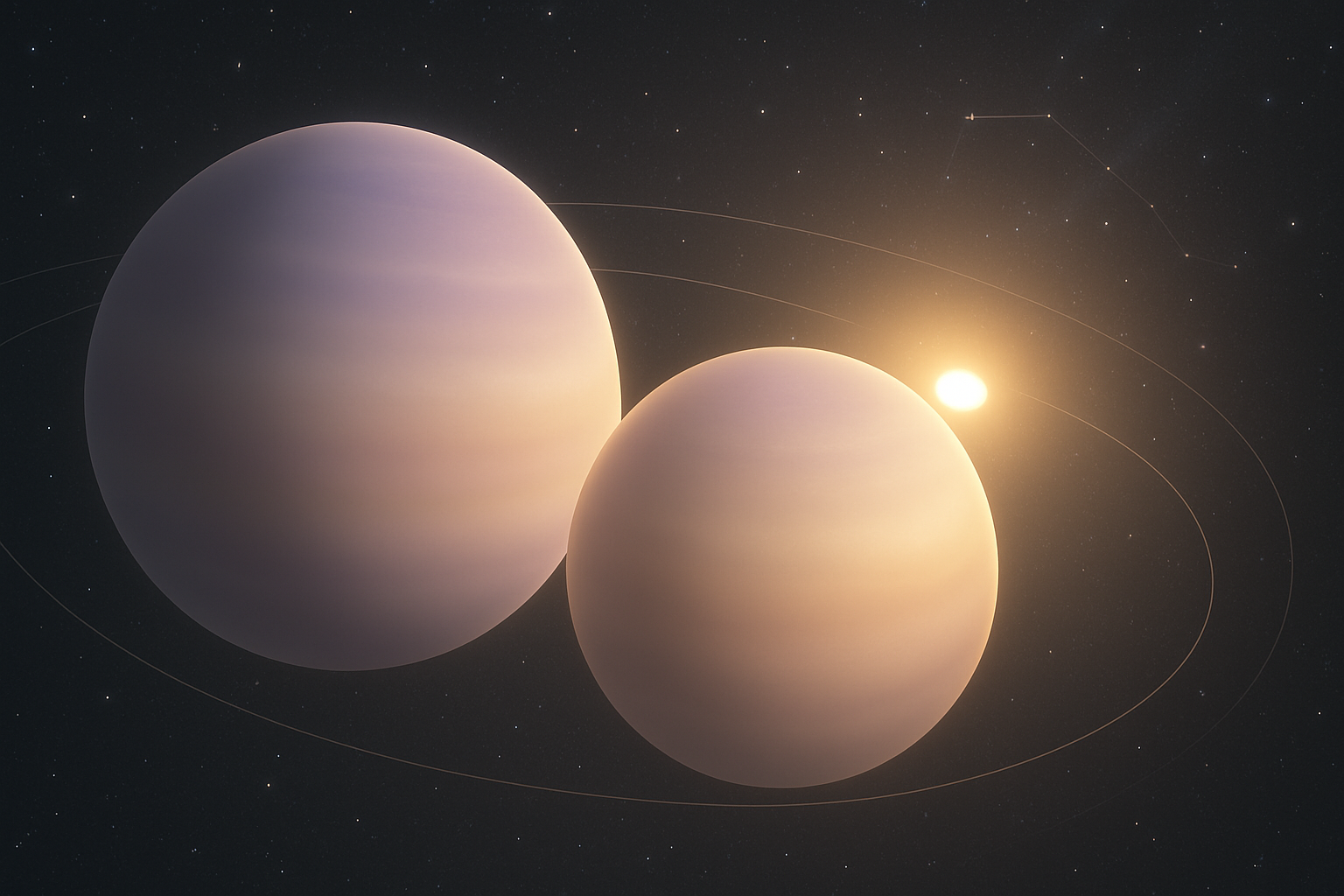
Astronomers have confirmed two giant planets that are nearly the size of Jupiter but astonishingly light for their dimensions—so diffuse that their average densities are comparable to, or lower than, cotton candy.
The planets, named TOI-791 b and TOI-791 c, orbit an F-type star roughly 1,110 light-years away in the constellation Volans. Researchers measured densities of about 0.038 and 0.047 grams per cubic centimeter, respectively, placing both among the lowest-density giant planets ever detected.
That does not mean the worlds are made of spun sugar, or that they have a solid surface. The comparison refers to average density: the planets’ enormous volumes are filled mainly by extremely extended atmospheres, likely dominated by hydrogen and helium. Their interiors may contain denser cores, but those cores account for only a small share of each planet’s apparent size.
TOI-791 b is about 99 percent of Jupiter’s radius, while TOI-791 c is roughly 16 percent wider than Jupiter. Yet their masses are far smaller than Jupiter’s. NASA lists approximate masses of 9.5 and 18.6 Earths—only a small fraction of Jupiter’s mass for objects with Jupiter-scale dimensions.
The key to weighing these seemingly weightless planets was their effect on each other. TOI-791 b circles its star every 139 days and TOI-791 c every 232 days. Their orbital periods sit close to a 5:3 relationship, so the planets’ gravity causes their transits to arrive early or late by as much as about 50 minutes. By modeling those shifts, the researchers inferred the planets’ dynamical masses.
The confirmation also required patience on Earth. Both planets produce transits lasting more than 11 hours—long enough to be difficult to observe from most locations. Several complete transits were recorded by the ASTEP telescope in Antarctica, where the continuous winter darkness made it possible to follow the events from beginning to end.
The system is unusual for another reason: both planets are long-period giants that transit the same star. Most known exoplanets in this broad category either orbit much closer to their stars or are found one at a time, making it harder to compare their histories within a single system.
That comparison may help answer a larger question in planetary science: how can a planet become so large without accumulating much mass? A giant planet’s radius depends not only on how much material it contains but also on its temperature, atmospheric composition, age and internal energy. Strong heating from the host star may contribute to inflation, but the extreme properties of super-puffs remain difficult to reproduce with standard formation and evolution models.
The discovery therefore matters less as a cosmic curiosity than as a stress test for those models. If TOI-791 b and c formed in different regions of the young planetary system and later migrated, their present arrangement may preserve clues about that journey. If they formed closer to their current orbits, scientists will need to explain how they acquired such expansive envelopes there.
For now, the most secure conclusion is also the strangest: two planets with roughly Jupiter-sized silhouettes have been measured to contain remarkably little mass. Further monitoring of their transit timing and, potentially, their atmospheres should show whether these worlds are temporary bloated phases—or a distinct pathway for building giant planets.
Sources & Further Reading
- Monthly Notices of the Royal Astronomical Society / Oxford AcademicPrimary source
- NASA SciencePrimary source
- NASA Science Exoplanet CatalogPrimary source
- NASA Science Exoplanet CatalogPrimary source
- University of Oxford
- The Associated Press
StoryBreak
Independent digital news and reporting, updated throughout the day.
This article was researched and drafted with AI assistance and reviewed as part of StoryBreak's editorial process before publication. Read our editorial standards.