Very Hot Coffee and Tea Linked to Triple the Risk of One Esophageal Cancer Type, Study Finds
A study of nearly one million UK adults found that people who preferred very hot tea or coffee had roughly three times the risk of esophageal squamous cell carcinoma compared with those who preferred warm drinks. The finding did not extend to esophageal adenocarcinoma and does not prove that hot beverages cause cancer.
By StoryBreak
Published September 9, 2026 at 4:27 PM
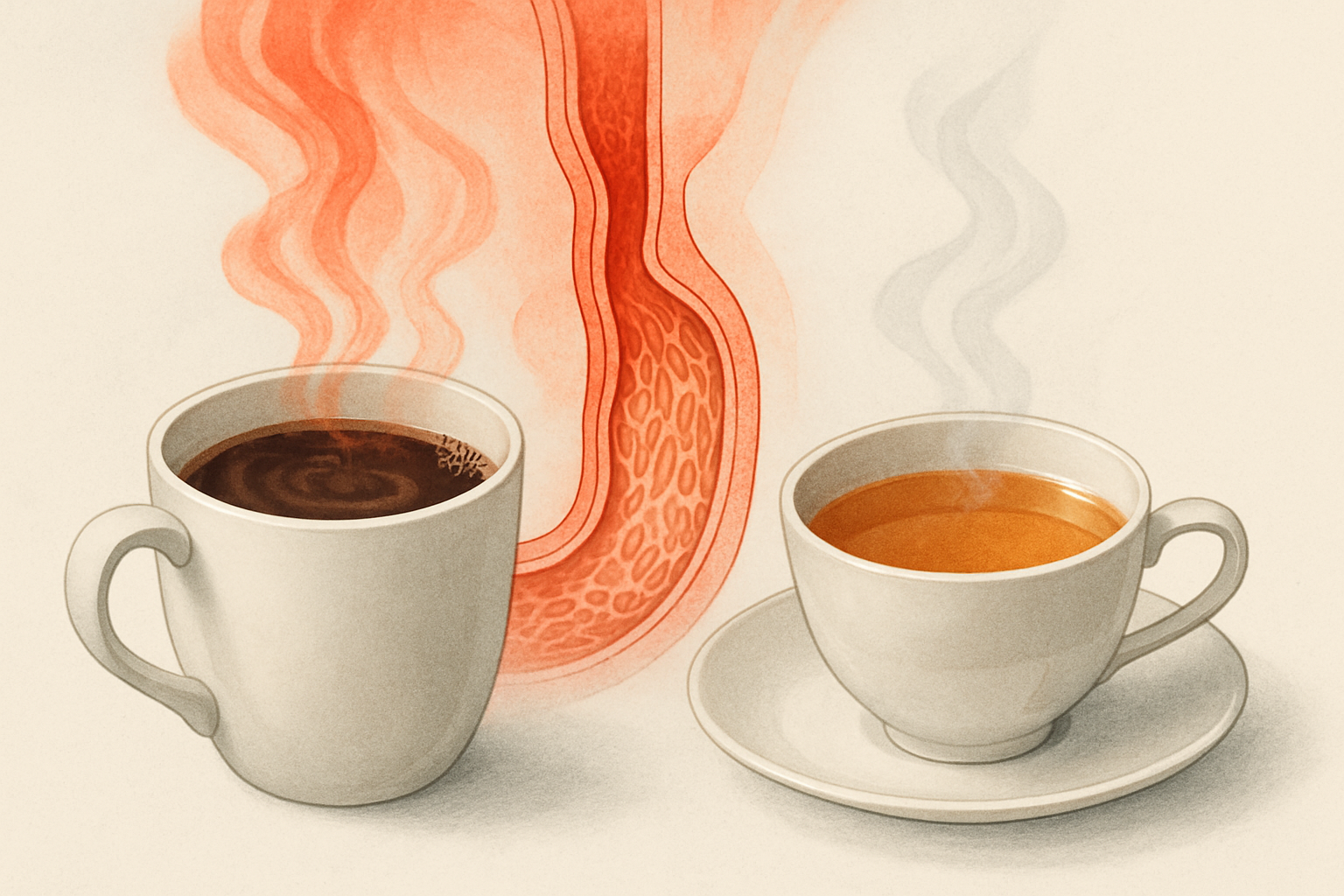
A large new study is strengthening the case for letting coffee and tea cool before drinking them.
Researchers who analyzed health data from 977,282 adults in two major UK cohorts found that people who preferred their hot drinks “very hot” had more than three times the risk of developing esophageal squamous cell carcinoma compared with people who preferred warm drinks. The result held after the researchers accounted for how often participants drank tea or coffee.
The study, published online September 8, 2026, in the International Journal of Cancer, tracked participants in the Million Women Study and the UK Biobank. During follow-up, the researchers recorded 2,348 cases of esophageal cancer: 1,045 were squamous cell carcinomas and 1,303 were adenocarcinomas.
The headline number was a relative risk of 3.17 for squamous cell carcinoma among people who preferred very hot drinks rather than warm ones. The study’s confidence interval ranged from 2.49 to 4.03, indicating a strong statistical association in the combined analysis.
But the result was not the same for every esophageal cancer. For adenocarcinoma, the relative risk associated with very hot drinks was 0.92, a finding that did not indicate an increased risk.
That distinction matters. Esophageal squamous cell carcinoma and esophageal adenocarcinoma develop through different biological pathways and have different established risk factors. A warning about very hot drinks should therefore not be read as a claim that coffee or tea raises the risk of every form of esophageal cancer.
The study also does not show that a particular cup of coffee causes cancer. Participants reported whether they generally preferred drinks that were warm, hot or very hot; the researchers did not repeatedly measure the temperature of every beverage. And because the analysis was observational, other differences between people who favor very hot drinks and those who do not could still contribute to the result, even though the researchers adjusted for drinking frequency and other factors.
Still, the finding fits a broader scientific pattern. The International Agency for Research on Cancer has classified beverages consumed above 65°C, or 149°F, as probably carcinogenic to humans. Earlier prospective research in Iran found that objectively measured tea temperatures of 60°C, or 140°F, and above were associated with increased risk of squamous cell carcinoma. Those studies largely involved populations where very hot tea or maté is common.
The new UK analysis extends that concern to ordinary tea and coffee habits in a Western population. It also suggests that temperature may matter independently of the beverage itself: the association was found among people drinking tea and coffee, rather than being limited to one particular plant or preparation.
For consumers, the practical message is less dramatic than the headline. The study does not call for abandoning coffee or tea. It points instead to a small behavior change: wait until a drink is comfortable to sip rather than consuming it while it is scalding hot. Adding milk may lower the temperature, but it does not guarantee that a drink is cool enough.
The next research challenge is more precise temperature measurement. “Very hot” is a personal description, and people do not experience heat identically. Studies that record actual drink temperatures over time could help identify the level and pattern of exposure most closely linked to cancer risk.
For now, the strongest interpretation is also the narrowest one: repeatedly drinking very hot beverages appears to be associated with a higher risk of esophageal squamous cell carcinoma. It is not proof that hot coffee or tea causes cancer, and it is not a reason to treat all coffee and tea consumption as dangerous.
Sources & Further Reading
- International Journal of Cancer / Wiley Online LibraryPrimary source
- Science Media Centre
- National Cancer Institute / PubMed CentralPrimary source
- International Agency for Research on CancerPrimary source
StoryBreak
Independent digital news and reporting, updated throughout the day.
This article was researched and drafted with AI assistance and reviewed as part of StoryBreak's editorial process before publication. Read our editorial standards.