
Astronomers Find the Youngest Known Planet — and It Is Still Growing
Elias 2-24 b is less than one million years old, still embedded in the disk that formed it, and forcing scientists to rethink how quickly giant planets can emerge.
By StoryBreak
Published September 18, 2026 at 12:12 AM
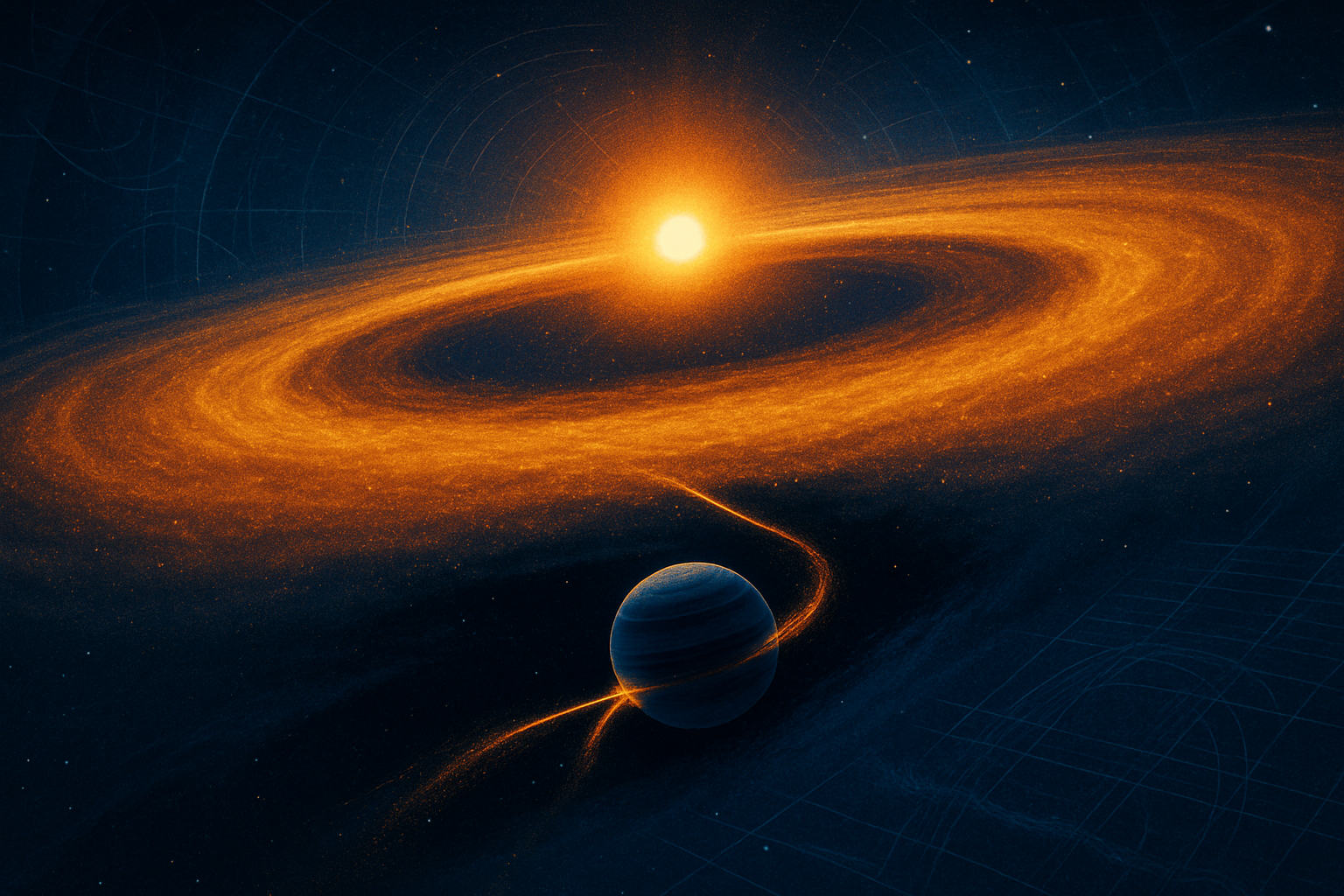
Astronomers have confirmed the youngest planet ever found outside our solar system: a world less than one million years old that is still gathering material from the disk of gas and dust where it was born.
The planet, named Elias 2-24 b, is roughly as massive as Jupiter and circles a young star about 450 light-years from Earth. Unlike most known exoplanets, it has not yet become a finished, detached world. It remains inside its natal disk, in a gap that its gravity appears to be helping carve through the surrounding material.
That makes the discovery more than a new entry in an expanding catalog of distant planets. It is a rare look at a planetary system during construction.
Most exoplanets have been detected through the transit method, when a planet passes in front of its star and causes a tiny dip in the star’s brightness. That approach favors planets on tight orbits and systems old enough for their surrounding dust to have cleared. Very young planets are usually hidden by the thick disks from which they form.
Elias 2-24 b was found using a different strategy. Astronomers examined observations of several young stars made with the W. M. Keck Observatory’s coronagraph, an instrument that blocks much of a star’s glare so that faint nearby objects can be seen. The team revisited archival observations from 2018 and 2020 and tracked a dim point of light over time.
Earlier observations had already made the Elias 2-24 system intriguing. The Atacama Large Millimeter/submillimeter Array had revealed gaps in the star’s disk, while the European Southern Observatory’s Very Large Telescope later detected a faint source in one of those gaps. But the source could have been an imaging artifact or a distant background star.
The archival Keck data helped resolve that uncertainty. The object moved in a way consistent with a planet orbiting Elias 2-24, rather than remaining fixed like a background star. Its location inside the disk gap also matched the expected position of a planet clearing a path through the material around its star.
The result creates a problem for existing models. Astronomers have generally estimated that forming a Jupiter-sized planet at roughly Jupiter’s distance from a Sun-like star should take about five million years — and potentially longer at greater distances. Elias 2-24 b is located about 55 times farther from its star than Earth is from the Sun, yet it appears to have reached Jupiter’s scale before its system is even one million years old.
That does not mean the formation models are useless, or that the planet’s age is known with day-to-day precision. The age and mass are estimates, and the object sits near the limits of what current telescopes can detect. But the discrepancy is scientifically valuable: it identifies a stage of planet formation where present theories may be missing an important process.
One possibility is that giant planets can grow rapidly by pulling in gas and solids from unusually massive or unstable regions of a young disk. Another is that some planets form through pathways faster than the gradual accumulation of material assumed by the standard picture. Elias 2-24 b cannot by itself decide between those explanations, but it gives researchers a concrete target for testing them.
The next step will be finding more planets at the same formative age. NASA’s Nancy Grace Roman Space Telescope, equipped with advanced technology for separating faint planets from bright stars, may help reveal worlds that are currently hidden in the glare.
For now, Elias 2-24 b offers something astronomers almost never get: not a fossil record of a planet’s birth, but a view of the construction site itself.
Sources & Further Reading
- NASA Science
- The Astrophysical Journal LettersPrimary source
- W. M. Keck ObservatoryPrimary source
- European Southern ObservatoryPrimary source
- University of Arizona News
StoryBreak
Independent digital news and reporting, updated throughout the day.
This article was researched and drafted with AI assistance and reviewed as part of StoryBreak's editorial process before publication. Read our editorial standards.