Federal Judge Blocks ‘Loyalty Question’ Used in More Than 70,000 U.S. Government Job Postings
A Massachusetts judge has stopped the Trump administration from asking federal job applicants how they would advance the president’s policies, finding the unions challenging the practice likely to prevail on First Amendment and administrative-law claims. The preliminary ruling blocks future use of the question but leaves unresolved how previously submitted answers may be treated.
By StoryBreak
Published September 12, 2026 at 8:29 PM
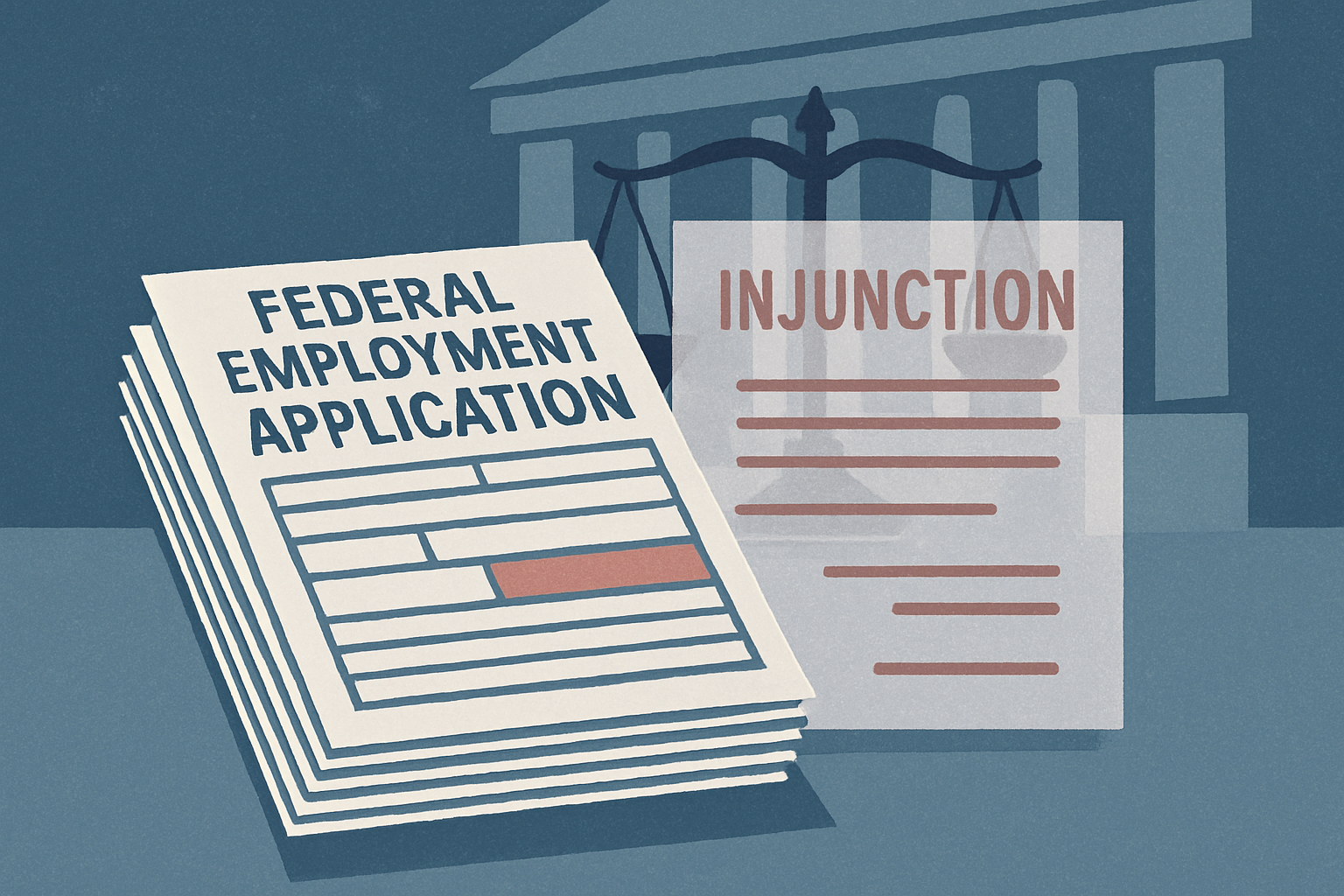
A federal judge in Massachusetts has blocked the Trump administration from continuing to ask applicants for civil-service jobs how they would advance President Donald Trump’s executive orders and policy priorities—a question unions described as a political loyalty test.
U.S. District Judge George A. O’Toole Jr. issued the preliminary ruling Friday, September 11, in a lawsuit brought by the American Federation of Government Employees, the American Federation of State, County and Municipal Employees, and the National Association of Government Employees. The unions challenged the Office of Personnel Management’s decision to include the question in federal job applications.
The question had appeared in more than 70,000 federal job postings, according to lawyers for the unions. Applicants were asked to identify a presidential initiative or executive order that was significant to them and explain how they would help advance the administration’s priorities if hired.
The administration presented the essay questions as part of a broader effort to change federal hiring. But the unions argued that asking candidates to explain their relationship to a president’s political agenda was incompatible with a professional civil service, particularly for jobs that are not political appointments.
O’Toole’s ruling does not end the case. It is a preliminary decision, issued while the court considers the unions’ larger claims. The judge found that the plaintiffs were likely to succeed in arguing that OPM’s policy violated applicants’ First Amendment rights and the Administrative Procedure Act.
That finding is significant because it treats the question as more than an ordinary hiring requirement. A government agency can assess whether an applicant has the skills to perform a job. The legal dispute is over whether it can also demand an explanation of the applicant’s political views—or willingness to promote the sitting president’s agenda—as part of the application process.
The ruling also leaves an important issue unresolved. The unions sought broader relief that would have prevented the government from using applicants’ answers, or their refusal to answer, in hiring decisions. O’Toole did not grant that request. In practical terms, the order stops agencies from continuing to put the question on applications, but it does not automatically eliminate the possible impact of answers already submitted.
That distinction matters for applicants who encountered the question before Friday’s ruling. The unions had argued that even an officially “optional” question could pressure candidates to respond if the application system made it difficult to proceed without an answer—or if applicants feared that declining could hurt their chances. Earlier court filings and reporting documented disputes over whether the question was genuinely optional in practice.
For now, federal agencies must stop using the challenged question while the lawsuit proceeds. The government may seek appellate review, and the court still must decide the underlying claims on a more complete record.
The immediate effect is therefore narrower than a final judgment but broader than a symbolic rebuke. The administration’s hiring policy has been interrupted across the federal application system, while the courts continue to determine whether asking job candidates to explain their commitment to a president’s policies was unlawful in the first place.
StoryBreak
Independent digital news and reporting, updated throughout the day.
This article was researched and drafted with AI assistance and reviewed as part of StoryBreak's editorial process before publication. Read our editorial standards.