A Humpback Whale Has Traveled 60 Miles Inland Into California’s Sacramento River Delta
A known adult humpback whale has moved from San Francisco Bay into the Sacramento-San Joaquin Delta near Rio Vista, prompting marine-mammal experts to monitor the animal and urge the public to keep away.
By StoryBreak
Published September 19, 2026 at 11:31 PM
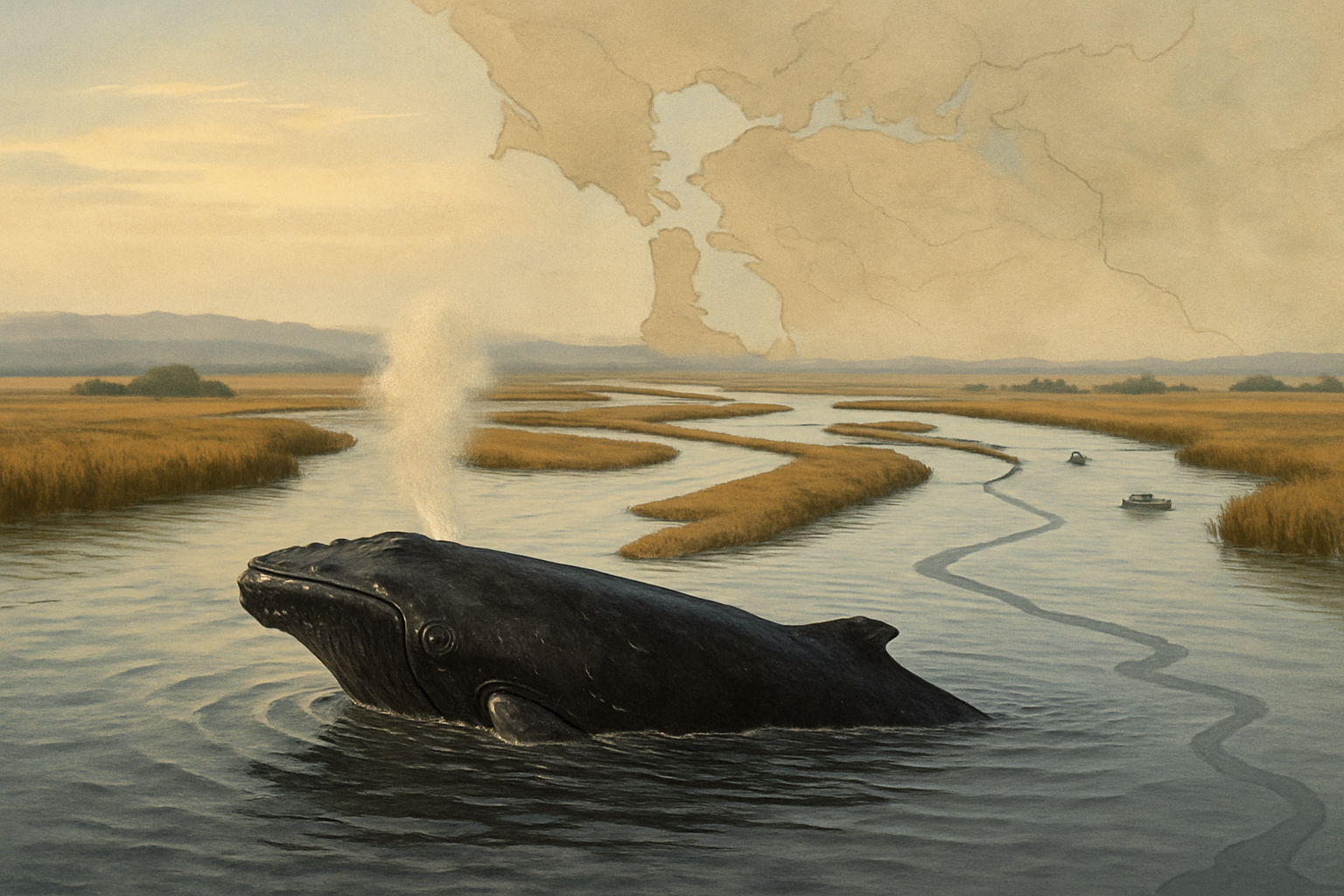
An adult humpback whale has traveled roughly 60 miles inland from the Pacific Ocean into California’s Sacramento-San Joaquin Delta, a rare journey that has drawn marine-mammal researchers and crowds of curious boaters.
The whale, identified by The Marine Mammal Center as “Rio,” was first spotted in San Francisco Bay on Tuesday, September 15. By the following morning, it had continued east through the Bay and into the Delta near Rio Vista, according to the center. A fisherman later recorded the animal surfacing in the Sacramento River while he was out looking for salmon and striped bass.
The whale’s inland route is unusual, but the geography helps explain how it happened. The Sacramento-San Joaquin Delta is a sprawling network of tidal channels linking the Bay with the region’s major rivers. For a whale moving east through San Francisco Bay, those channels can present a continuous waterway—albeit one that leads far beyond its ordinary marine environment.
The Marine Mammal Center said its experts were preparing a visual assessment and coordinating with partners who were observing the whale. The center does not yet know whether Rio is simply passing through or whether an underlying health problem could have contributed to the unusual movement.
That uncertainty is important. A whale that surfaces regularly and appears to move steadily may still require close observation, particularly in a busy waterway with recreational and commercial boats. The center has asked people not to chase, surround, follow or attempt to steer the animal. Anyone encountering Rio should remain at least 100 yards away and allow the whale to choose its own course.
Researchers were able to identify the animal through Cascadia Research Collective’s photo-identification catalog. Rio has been documented 15 times over the past 24 years in California and Mexico. The most recent recorded sighting before this week was in Baja California in February 2026. As with many individually cataloged humpbacks, identification is based on distinctive patterns on the tail flukes and other markings.
The whale’s apparent detour also has a California precedent. In 1985, a humpback known as Humphrey spent weeks in the Rio Vista area before eventually returning to the ocean. In 2007, a mother and calf known as Delta and Dawn traveled into the Sacramento River Delta and remained there for about 20 days before making their way back toward San Francisco Bay and the open ocean.
Those earlier episodes offer some historical reassurance, but they do not make the current sighting routine. The Marine Mammal Center describes Rio’s present location as an “out-of-normal habitat area,” and its eventual condition and destination remain unknown.
For now, the most useful role for the public is restraint rather than rescue. A crowd pressing close to the whale, boats blocking its path or people trying to guide it could add stress and complicate the work of specialists. The center is asking observers to report sightings while giving the animal room to move.
The larger lesson is that the Bay and Delta are not separate worlds. They form a connected, heavily trafficked water system capable of carrying marine wildlife deep inland. But once a humpback follows that system into the river network, researchers must balance the public’s fascination with the animal’s need for space—and wait to see whether Rio can find the way back out.
Sources & Further Reading
- The Marine Mammal CenterPrimary source
- Associated Press
- The Marine Mammal CenterPrimary source
StoryBreak
Independent digital news and reporting, updated throughout the day.
This article was researched and drafted with AI assistance and reviewed as part of StoryBreak's editorial process before publication. Read our editorial standards.