
Scientists Receive Up to $19.8 Million to Develop Bioprinted “Universal” Livers
A Terasaki Institute-led team will use engineered stem-cell-derived liver cells, bioreactors and porous-bed bioprinting to pursue transplantable liver tissue that could work without a donor match or lifelong anti-rejection drugs. The project is an ambitious research effort, not yet a treatment available to patients.
By StoryBreak
Published October 2, 2026 at 6:38 PM
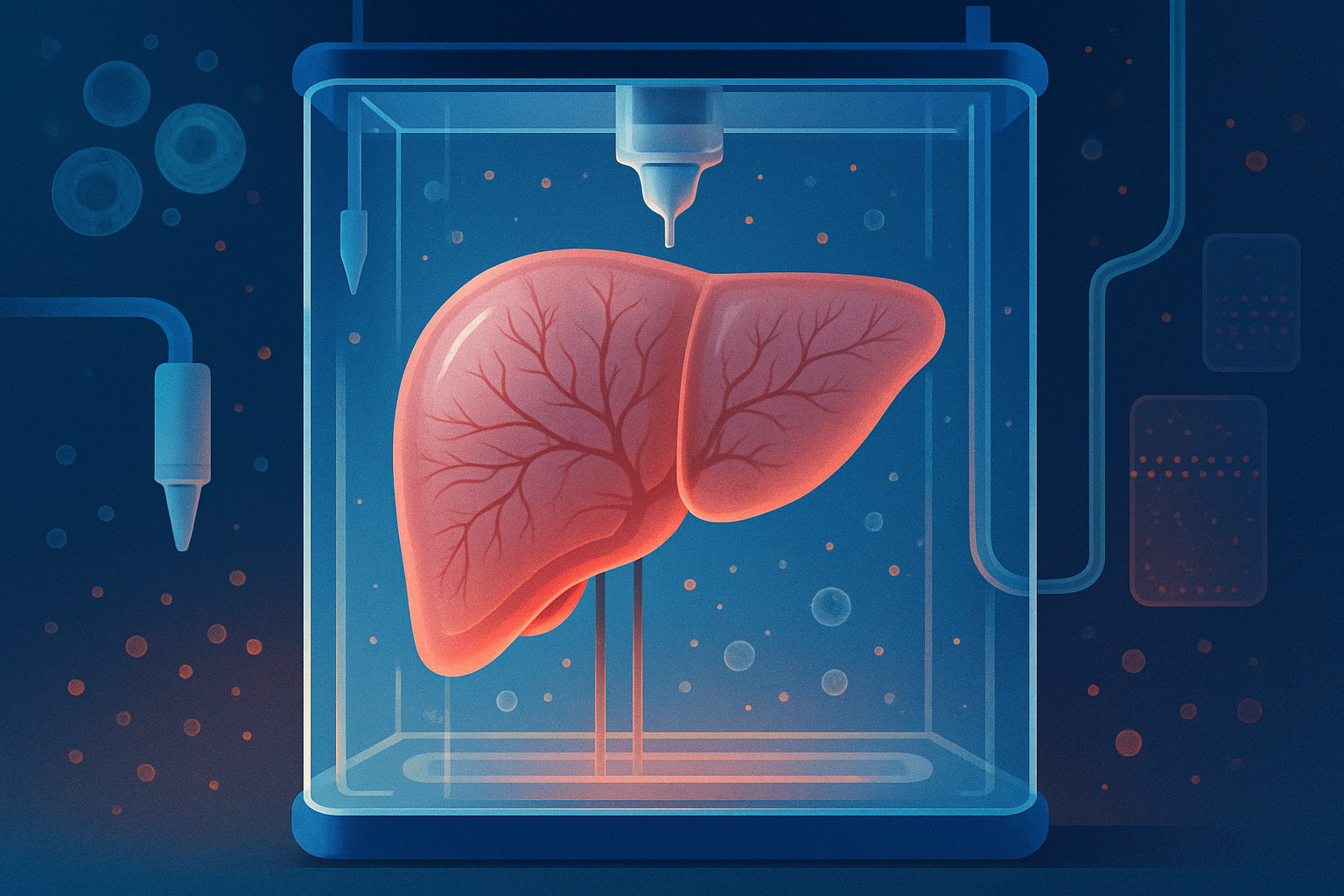
Scientists are taking another step toward an organ that could be manufactured instead of donated.
The Terasaki Institute for Biomedical Innovation will lead a project backed by up to $19.8 million from the Advanced Research Projects Agency for Health to develop bioprinted liver tissue designed for transplantation. The award, announced October 2, 2026, is part of ARPA-H’s PRINT program, a broader effort to create organs and tissues that could be produced on demand.
The project, called Prometheus, combines three difficult tasks. Researchers plan to create liver cells from induced pluripotent stem cells that have been engineered to reduce the likelihood of immune rejection. They will then grow the cells in large-scale bioreactors and use porous-bed bioprinting to assemble them into structured liver tissue.
The goal is an “universal” graft: tissue that would not require the same kind of donor-recipient matching used in conventional transplantation. The team also hopes such a graft could reduce or eliminate the need for lifelong immunosuppressive medication.
That would address two major weaknesses in liver transplantation. Donor organs are limited, leaving thousands of people waiting. The 2023 OPTN/SRTR annual data report recorded 9,745 adult liver candidates still on the U.S. waiting list at the end of that year, after nearly 14,000 new adult registrations. Patients can also face serious long-term consequences after receiving an organ.
According to the National Institute of Diabetes and Digestive and Kidney Diseases, liver-transplant recipients generally need anti-rejection medicines for the rest of their lives. Those drugs lower the risk that the immune system will attack the transplanted organ, but they can also increase vulnerability to infections and contribute to complications including diabetes, high blood pressure and kidney damage.
The promise of the new project lies in trying to solve both problems at once: manufacture more liver tissue and make it less visible to the recipient’s immune system. But “universal” is currently a design objective, not a clinical fact. The cells must still prove that they can perform the liver’s many functions, remain stable after implantation and avoid dangerous immune or tumor-related effects.
The blood-supply problem is especially important. A printed liver cannot function as a solid block of cells; it needs an intricate network capable of delivering oxygen and nutrients and carrying away waste. ARPA-H describes producing a human-sized organ with the cells, vessels and tissue materials needed to function as a real liver as a challenge that has not yet been solved in tissue engineering.
The Terasaki-led team’s early work will therefore focus on the foundations of a future transplant rather than immediate patient treatment. Researchers must establish reliable cell manufacturing, demonstrate that the printed tissue survives and functions in laboratory models, and show that production can be repeated at clinical scale. Human trials, if the project reaches that point, would come later and would require separate safety and regulatory review.
The award is one of several ARPA-H-backed attempts to tackle organ scarcity through bioprinting. Other teams are pursuing different strategies, including patient-specific tissues, immune-compatible livers and artificial organs with restored blood-vessel and bile-duct systems.
What matters now is not whether a printed liver can be announced, but whether it can behave like one. The next meaningful milestones will be evidence of sustained liver function, adequate vascularization, safety of the engineered cells and a manufacturing process that can produce consistent grafts. Until then, the $19.8 million award represents a serious investment in a possible future—not a replacement for donor transplantation today.
Sources & Further Reading
- Advanced Research Projects Agency for Health (ARPA-H)Primary source
- Advanced Research Projects Agency for Health (ARPA-H)Primary source
- Terasaki Institute for Biomedical Innovation via EurekAlert!
- Scientific Registry of Transplant Recipients / Health Resources and Services AdministrationPrimary source
- National Institute of Diabetes and Digestive and Kidney DiseasesPrimary source
StoryBreak
Independent digital news and reporting, updated throughout the day.
This article was researched and drafted with AI assistance and reviewed as part of StoryBreak's editorial process before publication. Read our editorial standards.