Chicago’s Sidewalk Robot Traffic Jam Exposes the Hard Part of Autonomous Delivery
A routing error sent at least a dozen Coco delivery robots into a Lincoln Park sidewalk cluster, briefly blocking pedestrians and renewing questions about whether robot fleets can safely share Chicago’s public space.
By StoryBreak
Published September 19, 2026 at 11:43 PM
Chicago’s sidewalks briefly became a testing ground for a problem autonomous delivery companies rarely advertise: too many robots trying to solve the same problem at once.
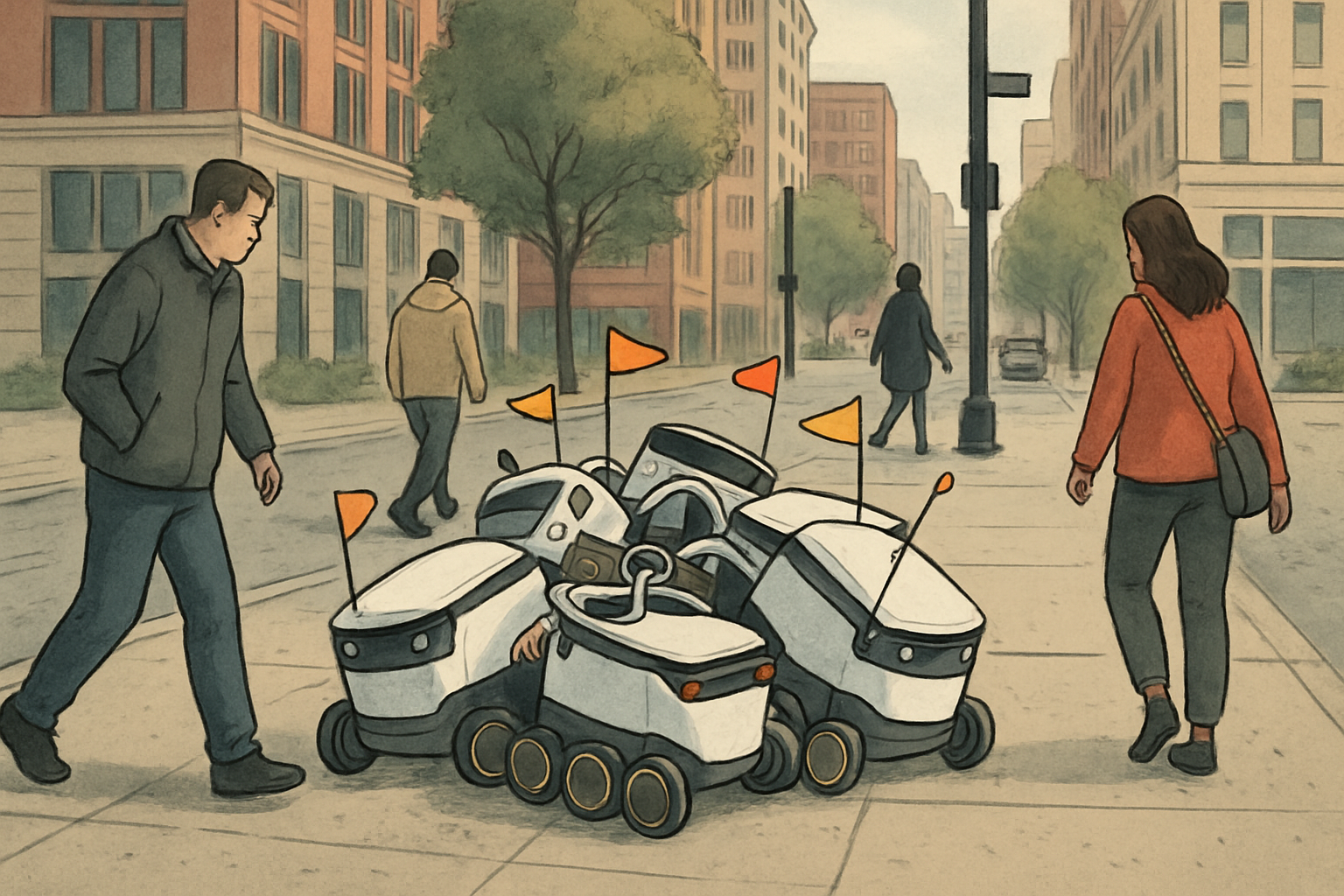
At least a dozen Coco delivery robots clustered along North Clark Street in Lincoln Park during a recent morning, creating what witnesses described as a traffic jam on the sidewalk. A video of the scene spread online, showing the small delivery machines gathered together while pedestrians attempted to get around them.
Coco said the episode was caused by a “sidewalk deployment error.” According to the company’s explanation, several robots leaving a station to begin their daily routes were rerouted at the same time, producing a concentrated group instead of a dispersed fleet. The company said the situation was cleared within minutes and that it had added safeguards to prevent a repeat.
That explanation matters because it points to a fleet-level failure, not simply a robot encountering a trash can, a person or a blocked path. Each machine may be programmed to detect obstacles and find an alternate route. But when multiple robots receive similar instructions in the same constrained environment, their attempts to avoid one another can become the obstacle.
For pedestrians, the distinction is academic only up to a point. A sidewalk blocked for several minutes is still blocked. The impact can be especially serious for people using wheelchairs, walkers or strollers, who may not be able to maneuver around a dense cluster or safely enter the street to bypass it.
Chicago has been testing delivery robots as an alternative to car-based short-distance deliveries. WBEZ has reported that Coco began appearing in parts of the city in late 2024 and that Serve Robotics also operates robots under the city’s pilot program. The companies promote the machines as a way to reduce car trips and emissions while handling short deliveries.
The tradeoff is that the cost is shifted from the roadway to the pedestrian realm. A delivery car occupies curb space or a traffic lane; a sidewalk robot occupies walking space. In a city with narrow sidewalks, restaurant seating, signs, poles, bicycles and construction barriers, the available margin for error is already limited.
The Lincoln Park incident also illustrates why scaling autonomous systems is not simply a matter of adding more units. A single robot can be evaluated for its sensors, speed and ability to stop. A fleet must also be evaluated for coordination: how machines respond when they meet, how they recover from a shared routing error, and how quickly a human operator can intervene when the system creates a blockage.
Chicago residents have already raised broader concerns about the rollout, including pedestrian access and the way the robots fit into public space. WBEZ reported that opposition has included a petition calling for the program to be paused. Earlier incidents involving delivery robots and bus shelters have added to the scrutiny.
Coco’s response may prevent this exact error from recurring. But the more consequential test is whether the city and the companies can show that the safeguards work under ordinary urban pressure—not just in controlled demonstrations. For sidewalk delivery to become routine, the robots will have to do more than complete deliveries. They will have to remain nearly invisible to the people whose paths they share.
That is the standard the Chicago cluster made visible. The technology did not fail because the robots could not move. It failed because, for a few minutes, they moved together in the wrong way.
Sources & Further Reading
StoryBreak
Independent digital news and reporting, updated throughout the day.
This article was researched and drafted with AI assistance and reviewed as part of StoryBreak's editorial process before publication. Read our editorial standards.