
The Human Lost to a Humanoid Robot—But Not to Artificial Intelligence
A viral San Francisco cage fight put influencer Frankie LaPenna against a six-foot Terminator-styled humanoid robot. The dramatic footage shows the machine landing heavy kicks, but the robot was remotely piloted, making the event a demonstration of teleoperation and entertainment—not autonomous combat.
By StoryBreak
Published September 21, 2026 at 11:07 PM
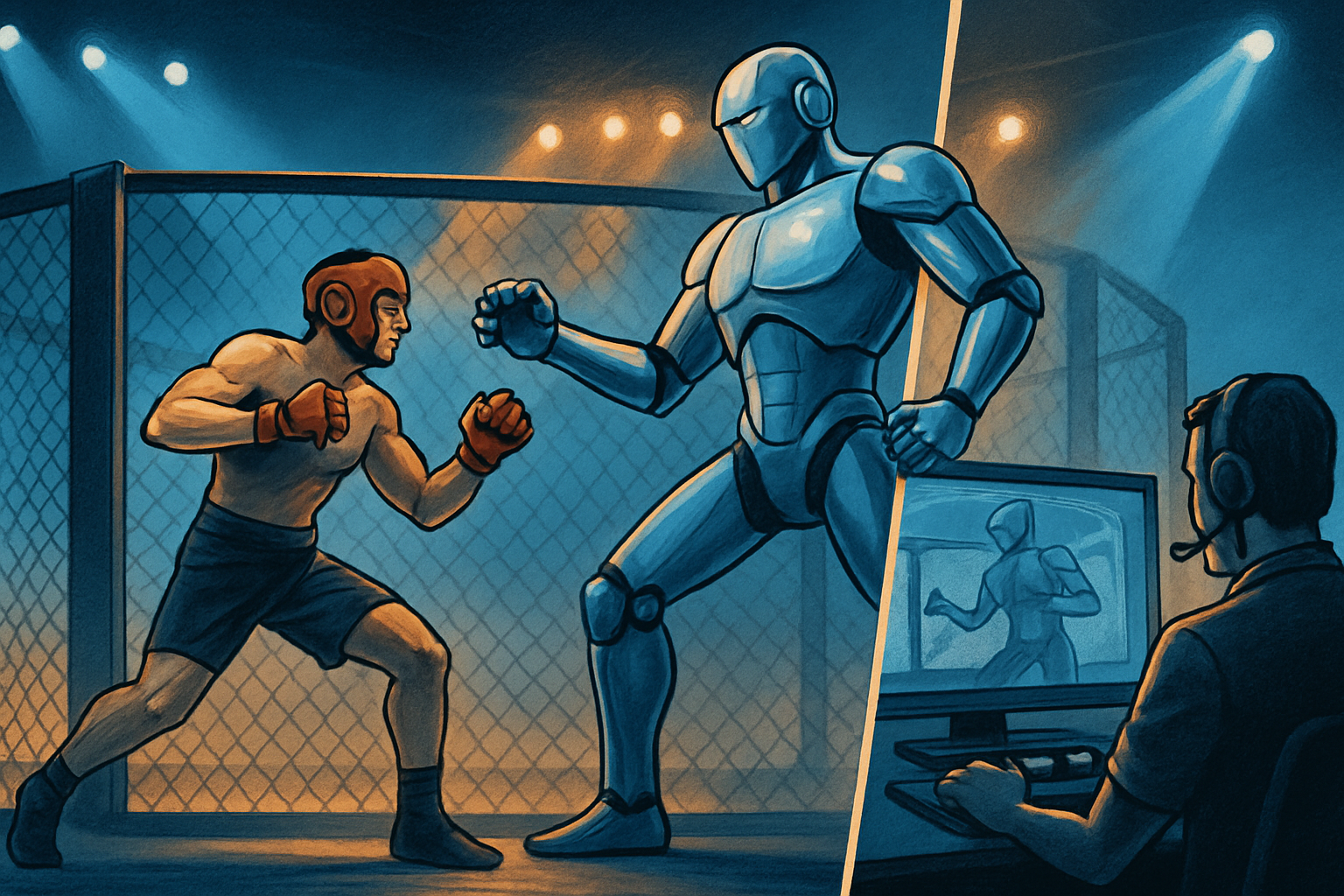
A human stepped into a San Francisco cage with a six-foot humanoid robot last week. The robot kicked him across the ring, battered him against the enclosure and made a viral spectacle out of a question that has mostly belonged to science fiction: what happens when a person fights a machine built in human form?
The answer, for now, is less “artificial intelligence wins” than “a human operator controls a powerful mechanical body.”
The bout took place on September 18 and featured influencer Frankie LaPenna against a Terminator-styled robot at an event organized by REK, a U.S. company developing humanoid-robot combat entertainment and a related virtual-reality simulator. Video released around September 21 shows LaPenna landing several punches before the robot responds with combinations and hard front kicks. One kick sends him flying across the mat.
The footage looks like a preview of a future combat sport. It is also carefully engineered theater. REK’s own description of its live events says the robots are operated by human pilots. The machines are real, but they are not independently deciding how to attack. A person is making the tactical choices while standing somewhere outside the cage, transmitting movements to the robot.
That distinction matters. An autonomous fighting robot would need to perceive an opponent, interpret rapidly changing body positions, select a safe response and execute it while maintaining balance. The San Francisco demonstration showed something narrower but still technically significant: a full-size humanoid platform can transmit a pilot’s movements into a live, contact-heavy environment without immediately collapsing or becoming uncontrollable.
In other words, the event was closer to remote combat than to a machine uprising. The robot supplied the mechanical body, reach and force; the pilot supplied the decisions.
The result was not presented as a conventional professional bout. No independently verified scorecard has surfaced, and accounts disagree about the outcome. Some reports say the footage makes the robot look dominant. REK later claimed that LaPenna continued and ultimately defeated it. The available evidence supports calling the fight a demonstration rather than a formally adjudicated sporting contest.
REK’s business model makes that framing important. Its website promotes live humanoid-robot fights alongside a simulator designed to train prospective pilots. That turns the cage into a testbed for entertainment, control systems and audience engagement. It also creates a pathway for companies to gather practical data about how robots behave when pushed, struck and forced to recover in unpredictable situations.
The timing is notable. Chinese robotics company EngineAI has also staged humanoid-robot combat events, placing full-size machines in an MMA-style cage. Those contests have helped turn balance, striking, durability and recovery into spectator-friendly demonstrations. REK’s event adds a new ingredient: a human opponent, and with it a more immediate conversation about safety.
The next meaningful milestone will not be another dramatic kick. It will be evidence that a robot can fight—or perform similarly complex contact tasks—without a human pilot making the decisions. Until then, the viral San Francisco bout says less about machines replacing fighters than about a new kind of controller turning a humanoid robot into a very expensive, very physical video-game avatar.
Sources & Further Reading
StoryBreak
Independent digital news and reporting, updated throughout the day.
This article was researched and drafted with AI assistance and reviewed as part of StoryBreak's editorial process before publication. Read our editorial standards.