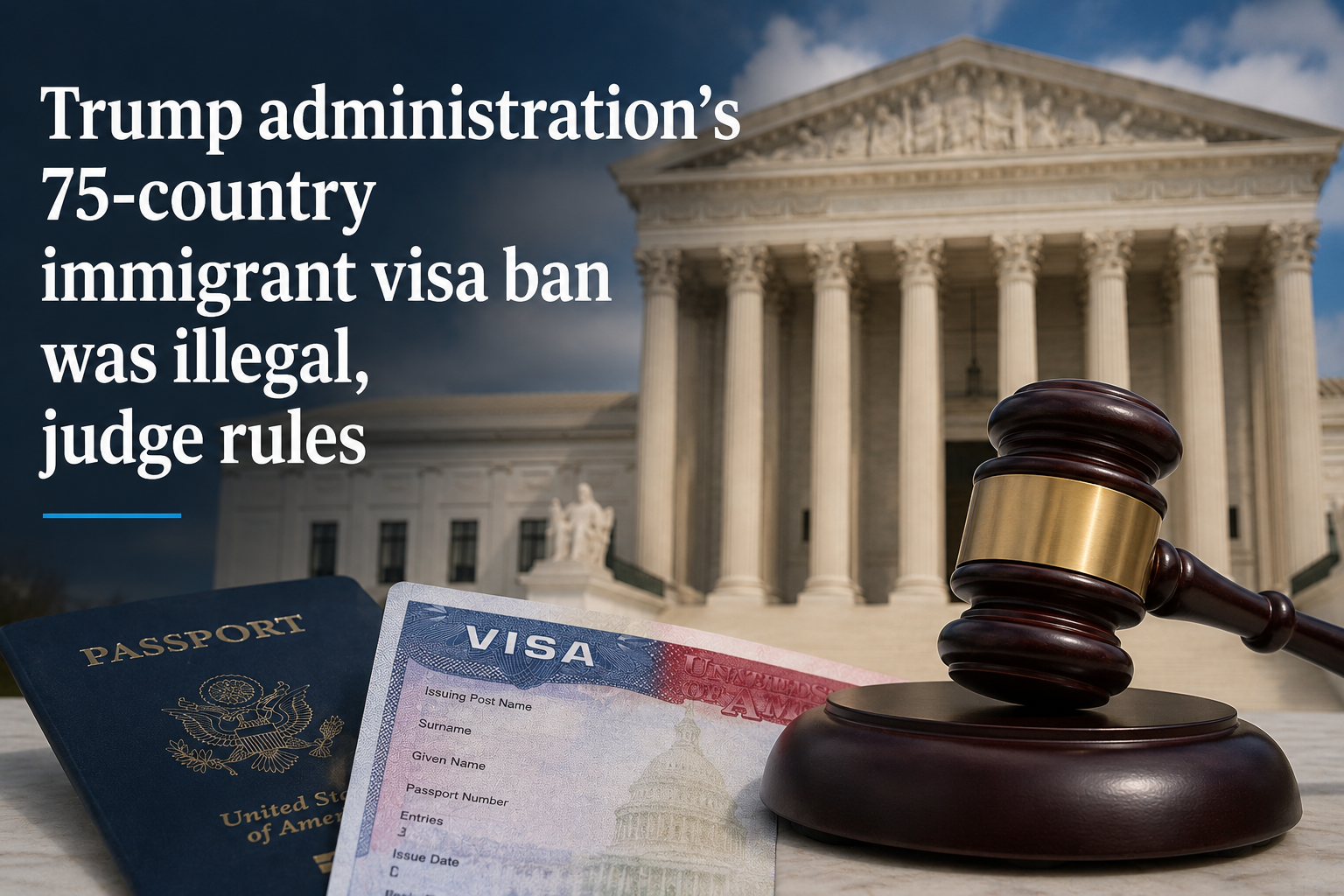
Trump administration’s 75-country immigrant visa ban was illegal, judge rules
A federal judge in New York vacated the State Department’s policy suspending immigrant visa processing for nationals of 75 countries, finding that it exceeded Secretary of State Marco Rubio’s authority and violated federal immigration law.
By StoryBreak
Published August 22, 2026 at 9:08 PM EDT
Updated September 6, 2026 at 8:08 PM EDT
A federal judge has struck down a Trump administration policy that suspended the issuance of immigrant visas to applicants from 75 countries, ruling that the measure was unlawful and exceeded the authority of Secretary of State Marco Rubio.
U.S. District Judge Jeannette A. Vargas of the Southern District of New York issued the decision Friday, August 21, in a lawsuit brought by immigration advocacy organizations, visa applicants and U.S. citizens sponsoring relatives abroad.
The policy, announced by the State Department in January and put into effect on January 21, directed consular officers to halt immigrant visa processing for nationals of the designated countries. The administration justified the suspension by citing concerns that some applicants could become dependent on public assistance and be classified as “public charges.”
Vargas rejected the government’s use of nationality as a blanket basis for suspending visa issuance. She found that the policy conflicted with provisions of the Immigration and Nationality Act that prohibit discrimination in the issuance of immigrant visas based on nationality, among other characteristics.
The judge also concluded that the policy improperly restricted the role of consular officers. Under the administration’s directive, applicants could be refused under a procedural provision even when officers had determined that they were otherwise eligible for an immigrant visa and had not identified an independent legal reason to deny the application.
The ruling vacates the policy and sets aside visa refusals based solely on the 75-country suspension. Those cases must be returned to the State Department for individualized review. The decision does not guarantee that every affected applicant will receive a visa; applicants can still be denied if officials find a separate ground of ineligibility under federal immigration law.
The countries covered by the policy span regions including Africa, Asia, Latin America, the Caribbean, the Middle East and Eastern Europe. Reports identified countries such as Afghanistan, Bangladesh, Brazil, Colombia, Iran, Nigeria, Pakistan, Russia, Somalia and Thailand among those affected.
The lawsuit was filed by the Catholic Legal Immigration Network, African Communities Together and individual plaintiffs. The groups argued that the policy separated families, disrupted employment-based immigration and replaced legally required case-by-case decisions with a categorical restriction based on nationality.
In a statement after the ruling, attorneys and immigration advocates described the decision as a major victory for families and for the principle that visa applications should be evaluated on their individual facts. The challengers also said the policy had left applicants in limbo after they had completed significant parts of the immigration process.
The administration had defended the measure by pointing to its authority to regulate immigration and to Supreme Court precedent upholding a different set of national-security-based travel restrictions during President Donald Trump’s first term. The case before Vargas, however, concerned the suspension of immigrant visa issuance and the State Department’s authority to impose a nationality-wide pause based on public-charge concerns.
The Justice Department and State Department did not immediately announce whether the government would appeal. An appeal could produce further litigation over the scope and timing of the ruling, but unless the decision is stayed, the policy has been vacated and affected applications are to return to individualized processing.
StoryBreak
Independent digital news and reporting, updated throughout the day.
This article was researched and drafted with AI assistance and reviewed as part of StoryBreak's editorial process before publication. Read our editorial standards.