
NATO Jets Shoot Down Drone Over Lithuania as Baltic Airspace Tensions Rise
NATO fighter jets destroyed an unidentified drone over Lithuania after it entered the country’s airspace overnight, Lithuanian authorities said. The drone’s origin and purpose remain under investigation, but the incident underscores how quickly unmanned aircraft linked to the wider Russia-Ukraine war can create a military crisis inside NATO territory.
By StoryBreak
Published September 16, 2026 at 2:19 AM
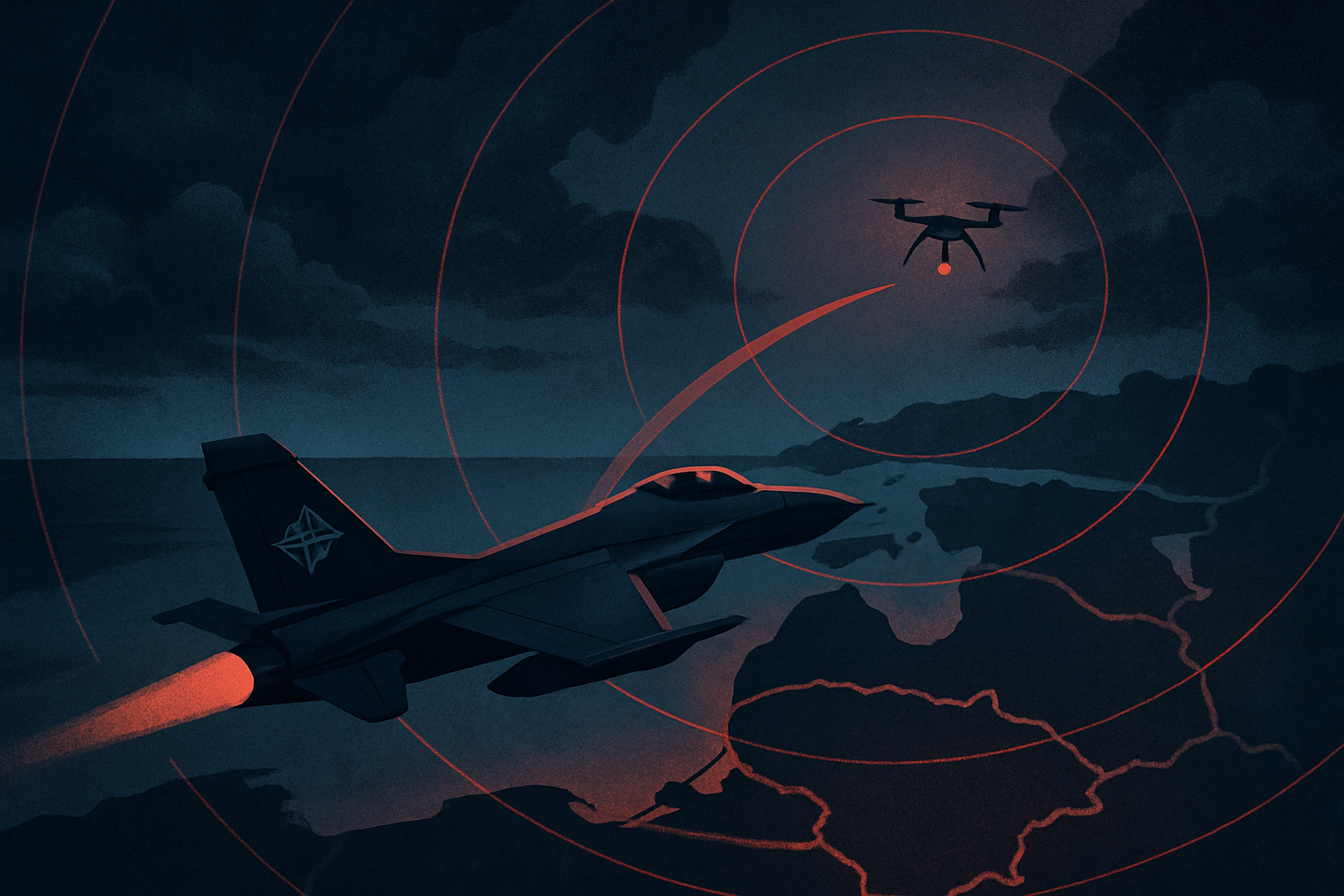
NATO fighter jets shot down an unidentified drone over Lithuania overnight, marking the first such interception reported in Lithuanian airspace and adding a new pressure point to an already tense Baltic security environment.
Lithuania’s National Crisis Management Centre issued an air-raid warning for the Kaunas region at 12:22 a.m. local time on September 15. The drone was later destroyed near Pratkūnai, about 100 kilometers west of Vilnius, according to reporting by The Associated Press.
Lithuanian Defence Minister Robertas Kaunas thanked the Italian crews assigned to NATO’s Baltic air-policing mission, saying the episode demonstrated the strength of allied cooperation. Italian fighter aircraft are currently part of the NATO mission responsible for monitoring the airspace of Estonia, Latvia and Lithuania.
The key fact that remains unresolved is the drone’s identity. Lithuanian authorities have not said whether it was Russian, Ukrainian, Belarusian or launched by another actor. Officials have also not publicly described the incident as a deliberate attack on Lithuania. Those distinctions matter: drones connected to the war in Ukraine have previously strayed into or crashed in NATO territory, while Russia and Belarus have repeatedly been accused by European governments of hostile activity along the alliance’s eastern flank.
That uncertainty does not make the incident minor. It demonstrates the difficulty of defending NATO airspace against small, relatively inexpensive aircraft whose flight paths can be hard to track and whose intentions may not be clear until they are close to the ground. A fighter jet can destroy such a target, but using a high-end aircraft to counter a low-cost drone creates an expensive and potentially unsustainable response model if incursions become routine.
The Baltic states have been dealing with versions of this problem for months. In May, a NATO fighter operating from Lithuania shot down a drone over southern Estonia. In June, French aircraft participating in the Baltic air-policing mission destroyed a drone that entered Latvian airspace. Lithuania has also documented earlier drone crashes, including Russian-made Gerbera-type aircraft that crossed from Belarus in 2025.
The pattern points to two overlapping realities. First, the war in Ukraine is producing airspace spillover: attack drones and other unmanned systems can cross borders accidentally, be disrupted by electronic warfare or follow routes that bring them over NATO territory. Second, the repeated incursions are forcing NATO to treat the eastern flank as a permanently active air-defence problem, even when there is no immediate evidence of an attack on an alliance member.
For Lithuania, the next step is attribution. Investigators will need to reconstruct the drone’s route, inspect its wreckage and determine whether it carried explosives or military equipment. Those findings could shape the diplomatic response and determine whether the incident is treated as an accident, a consequence of electronic interference or a hostile operation.
For NATO, the immediate message is more practical than political: the alliance detected an unidentified aircraft, scrambled fighters and brought it down. The harder test is what comes next—building a system that can identify such drones quickly, respond proportionately and avoid turning every ambiguous intrusion into a wider confrontation.
Sources & Further Reading
- Lithuania’s National Crisis Management Centre / LT72Primary source
- Ministry of National Defence of the Republic of LithuaniaPrimary source
- The Associated Press
- NATOPrimary source
- Ministry of National Defence of the Republic of LithuaniaPrimary source
- Ministry of National Defence of the Republic of LithuaniaPrimary source
StoryBreak
Independent digital news and reporting, updated throughout the day.
This article was researched and drafted with AI assistance and reviewed as part of StoryBreak's editorial process before publication. Read our editorial standards.