Accidental New Jersey Fiber Cut Disrupts Thousands of U.S. Flights
A failed FAA communications circuit and a backup fiber line accidentally severed during New Jersey construction forced ground stops and delays at major Northeast airports, sending disruptions across the country.
By StoryBreak
Published September 21, 2026 at 10:52 PM
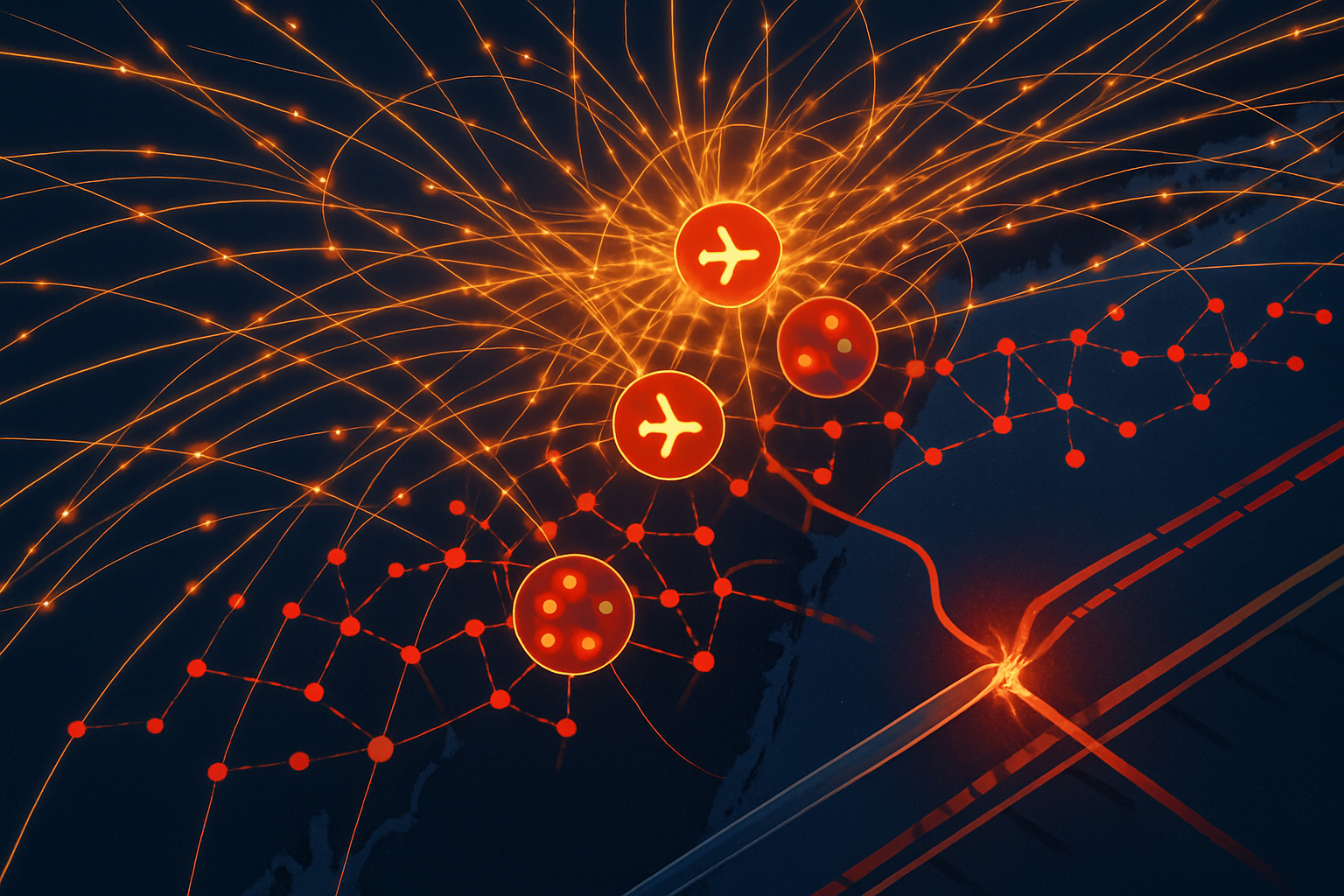
Thousands of U.S. flights were delayed or canceled Monday after a telecommunications failure at a key Federal Aviation Administration air-traffic facility collided with an accidentally severed backup fiber line in New Jersey.
The disruption centered on the Philadelphia Terminal Radar Approach Control facility, or TRACON, which manages aircraft arriving at and departing from Newark Liberty International Airport and helps coordinate traffic across the region. Newark, Philadelphia, New York-area airports and Boston were among the airports affected as the FAA restricted incoming traffic and imposed ground stops or delay programs.
The sequence mattered. According to accounts from FAA Administrator Bryan Bedford and Transportation Secretary Sean Duffy, the facility’s primary communications circuit failed Monday morning. When the system attempted to switch to its backup, officials discovered that a fiber line in New Jersey had been cut during construction by an Amtrak crew. Verizon said the damaged cable ran alongside an Amtrak rail line.
That turned a routine equipment failure into a broader airspace problem. Air-traffic systems depend on continuous communications between controllers, radar and airport facilities. When the available capacity falls below what controllers can safely manage, the FAA slows or stops arrivals rather than allowing congestion to build in the air or on the ground.
Flight-tracking data cited in contemporaneous reporting showed more than 5,600 flights delayed or canceled, with more than 1,200 disruptions at the three major New York-area airports. More than 100 flights were diverted. The totals were moving as airlines adjusted schedules and the system began recovering.
The effects reached well beyond New Jersey. Newark is a major United Airlines hub, while Philadelphia is a major American Airlines hub. Once aircraft and crews are out of position, a local air-traffic restriction can continue producing cancellations and delays after the original technical problem is fixed. Travelers in cities far from the Northeast can therefore feel the effects of an outage they never pass through.
The episode also exposes a less visible weakness in modern aviation: redundancy is only useful if separate backup paths remain operational. The FAA has been upgrading the communications network between New York and Philadelphia and has described plans for separate fiber routes, temporary satellite backup and systems that reduce dependence on a single data feed. Monday’s failure demonstrated why those measures matter.
The incident did not involve a reported aircraft accident. It was a capacity and communications failure that prompted officials to restrict traffic as a safety precaution. But the result was still consequential for travelers because the Northeast corridor is one of the most densely used parts of the U.S. airspace system.
By Monday evening, some restrictions had been lifted and flights were resuming at affected airports. The immediate priority was restoring the damaged line and installing a replacement circuit. The longer-term question is whether the network’s physical routes, construction safeguards and backup systems can prevent a similar combination of failures from turning one cut cable into a nationwide travel disruption.
Sources & Further Reading
StoryBreak
Independent digital news and reporting, updated throughout the day.
This article was researched and drafted with AI assistance and reviewed as part of StoryBreak's editorial process before publication. Read our editorial standards.