This Tiny Drone Navigates in the Dark by Feeling Its Way With Whiskers
Researchers at Delft University of Technology built a lightweight drone that uses flexible artificial whiskers and onboard processing to follow surfaces in complete darkness. The approach could help small aerial robots operate where cameras and conventional proximity sensors struggle—but it is still an experimental tactile-navigation system, not an all-purpose replacement for vision.
By StoryBreak
Published September 21, 2026 at 12:46 AM
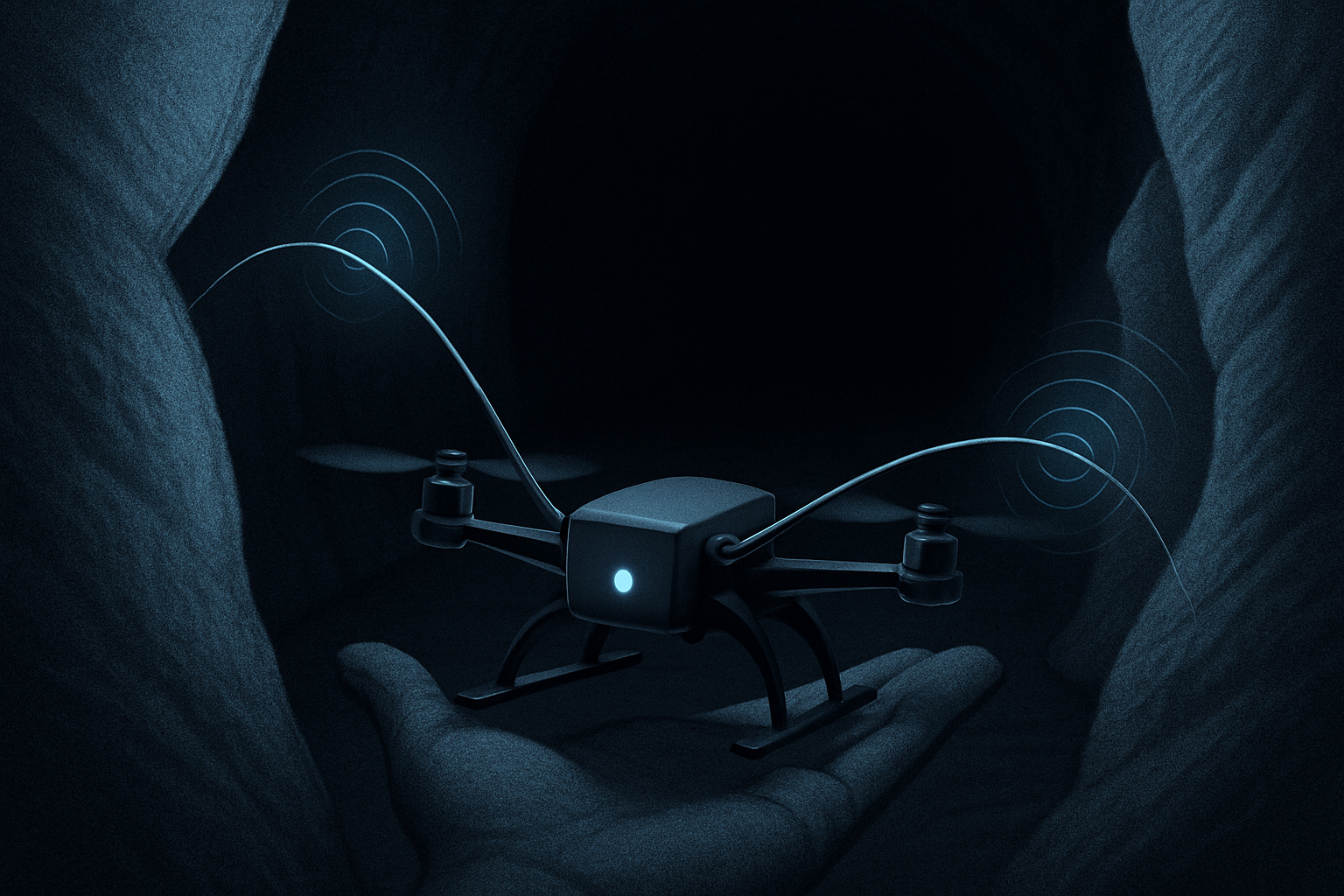
A tiny drone has learned an old biological trick: when it cannot see, it feels its way forward.
Researchers at Delft University of Technology have built a lightweight flying robot with two flexible artificial whiskers that let it detect nearby surfaces, estimate contact and follow walls in complete darkness. The work, published September 18, 2026, in Nature Communications, points toward a different model for drone navigation—one based not on seeing farther, but on making controlled contact useful.
The prototype weighs 44.1 grams. Its whiskers are made from thin Nitinol wire, a shape-memory alloy, and extend from the front of the drone. At the base of each whisker, miniature barometers measure pressure changes as the wire bends. Software then converts those signals into estimates of where and how the whisker is touching a surface.
That design borrows from rats and other animals that use whiskers to explore dark, confined environments. But flying robots face an extra problem: touching a wall can push a lightweight aircraft off course. The researchers therefore designed the whisker assembly to be compliant and low-force, while using filtering and machine-learning models to distinguish useful contact information from disturbances caused by the drone’s own propellers.
In real flight tests, the drone followed both rigid and soft surfaces in total darkness. It could trace the contours of surfaces while relying on tactile information for the immediate environment. The researchers also demonstrated navigation around obstacles that were difficult or impossible for vision-based systems to use reliably.
The system’s small size is central to the result. The paper describes a whisker sensing apparatus weighing 3.2 grams; the complete added hardware, including mounts and wiring, added about 6 grams to the aircraft. The processing pipeline runs onboard a microcontroller, avoiding the need to send sensor data to a nearby computer.
That matters because the smallest drones have little room for cameras, lidar or powerful processors. Even when those sensors fit, darkness, dust, smoke, reflective surfaces and visual clutter can reduce their usefulness. Touch, by contrast, does not need illumination. Its range is short, but it can provide reliable information once the robot is close enough to make contact.
The researchers’ broader system combines wall-following with an algorithm that chooses where to explore next. In simulations, the drone found the exit from an unfamiliar enclosed environment in nine of 10 trials, or 90 percent, within five minutes. The simulations also produced three-dimensional reconstructions of the explored spaces.
That result should be read carefully. The exit-finding and mapping performance was reported from simulation, while the physical demonstrations focused on tactile flight and following surfaces in darkness. The drone is not yet a general-purpose replacement for cameras or long-range obstacle sensors. A robot that navigates by touch must first get close enough to something—and contact can still create instability, trap the vehicle in corners or cause it to miss obstacles outside the whiskers’ reach.
The significance is more practical than futuristic. For a small drone entering a tunnel, damaged building, cave or industrial space, the ability to switch from vision to touch could provide a backup when the environment defeats cameras. It may also allow designers to build smaller robots that carry less sensing hardware and computation.
The next challenge is adaptability. The researchers suggest that future systems could learn to use short, multidirectional whisker sweeps with little or no task-specific labeling. If that works outside controlled demonstrations, tiny drones may gain a new kind of autonomy—not the ability to see everything, but the ability to safely make sense of what they can physically feel.
Sources & Further Reading
- Nature CommunicationsPrimary source
- arXivPrimary source
- TU Delft Research PortalPrimary source
- EurekAlert!
StoryBreak
Independent digital news and reporting, updated throughout the day.
This article was researched and drafted with AI assistance and reviewed as part of StoryBreak's editorial process before publication. Read our editorial standards.