U.S. strikes massive Venezuela oil deal covering more than 65 billion barrels
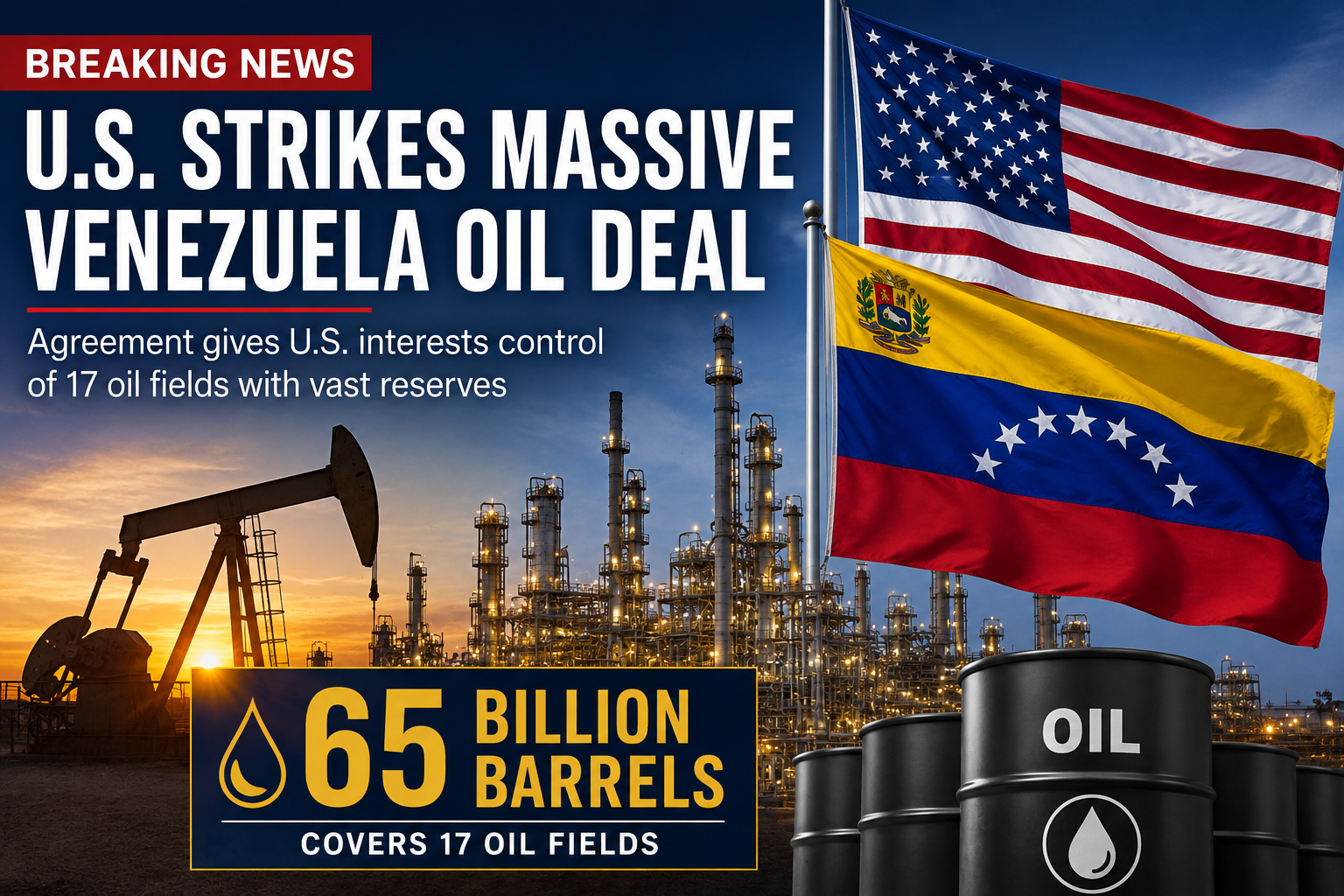
President Donald Trump has announced an unprecedented oil agreement with Venezuela that gives U.S. interests majority control over the development of 17 oil fields containing more than 65 billion barrels of proven reserves, as the administration looks to expand supplies and eventually bring down fuel prices.
By StoryBreak
Published August 29, 2026 at 11:06 PM
Updated September 7, 2026 at 12:01 AM
The United States has reached an extraordinary agreement with Venezuela that could dramatically expand America's role in one of the world's largest oil-producing regions.
President Donald Trump announced Friday that the United States and Venezuela had reached an agreement giving U.S. interests majority control over more than 65 billion barrels of proven Venezuelan oil reserves.
Trump called it the “biggest oil deal in world history.”
Venezuela's acting president, Delcy Rodríguez, has confirmed the agreement and described it as an important step toward rebuilding the country's struggling oil industry and economy.
The agreement centers on the development of 17 Venezuelan oil fields and could bring nearly $100 billion in private investment into the country's energy sector, according to officials.
If fully implemented, it would represent one of the most significant expansions of American involvement in Venezuela's oil industry in decades.
How the agreement would work
The arrangement is unusual.
According to information reported by the Associated Press, the U.S. government and an unnamed private operator would participate in a new company granted rights to develop the Venezuelan fields.
The agreement would give the United States 55% of the company's effective output, through a combination of an ownership stake and rights to purchase oil at cost.
Venezuela says the arrangement covers fields with a proven potential exceeding 65 billion barrels.
The concession would reportedly extend for 100 years.
The oil could provide a long-term source of crude for American refineries, while some could potentially be used to replenish the Strategic Petroleum Reserve, which the federal government maintains for energy emergencies.
Why Venezuela matters so much
Venezuela possesses an enormous amount of oil.
The country has the largest proven crude-oil reserves in the world, but its actual production is far below what those reserves might suggest.
Venezuela currently produces approximately 1.25 million barrels per day, according to Reuters.
Years of underinvestment, deteriorating infrastructure, political turmoil, sanctions and mismanagement have prevented the country from producing anywhere near its theoretical capacity.
That creates both an opportunity and a major challenge.
There may be tens of billions of barrels underground, but getting significantly more of that oil out of the ground will require enormous investment.
Will this lower gas prices?
Trump says it will.
The president said the agreement would increase oil supplies and substantially lower gasoline prices for Americans.
Secretary of State Marco Rubio has similarly argued that the deal could provide the United States with a stable source of lower-cost crude.
But consumers shouldn't necessarily expect gasoline prices to plunge immediately.
Venezuela's oil industry needs extensive investment in drilling equipment, pipelines, refineries and other infrastructure.
Reuters reports that analysts say it could take years for the agreement to produce a substantial increase in oil output.
The type of oil matters, too.
Much of Venezuela's crude is particularly heavy and requires specialized refining equipment. Some U.S. Gulf Coast refineries are capable of processing that type of oil, which is one reason Venezuelan crude has strategic value to the United States.
American oil companies still have to invest
Another major unanswered question is whether American energy companies will be willing to commit the billions of dollars required.
Venezuela has a complicated history with foreign oil producers.
The country nationalized its oil industry in the 1970s, and former President Hugo Chávez later tightened government control over projects operated by foreign companies.
Assets involving companies including ExxonMobil and ConocoPhillips were eventually expropriated.
Today, Chevron remains the only major U.S. oil company actively producing crude in Venezuela.
Chevron and ExxonMobil declined to comment on the newly announced agreement, according to AP.
Important questions remain unanswered
Despite the enormous numbers surrounding the announcement, important details remain unclear.
The White House has released relatively little information about the legal and financial structure of the agreement.
AP reports that the complete text of the agreement has not been publicly released. It remains unclear precisely how the U.S. ownership interest will operate, which private companies will participate and how quickly development can begin.
There could also be legal challenges.
Reuters reports that questions remain about whether parts of the arrangement comply with Venezuela's constitution and hydrocarbons laws, which historically reserved significant control over the petroleum industry for the Venezuelan state.
Venezuela sees an economic lifeline
For Venezuela, the agreement could mean much more than increased oil production.
Rodríguez's government estimates that development of the 17 fields could attract roughly $100 billion in private investment and eventually generate more than $209 billion in tax revenue for Venezuela.
That would represent a massive influx of capital into an economy that has endured years of crisis.
The deal also comes amid a dramatic transformation in relations between Washington and Caracas following the removal of Nicolás Maduro earlier this year.
The U.S. Treasury Department has recently modified Venezuela-related licenses to facilitate American investment and petroleum activity in the country.
A potentially historic deal — with a long way to go
The scale of the agreement is difficult to ignore.
Sixty-five billion barrels represents roughly one-fifth of Venezuela's enormous proven oil reserves.
If American companies successfully develop those fields, the agreement could reshape energy ties between the two countries and provide the United States with a major new long-term source of crude.
But having access to oil underground isn't the same as having millions of additional barrels flowing into American refineries.
Billions of dollars must be invested. Infrastructure must be rebuilt. Companies must agree to participate. Legal questions must be resolved.
So while the agreement announced Friday could ultimately have major consequences for U.S. energy supplies and gasoline prices, its full impact will likely be measured in years rather than weeks.
Sources & Further Reading
- The White House — Fact SheetPrimary source
- NPR
- Al Jazeera
- CNBC
StoryBreak
Independent digital news and reporting, updated throughout the day.
This article was researched and drafted with AI assistance and reviewed as part of StoryBreak's editorial process before publication. Read our editorial standards.