
Scientists Find Alzheimer’s Is Linked to a Hidden 3D Layer of the Human Genome
A study of individual brain cells from people with and without Alzheimer’s disease suggests that the physical folding of DNA changes alongside gene activity. The finding adds genome architecture—not just DNA sequence—to the list of biological processes researchers must examine in the disease.
By StoryBreak
Published September 13, 2026 at 5:10 PM
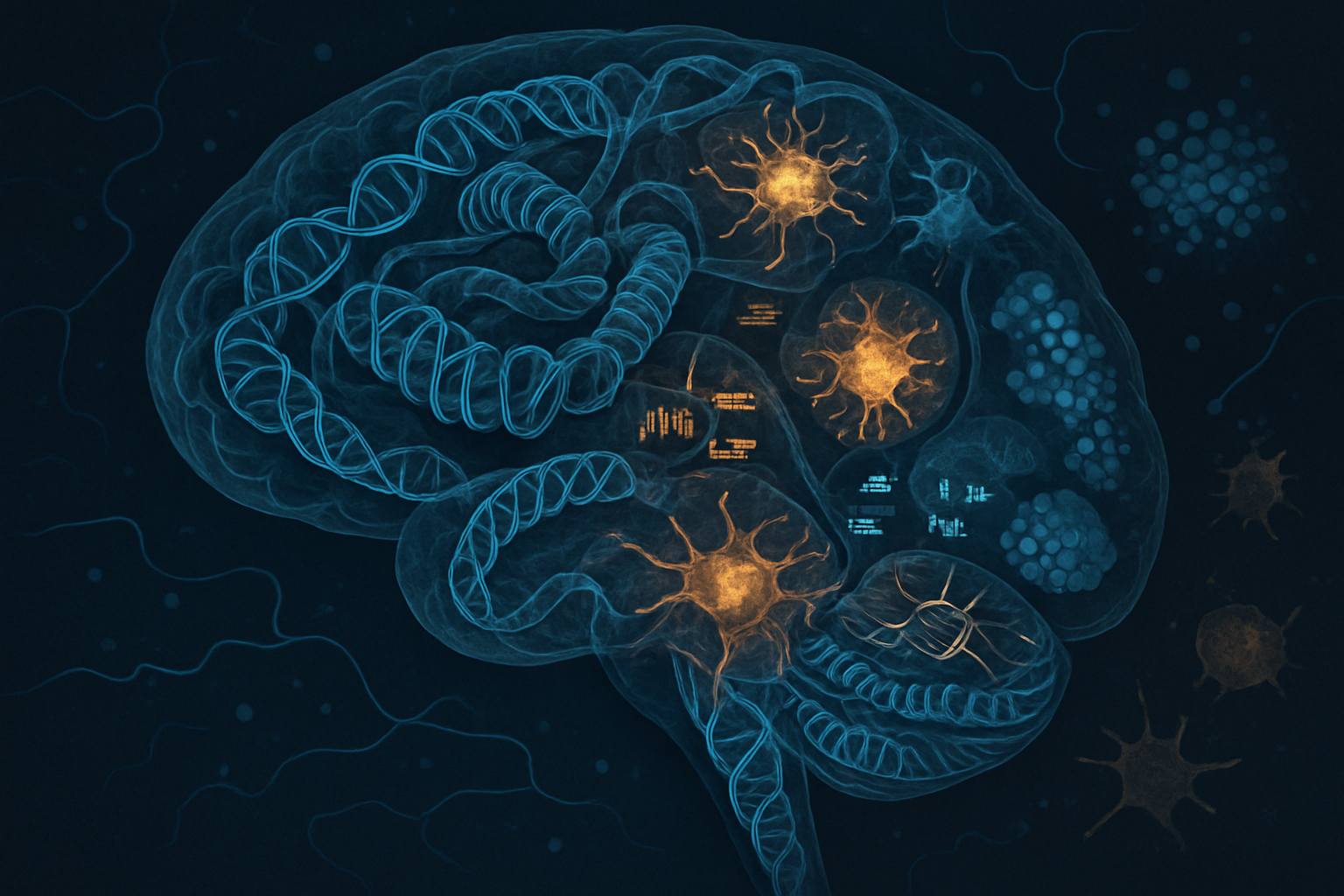
Alzheimer’s disease may be changing the genome in a way that standard genetic tests cannot see: by reshaping how DNA folds inside individual brain cells.
A study published July 23, 2026, in Science found that the three-dimensional organization of the genome differs in postmortem brain tissue from people with Alzheimer’s disease. The researchers linked those structural changes to shifts in gene activity, offering evidence that genome folding is an important part of Alzheimer’s biology.
The result is not the discovery of a new gene, and it is not proof that altered DNA folding starts the disease. Instead, it identifies another layer of regulation between the genome’s sequence and the behavior of brain cells.
DNA is often described as a linear code. Inside a cell, however, that code is tightly folded and looped into chromatin. The arrangement determines which genes can physically interact with nearby or more distant regulatory elements. When the arrangement changes, genes can become more or less active even though the underlying DNA letters remain the same.
The research team used a method called GAGE-seq to measure gene expression and three-dimensional chromatin structure in the same individual cells. That paired approach allowed the scientists to ask not only whether a gene was active, but also whether the surrounding genome was arranged in a way that could help explain its activity.
The researchers analyzed postmortem brain tissue from people with Alzheimer’s disease and age-matched individuals without the disease. The work covered multiple types of brain cells and combined the single-cell measurements with spatial transcriptomics and chromatin-accessibility data. The resulting maps showed cell-specific genome reorganization associated with altered neuronal, synaptic, metabolic and immune-related programs.
An important pattern was a weakening of some contacts between genes and the regulatory elements that help control them, along with changes in longer-range contacts. In Alzheimer’s-affected cells, active and inactive regions of the genome also appeared less sharply separated. These observations were associated with reduced gene activity in disease-relevant programs, although the study cannot determine whether the architectural changes are a cause of degeneration, a consequence of it, or both.
The researchers also developed a deep-learning model, Hicformer, to test whether three-dimensional genome information improved predictions of gene activity. According to the study, incorporating genome architecture helped predict disease-related, cell-type-specific expression changes better than relying on sequence-level information alone.
That finding matters because many Alzheimer’s risk variants lie outside protein-coding genes. Such variants may influence regulatory elements rather than directly altering a protein. A map of genome folding could help researchers identify which distant DNA regions are functionally connected to disease-associated genes—and which connections are disrupted in particular cell types.
But the study’s evidence comes with important limits. The NIH summary describes a comparison involving 10 people with Alzheimer’s disease and 10 people without it, all aged 75 or older. The samples were collected after death, providing a detailed snapshot but not a movie of disease progression. The results will need to be tested in larger, more diverse groups and across additional brain regions.
For now, the discovery is best understood as a change in the research map. Alzheimer’s is not only a disorder of abnormal proteins or individual genetic variants. It may also involve the way the genome is physically arranged—an organizational system that helps determine which genetic instructions a brain cell can read.
The next challenge is separating the structural changes that drive disease from those produced by damaged cells. If some of the altered contacts appear early and prove reversible, they could eventually become therapeutic targets. That possibility remains speculative, but the new maps give scientists a more detailed place to look.
Sources & Further Reading
StoryBreak
Independent digital news and reporting, updated throughout the day.
This article was researched and drafted with AI assistance and reviewed as part of StoryBreak's editorial process before publication. Read our editorial standards.