
FDA approves first-of-its-kind drug that could reduce blood draws for rare blood cancer patients
The FDA has approved Mimrylo, a first-in-class treatment for adults with polycythemia vera that helps control the overproduction of red blood cells and could substantially reduce patients' need for repeated therapeutic blood draws.
By StoryBreak
Published August 29, 2026 at 11:00 PM
Updated September 6, 2026 at 8:39 PM
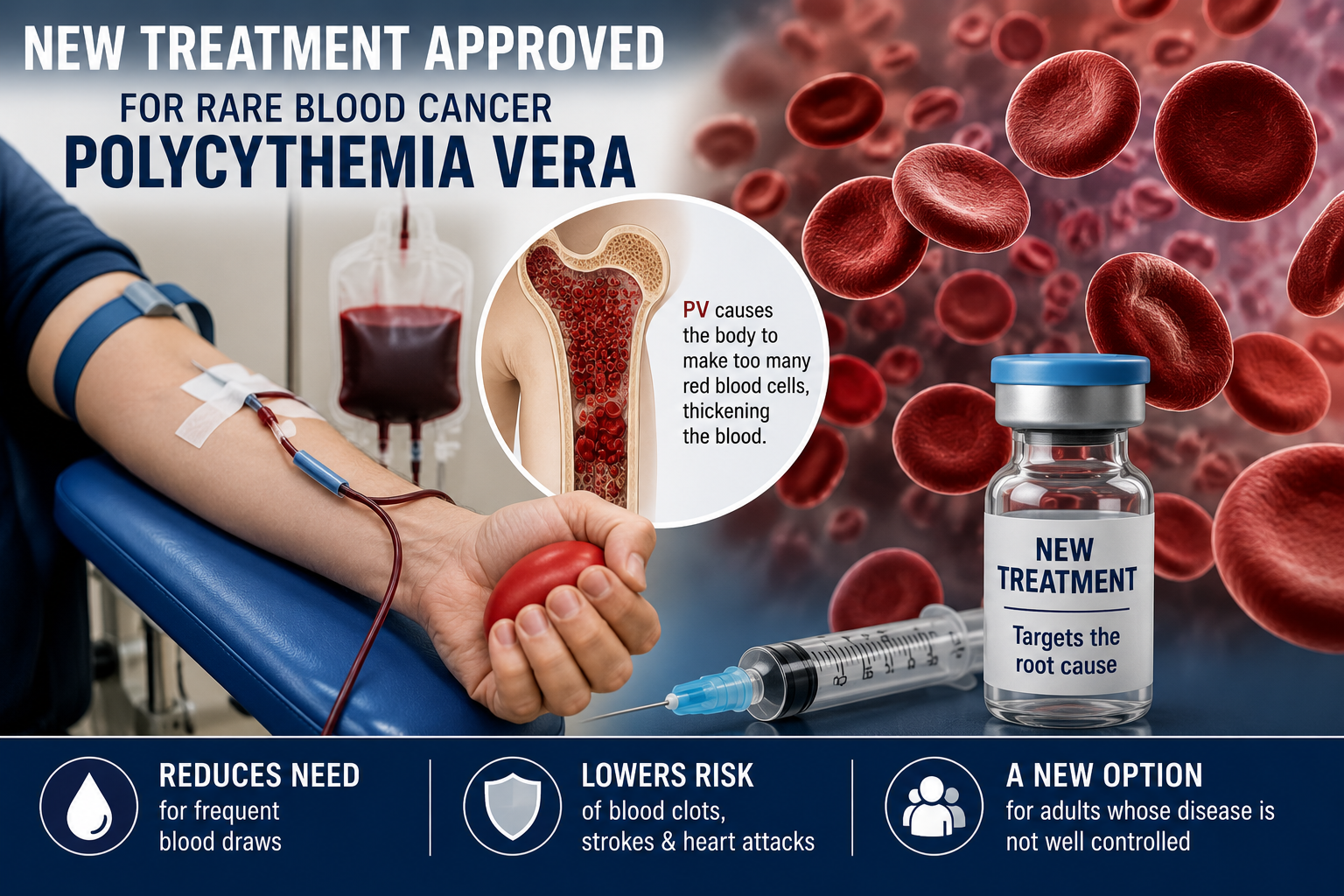
For many people living with a rare blood cancer called polycythemia vera, treatment has involved something that sounds surprisingly old-fashioned: regularly having blood removed from the body.
A newly approved medication could change that for some patients.
The U.S. Food and Drug Administration on Friday approved Mimrylo, also known as rusfertide, a first-of-its-kind treatment for adults with polycythemia vera whose disease has not been adequately controlled with existing therapies.
Polycythemia vera, often shortened to PV, causes the body to produce too many red blood cells.
Those excess cells can make the blood thicker, increasing the risk of dangerous cardiovascular complications including blood clots, strokes and heart attacks.
The new treatment takes a different approach to controlling that overproduction.
Why patients have blood removed
One of the primary goals in treating polycythemia vera is keeping a patient's hematocrit below 45%.
Hematocrit represents the proportion of a person's blood made up of red blood cells.
For some patients, controlling it requires therapeutic phlebotomy.
The procedure resembles donating blood: blood is removed through a vein to reduce the number of circulating red blood cells.
But unlike someone occasionally donating blood, a patient with poorly controlled PV may need the procedure repeatedly.
The FDA said frequent phlebotomies can create an ongoing burden for patients.
The new drug works differently
Mimrylo is the first approved treatment for polycythemia vera designed to mimic hepcidin, a hormone the body naturally uses to regulate iron.
Iron is essential for producing red blood cells.
By controlling how much iron is available for that process, rusfertide can help limit the body's excessive production of red blood cells and keep hematocrit under control.
Rather than simply removing excess red blood cells after they're produced, the treatment therefore targets a biological mechanism involved in their production.
That's what makes the drug particularly notable.
Trial involved 293 adults
The FDA based its approval in part on results from a Phase 3 clinical trial known as VERIFY.
The randomized, double-blind trial included 293 adults with polycythemia vera who continued to require frequent phlebotomies despite receiving standard treatment.
Participants received either rusfertide or a placebo in addition to their existing treatment.
During weeks 20 through 32, 76.9% of patients receiving rusfertide achieved the trial's clinical-response goal, compared with 32.9% of those receiving placebo.
That response was defined around maintaining hematocrit control without meeting the criteria for another phlebotomy.
Researchers also found improvements in measures including fatigue and overall symptom burden.
The goal isn't necessarily eliminating every blood draw
The approval doesn't mean therapeutic phlebotomy will disappear from polycythemia vera treatment.
Patients may still require blood draws depending on how well their disease is controlled, and rusfertide is being used as part of a broader treatment strategy rather than as a universal replacement for existing care.
But reducing how frequently patients need phlebotomy could make a significant difference in day-to-day life.
The FDA described the treatment as a new option for people who haven't achieved adequate disease control with existing therapies.
What about side effects?
According to the FDA, the most commonly reported adverse reactions included injection-site reactions, anemia and fatigue.
Because the medication changes how iron is distributed in the body, healthcare providers will need to monitor patients appropriately during treatment.
Rusfertide is administered by injection.
As with any newly approved prescription drug, whether it's appropriate for an individual patient is a decision that needs to be made with that person's healthcare team.
A different way of treating the disease
Polycythemia vera is chronic, meaning patients can live with the disease and its treatment demands for years.
Takeda estimates that roughly 90,000 people in the United States have PV.
The disease can also cause symptoms such as severe fatigue, itching, difficulty concentrating and night sweats.
The approval of rusfertide doesn't cure PV.
Instead, it introduces a new way to address one of the disease's fundamental problems: the production of too many red blood cells.
For patients who have spent years repeatedly having blood removed to keep those cells under control, that distinction could be significant.
Sources & Further Reading
StoryBreak
Independent digital news and reporting, updated throughout the day.
This article was researched and drafted with AI assistance and reviewed as part of StoryBreak's editorial process before publication. Read our editorial standards.