Why Salt Raises Blood Pressure More in Some People Than Others — Scientists May Have Found a Key Reason
A 2025 study points to a gut-microbiome-derived metabolite called isovalerylcarnitine as a possible reason some people are far more sensitive to dietary salt. The finding is promising, but it is not yet a human treatment.
By StoryBreak
Published September 7, 2026 at 9:57 PM
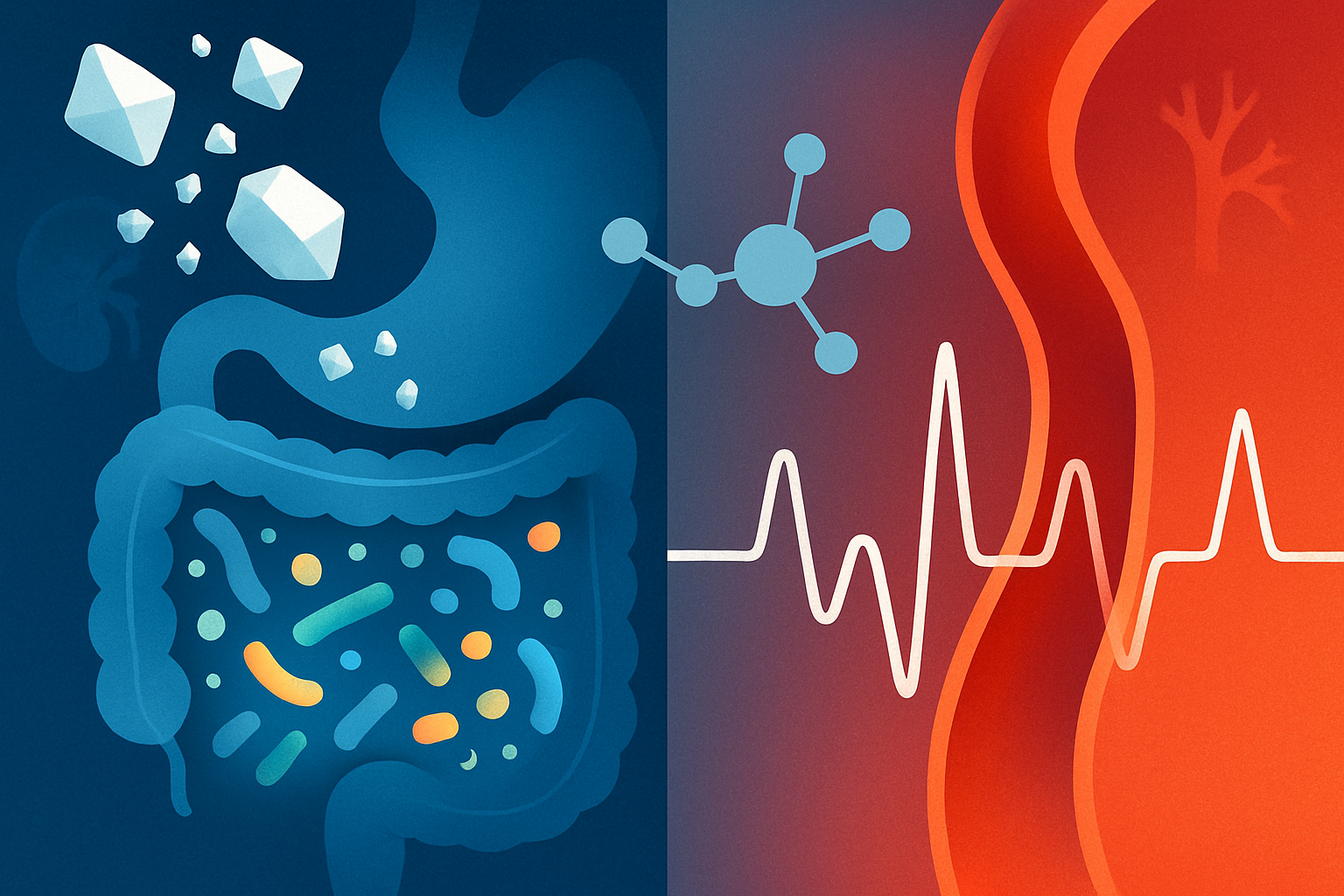
For some people, a salty meal barely moves blood pressure. For others, the same increase in sodium can produce a marked rise. Scientists may now have a clearer explanation for part of that difference: the gut appears to help determine how the body responds to salt.
A study published in Nature Communications in December 2025 identified a molecule called isovalerylcarnitine as a possible regulator of salt-sensitive blood pressure. The molecule is a metabolite associated with gut microbes and the body’s processing of certain nutrients.
The researchers studied 528 people during a dietary intervention that included low-salt and high-salt phases. They analyzed participants’ blood, stool and blood-pressure changes, looking for biological differences between people whose pressure was relatively resistant to salt and those whose pressure rose more sharply.
High-salt intake changed dozens of gut-microbial species and circulating metabolites. Among those signals, isovalerylcarnitine stood out. Its levels fell with high-salt exposure, and larger changes were associated with a stronger blood-pressure response.
That pattern does not, by itself, prove cause and effect. A metabolite can track with a disease process without driving it. To test the possibility further, the researchers turned to rats bred or used as models of salt-sensitive hypertension. In those experiments, giving the metabolite reduced some of the blood-pressure and vascular effects of a high-salt diet.
The rat findings make the result more than a simple association, but they do not make isovalerylcarnitine a proven human therapy. The animal doses and delivery methods cannot be translated directly into something people should buy or take. The human portion of the research was also relatively short, meaning it cannot answer whether the metabolite predicts years of future hypertension or cardiovascular disease.
The study’s larger importance is that it moves the salt-sensitivity discussion beyond the idea that everyone handles sodium in the same way. Researchers already know that kidney function, age, sex, genetics, metabolic health and blood-vessel behavior can influence the response. Recent scientific reviews also describe roles for the immune system, the nervous system and the gut microbiome.
This emerging picture helps explain why a single recommendation—eat less salt—can be medically sound but biologically incomplete. Reducing sodium lowers blood pressure for many people, but the size of the benefit varies. Some people may retain sodium more readily, experience stronger vascular effects or develop a more inflammatory response after high-salt exposure.
The gut-microbiome finding could eventually lead to a more precise approach. A blood or stool marker might one day help identify people who are especially salt-sensitive, allowing clinicians to focus dietary counseling or other prevention efforts where they are most effective. Researchers might also investigate whether diet, medication or microbiome-targeted treatment can preserve beneficial metabolites.
That future remains uncertain. The American Heart Association has described gut microbes and their metabolites as promising areas of hypertension research while emphasizing that the mechanisms are not yet fully understood. No established clinical test currently uses isovalerylcarnitine to guide sodium recommendations, and the study does not justify taking supplements marketed to alter the molecule.
For now, the practical message is familiar but more nuanced: sodium affects blood pressure through a network of systems, and that network differs from person to person. A normal reading after one salty meal does not prove that salt has no long-term effect. Likewise, a strong response may reflect underlying kidney, vascular or metabolic vulnerability—not simply a lack of willpower.
The next test for the discovery will be whether the finding holds in larger and more diverse human populations, whether it predicts who develops hypertension, and whether changing the pathway safely changes blood pressure. Until then, the research offers a promising clue—not a replacement for proven blood-pressure monitoring, medical care or sensible sodium reduction.
Sources & Further Reading
- Nature CommunicationsPrimary source
- PubMed / National Library of MedicinePrimary source
- American Heart AssociationPrimary source
- Nature Reviews CardiologyPrimary source
StoryBreak
Independent digital news and reporting, updated throughout the day.
This article was researched and drafted with AI assistance and reviewed as part of StoryBreak's editorial process before publication. Read our editorial standards.